Recently,
I visited the place where I spent a full 15 months or exactly one half of my
active days in National Service. I am referring of course to the old SAFTI
(Singapore Armed Forces Training Institute) in Pasir Laba Camp.

As
some of you might know, I am one of the 'editors' of the National Heritage
Board's meta-blog, yesterday.sg; but we prefer to call ourselves Friends of
Yesterday, or Foyers. My fellow Foyer, Peter Chan, is also an 'old boy' of
Safti (henceforth, whenever I say Safti, I am referring to the old Safti and
not the new Safti Military Institute). He too went through his OCS (Officer
Cadet School) training in Safti and later served as an instructor and staff
officer at OCS HQ in the mid 1970's. When the two of us heard that our
Yesterday.sg project chief at NHB, Walter Lim, was also on the committee
overseeing the Army Museum project, we practically begged him use his influence
to arrange for us to make a brief visit to the Pasir Laba Camp. And so this was
how Peter and I got to visit a place I have not set foot into for 29 years.
Although from time to time, I did go to the demolition range as well as the
rifle ranges during my combat engineers and reservist days, I have not set foot
into Pasir Laba Camp itself since May 1977.
And these two
sentimental and thick-skinned 'lau pengs' (old soldiers) even had the gall to
email a wish list of the 'must see' and ‘nice to have' places to our kind and helpful
coordinator, Major Psalm Lew of the Army Museum Project Secretariat. Let me
give you a brief report of the places we saw and the thoughts that when through
my mind during this sentimental trip down memory lane.
FOFO Hill
 |
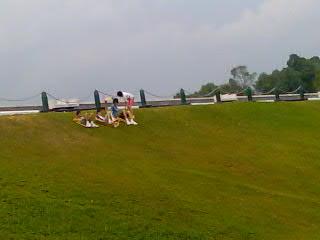
| FOFO Hill, viewed from Peng Kang Hill |
Our first stop
was FOFO Hill. For the uninitiated, Fofo stands for Fighting On Fortified
Objective. As I surveyed the area, I was surprised how much details of our
training came back to me. For example, I could clearly recognise the FUP area
at the foot of Peng Kang Hill where the troops formed up waiting for the
command to launch the attack on Fofo Hill. I also saw the 'gap' where we placed
the Bungalore torpedoes for breaching wire obstacles and Dragon charge for
breaching minefields. It was also here that we were taught how to cut barbed
wires silently and to gauge the direction of the wind and toss our smoke
grenades. I also recalled one nasty incident here. It happened during night
training. I was firing away (blanks) in the zinc sheet lined trenches for some
time before having to emerge and move to another location. So I placed my rifle
on the edge of the trench and pressed down on the ground to lift myself out of
the trench. Suddenly I felt a searing pain on my right palm. I had accidentally
pressed on the barrel of my rifle which had become red hot from all that firing
earlier. I got a nasty burn from that incident.
Peng Kang
Hill
The most
challenging part of our visit was to climb up the famous Peng Kang Hill. Every
soldier who has passed through the gates of Safti knows this famous hill. Many
a times, they would have been punished to run up this hill I am sure. As I
struggled up the slippery slope, I couldn't help wondering how on earth we were
able to charge up this hill in those days. Anyway, my efforts were rewarded by the
view at the top – well, not exactly the peak, but high enough to catch a
wonderful view of the surrounding hills, a landscape that is unique to that
part of Singapore, and which many Singaporeans never had a chance to see. As I
gazed at the surroundings, my thoughts went back to the time we had our Target
Indication training. We actually carried the training aids and lecterns up this
hill where our platoon commander would give his lecture under the hot sun. It
is also hard to believe that I can recall the procedure for target indication
which went something like this:
Section (or
platoon), 200 (distance in metres), 2 o'clock
(to indicate the direction), Tree
(or some other prominent object), Right: 2 fingers (followed by a
description of what the enemy was doing. We liked to coin some silly
description like: "Enemy reading comics under the tree") … the rest I
cannot remember.
I also found
the area to be surprising peaceful and quiet. My mind’s image of this area was
always filled with sounds of gunfire from the nearby rifle ranges echoing
through the surrounding hills, and 3-tonners and land rovers speeding up and
down Pasir Laba Road and troops marching or running or gathered in pockets
attending lessons.
After Peng Kang
Hill we proceeded to the Pasir Laba Camp proper. On the way we stopped to see
the obstacle course and the magazine where the famous 'haunted' Tower 2 was
located. We were informed that the place no longer functioned as an ammunition
dump and the 3 towers had been removed. We also stopped outside the reservist
camp site which seemed to hold some memories for Peter. As for me, most of my
reservist stints were spent on Pulau Tekong and the old Sembawang Camp.
Pasir Laba
Camp Itself
The moment we
entered the camp, it struck me that this was no longer the same place that I
knew from nearly 3 decades ago. Previously, there was a straight road that ran
from the gate all the way to the other end of the camp near to where the
swimming pool still stood and then swerved sharply to the right leading up to
the three OCS blocks, ending at 'my block', Charlie company. On either side for
the road were lots of open ground and fields. Huge signboards with names like
SISL (School of Infantry Section Leaders) and SISW (School of Infantry Support
Weapons) and low buildings used to line these fields. And invariably, you will
see troops running in step and singing silly army songs that went something
like this:
“Everywhere we
go-oh. People want to know-oh. Who we are-aa. Where we come from.”
But now, all I
saw was a concrete jungle comprising spanking new buildings with adjacent car
parks and linked by clean new roads. The entire section that housed our beloved
Safticana where we bought our sundries and snacks was gone. So were the lecture
theatres which had huge banners with quotations like; “The more you sweat in
peace, the less you bleed in war”. Fortunately, the three OCS blocks were still
standing. They appeared to have been 'upgraded' and looked different from the
ones in which I spent 9 grueling months as an officer cadet. Gone also was the
huge field in front of the 3 blocks.
 |
| During my time, this parade square was black in colour. |
Our final stop
was the Safti Parade Square where I finally got to see the place where I spent
my first night in the army. Other than the usual HDB-style upgrading, this
place remained relatively unchanged. The cook house and drill hall have gone,
and the colour of the parade square has changed to red, but the four company
blocks have remained where they were before. It is hard to believe that I was
standing at the place where I had spent countless hours marching under the hot
sun, sometimes seeing my friends faint from standing too long in one place when
we practiced elaborate drills like the ‘trooping of colours’. This was the very
place where we were often punished with ‘extra drills’ at night and of course
doing the ‘change parades’ which today's soldiers no longer get to enjoy. I
could clearly see the spot where my recruit mate was punished till he threw up
his lunch. And I could practically here the cheers that greeted me when I was
punished to run around the parade square with my Pepsi bottle lifted high like
an Olympic torch. (Full story here)
Finally, it was
time to say goodbye and thank our hosts for their kind hospitality. As we drove
down the short stretch of Pasir Laba Road in front of the camp, we caught a
glimpse of that familiar perimeter fence along which we used to patrol when we
were doing guard duty. I tried unsuccessfully to locate the nearby training
shed from which we used to stare out at the Green Bus Service Number 175,
envying the civilians for the freedom they enjoyed outside.
Even as we
drove home and tried to retrace the old Upper Jurong Road, and ended up in
Jurong Point instead, we realised that just like Jurong Road and most parts of
Singapore, the old Safti at Pasir Laba camp has transformed beyond recognition
for people of my generation. Only the hills, it appears, have not changed.
My feelings
from this short jog down memory lane are best summed up by this classic Tang
dynasty poem;
回乡偶书 (贺知章)
An Impromptu Verse on Returning Home by He
Zhizhang
少小离家老大回,
乡音无改鬓毛衰。
儿童相见不相识,
笑问客从何处来?
Left home when young, I return when old
Accent unchanged, my hair has thinned
Children I meet do not know me
"Traveler, where are you from?" they ask laughingly
Source: Tang Poems Revisited; translated by Lien Wen Sze and Foo Check
Woo, EPB Publishers Pte Ltd