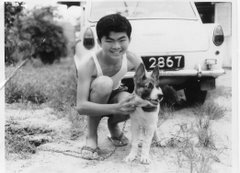
Hi Judith,
Wednesday, October 30, 2013
From my Inbox – Judith Johnson remembers my kampong
Hi Judith,
Thursday, May 27, 2010
Mike Robbins’ fond memories of Singapore
Just recently found your site. It is nice to know that you are trying to preserve memories of old Singapore.
My wife and I were fortunate to spend three years on the island from 1966-69 living mainly in the Naval Base at Sembawang. We have been back twice since 1969, and the changes that have taken place make the place almost unrecognisable.
Surprisingly our first flat in Cairnhill Road was still there as was our house in Sudan Road - photos of that attached. The only noticeable change from the outside was the house now had air-con.
Our one regret is that we lost touch with our amah in Cairnhill Court. Her name was Lee Boon Yong. She was a much valued member of our family. She had one son only called John who would now be about 50. She originally lived in a kampong near Bukit Timah, but was re-housed in the early flats in Toa Payoh. Yong was our first amah in Cairnhill Court off Cairnhill Road not in Sembawang. In the house in Sudan Road,we had a couple who lived in the servants quarters at the back of the house. The amah's name there was Yok and her husband we also knew as John. He worked in the base but was also a very good pastry cook.
I have other old photos and documents from that time some of which I could scan I think if you would like to add to your collection.It was interesting to see that the old oil fuel depot at Sembawang still had some tanks standing which I understand feed the nearby power station.
Have fond memories of working closely with a ship's chandlers company - Soon Aik in Outram Road - the Quah family. Went to a family wedding on the rooftop at 225 Outram Road. Also have fond memories of taking our young children into the botanical gadrens, buying a small cone of peanuts and watching the monkeys sneak up and snatch the whole paper cone from their hands. How times have changed!Keep up the good work to preserve for the next generation
Best wishes
Mike Robbins
Saturday, May 22, 2010
Andrew Grigsby’s fond memories of Singapore
Dear Lam Chun See,
(Andrew must be referring to this water apple or jambu. Took this photo at Bishan Park, by the way)
I remember the Monsoons which was such fun standing in the warm rain with flip flops on and just shorts. The houses we lived in were still standing when my sister went there on a holiday 6 years ago.
Hello Chun See.
Sketch and Google Earth image
The two buildings with 6 flats in each (X) was set back from the Pasir Panjang Road and accessed by a short drive, and there were two of them. One was set sideways and the other set further back and facing the road. We were friends with the local people in the house next door. When we walked out of the short drive and turned left towards Haw Par Villa there was a wooden shop that sold our favourite Ice Balls; you know the ones. It was made from a block of ice that was created by grinding the ice block on a mangle with a blade on it. i can draw it for you. It was put in a piece of paper and coloured juice poured all over it before we ate it.
My email to Andrew
I am afraid I have some bad news for you. I went down to Pasir Panjang to check the area shown in your Google satellite photo. I believe that satellite image must be several months old because the area has now been built into a condominium complex. If you look at the attached photo it is probably the condo behind the yellow car. At first I thought it was the construction site to the right of the car I even asked the construction site supervisor if he knew what the area was like before they began demolition work; but he wasn't aware.
PS.
Wednesday, June 25, 2008
Charles Jordan remembers Singapore
Thanks Charles, for your story and the photos.
RAF Changi Sec School Sep 1957 - Apr 1960We sailed aboard the SS Nevasa 20,000 Ton Troop ship (P&O Line) from Southampton 23 Aug 57 via Suez. It was a very rough passage across the Bay of Biscay & I recall there were many sea sick persons, but not I.
After several days from passing Gibraltar, we finally stopped and temporarily anchored near to the entrance to Port Said, Egypt. I recall there were masts of sunken vessels sticking out of the sea at obscure angles. I noted several elongated concrete structures that that been built on rocky outcrops forming a type of man-made barrier. These had beacons on. We may have stopped for about 24 hours, well it seemed to me to be for ever. According to our Captain, we were the 2nd ship to navigate the Suez Canal since the end of the (fifties) Middle East conflict [as Pat Bramwell states, I now recall there were Tanks and other Army units along both sides of the canal and we were given strict instructions by the Captain, to stay below deck, in case we caused an International incident!! I recall just how very hot it was below deck. Everyone had their port-holes open to let in what little waft of cool air we could get. I also recall that we had to stop about half way along the canal to allow another vessel steaming north, to pass us before we were allowed to continue. It was very hot below deck. By that time, there were no more tanks and infantry along the canal banks and we took advantage of the warm breeze on deck. I also recall that during this period whilst we waited to continue, a number of Arabs in canoes called from below and held up wooden carvings and such like. Several seamen appeared and tied lengths of rope to the ships railings and dropped lengths of rope to these Arabs. Quickly items were tied to the ropes and the Arabs would call out for us to haul them up to see if any wanted to buy. I recall one adult lady shouting down to the boatmen and then drop coins into the water beside their boats. I saw a young boy dive into the water and retrieved the money. It was noticeably cooler when we continued south towards the Red Sea and finally the Indian Ocean. During our virtually uneventful passage across the Indian Ocean, I witnessed Flying Fish, Porpoises/Dolphins and a quantity of sea birds. On one occasion a few of the Army lads gathered on the aft deck and inflated large balloons from a gas canister, tied knots and released them. There were riflemen who would try to shoot them down. There was very little to do apart from play cards or table tennis. There was a ships NAAFI shop, where we purchased crisps and lemonade etc. My dad knew the Head Waiter, I forget his name, but he was a middle aged man with dark receding hair. He was okay I suppose & I started collecting the ships menus as an interest. Ship menus are collectables these days.
We arrived in Singapore on 14 Sep 1957
Having disembarked, leaving some of our friends on board (going on to Hong Kong), our family were driven to temporary accommodation in the name KATONG GRANGE near Geylang. A few days later, another family arrived with 2 sisters, Sonia & Elaine. [I have been in touch with Elaine (Beckham) who currently lives in California, USA]
During my time at Changi, I joined the Scout Group at Changi and attended the Scout Jamboree at Geylang during 1958 and met with Lady Baden-Powell and Prince Philip.
Later I joined the Malaysian Air Training Corps (MATC), based at Kallang (see photo below) Incidentally, the officer I believe became the Air Chief Marshall of the RMAF based at KL.
During my time with the MATC, Singapore became Singapura and an independant state of Malaya during April 1959 and I along with the MATC was on that parade (see photo below)
Having returned by a 'Whispering Giant' (Brittannia) to UK on 12 APR60 moved to RAF Rudloe Manor where I found great difficulty in finding a pupils place at any of the local BATH schools and colleges.
I found myself employment with the Bath Co-operative Society as Stockroom Boy, general dogsbody and tea maker. Whilst in the Despatch Dept one day, I found evidence of a rodent and lay a non maiming mouse trap. Having caught this LARGE mouse, I placed it in a vacuum tube bound for the Accounts Dept run mainly by female staff. The mouse was obviously petrified and as the tube was recovered and opened, it leapt out, crapping as it went, all over various accounts and other important paperwork. I could hear the screams from four floors down. Oh, how I laughed! I was sacked! Good though....
I sat an entrance exam for the RAF. I visited RAF Cardington, Bedford and went to RAF Cosford 23SEP60 as a Boy Entrant. Became a Telegraphist (Morse Cade, Teleprinters & general telecommunications in Signal Offices, etc) and was posted to:
- RAF West Raynham (JUL62-OCT63)
I married Sep 1972 and was blessed with a beautiful baby girl (Josephine) 29 May 1975 During my time with the RAF, I completed an 18 jump Parachute course, Desert & Jungle Survival Courses - I was a member of the RAF Inter-Services Sailing Team
NOV73...Joined Kent Police & posted to Gillingham, Chatham, Margate, Maidstone & West Malling where I decided it was time for a change as the Police Force was not the Force I had joined...
During my time at Margate, I organised a class reunion inviting Mr Pine
I divorced May 1982.
I remarried Aug 1983. I have a Stepson, Andrew and a further 2 wonderful children. Louise & Robert.
Whilst with the Police I built my own Phantom sailing dinghy [Photo 799] from paper plans over the winter of 1979-80 and during 1983, I won the British PHANTOM National Championships at Grafham Water.
I was elected as Phantom Class Secretary 1986-89.
During 1988, I was invited aboard 'RADICAL' the Blue Arrow British Team for the America's Cup Challenge yacht, then based at Falmouth. [3 x Photo's]
I left the Kent Police to set up my own company : Nightsafe Investigations, Marine & Security Services (UK) Maidstone office in MAR94.
I now have my own 26 ft Snapdragon berthed at Oare Creek, Faversham.Plus a Moody 56 based in Falmouth. 'Jamboreee' is chartered out.
Back in JUL91 I flew to Belfast to board a 50ft Yawl 'Sally Endeavour' (sail training ship for the Duke of Edburghs Aware Scheme) to sail 10 children from families of [RUC Disabled Police Officers Association] to Cowes for Cowes week. [5 girls, 5 boys ages 12 - 19 years. 5 Roman Catholics and 5 Protestants] Thrown together - they got on!!
We sailed to Falmouth non stop and gave them a tasty meal in a local restaurant. Then on to Cowes. We moored to a pontoon in the river. We signed on for 3 races. All other yachts had been stripped out for light weight performance racing. Sally Endeavour had not been out of the water for 18 months and therefore had a certain amount of slime under the water line. She was carrying 14 persons. Skipper, 1st & 2nd Mate, and 11 landlubbers including an RUC WPC. Only one of which had had any racing experience. Me. Heavy metal masts and rigging, Heavy sails cut for cruising, fuel, water, rations, bedding and personal belongings, in other words, NOT a 'mean machine' 1st race we did not finish. 2nd race we hit the mark called 'Brambles' with a resounding clang and were disqualified. We caused mayhem at the start of the 3rd race. They still talk about us at Cowes, we finished 27th on handicap of 36 starters in our class.
I have an elder brother, Keith (67) (who later joined the RAF as an Air Traffic Controller & FltLt) who visited us at Changi and a Younger sister, Josephine (60) who was a pupil at Changi Junior now (a Solicitor) in Halesworth, Suffolk.
As I am nearing retirement age, we will be moving to a quieter UK location, but as yet not too sure where - downsizing.
I am delighted to report that I have after many years searching, I have found several class mates.
........ and anyone else who is ex Changi.
Tuesday, November 27, 2007
My sentimental friend
“I feel that I have found several new friends via my writings and look forward to maybe meeting up with you, Peter and Zen next time that I manage to get to Singapore. At the moment I am not sure when that will be. On my personal list of 100 things to do before I die is "visit Singapore again!" It is such a wonderful place that I never tire of visiting it, talking about it and writing about it.”
His name is John Harper, and he came back, just as he said he would, with his lovely wife, Ann.
Together with two other ‘friends of Yesterday’, Victor and Peter, I brought John and Ann to see some of the places he wrote about, such as Changi/Lloyd Leas area where he first lived on arrival in Singapore, Changi Beach where he learned to swim, and Changi Board Walk area where he played. That was last Wednesday, 21 November. We had lunch at Changi Village. After lunch, we went to Gillman Village where John’s school, the Alexandra Grammar School was located. From there we proceeded to the place the British kids of his day loved, the Haw Par Villa, which thankfully had been restored to close to its original condition. The visit to Haw Par Villa was quite nostalgic for me too because I have not been there since I was a small kid. So it must be about half a century ago for me.
(with Peter at Changi Beach)
On Friday, I met them again, this time alone. We spent the morning at the Bird Park and in the afternoon, I brought them to Tengah Air Base, where John had lived for some time too after his dad was transferred there from Changi Air Base. Although we could not enter the air base, still the surrounding area brought back some memories for John.
It was really a joy for me to be able to share this time with my friends from the UK. I found it rather touching to see him struggling to remember some of the places that he used to love. Unfortunately, many of the places that John knew were either no long around, or have become restricted areas. For example, many of the places in Changi where he played have either become part of the Changi Airport complex, or the prison and drug rehabilitation complex, or part of the new RSAF Changi Air Base.
The Chua Chu Kang area has undergone even greater transformation. I tried to retrace the part of Chua Chu Kang Road that John would take on his way to school in Gillman from Tengah. Only a short stretch of the old CCK Road remained, and it was largely uninhabited. I managed to find a short stretch of this road next to where the former Keat Hong Camp was. This part is now known as Choa Chu Kang Avenue 1.
Some other places that John remembered, and which I was able to show him were the part of the Malayan Railway crossing at Choa Chu Kang Road and the steel railway bridges along Bukit Timah, near Hillview Road and Rifle Range Road. As for Gillman, it had changed so much that he couldn’t be sure where his school was. And both of us could not be sure where the swimming pool was either.
So to solve this and some of the other mysteries, I must wait for my other UK friends like Tom O’Brien, Brian Mitchell and Tom Brown to come visiting. Hope it won’t be long, because as we Singaporeans know only too well, places here have a way of disappearing overnight.
So guys … what are you waiting for?
Friday, August 17, 2007
AD 1947 – Ian Layzell’s Life Notes
It was Saturday, 18th October at 2.50am, in the Queen Alexandra British Military Hospital on Alexandra Road in Singapore, during a tropical thunderstorm that caused the lights to cut out. Mum remembers it well - arriving in an Army jeep that rattled its way to the hospital driven by a barefoot Malayan about 11pm. I arrived on the top floor, overlooking the morgue. Mum and Dad by then were living in Johore Bahru so not too far to drive. Dad went home and promptly went to bed and when the hospital tried calling him about 6am there was no answer, which was rather worrying in those days as the Bukit Tima road wasn’t a safe place to be. A friend who was staying with them called Mo had to go and wake him up. Next day, Dad brought Mum a can of peaches (but no tin opener) and some rice pudding which he, in his practical way thought she would appreciate, but all the other new fathers brought flowers. Poor Mum.
Sadly, my birthplace had been the scene of a tragic and horrific incident in February 1942, when Japanese troops massacred some 650 patients and staff of the hospital during their invasion of Malaya and Singapore. After finally being handed over to the Singapore Government in 1971, the building remained in its 1930s simplified Classical style and continues as the Alexandra Community Hospital today.And only a couple of months earlier, in August, Jawaharlal Nehru became the first Prime Minister of an independent India following the partition of Pakistan and India. The Labour Government granted them independence, obliging King George VI to relinquish his title of Emperor of India. It also granted independence to Burma and Ceylon in 1948, and gave up Britain’s Palestinian Mandate leading to the establishment of Israel and the first Arab-Israeli War. George VI reigned but all was definitely not well with the world and the British Empire was beginning to crumble.
The King and Queen at Sandringham in 1947
Only two years before my birthday, in 1945, President Harry S. Truman had decided to drop ‘the bomb’ in Japan to end the Pacific war quickly without the loss of further American lives. The first was dropped on Hiroshima on 6th August, and the second on Nagasaki three days later. On 14th August Japan announced its surrender. On the 8th August the USSR had declared war on Japan – nice timing.
Political changes were matched by cultural changes. In 1947 Jackson Pollock dropped Abstract Expressionism on the art world with Full Fathom Five and his action-painting technique, where paint was dripped onto vast canvases laid on the floor. This was to be a great influence on my own artistic endeavours in the Art Room at Tiffin School.
Princess Elizabeth, as she was then, married Prince Philip the Duke of Edinburgh in 1947 and a year later gave birth to Charles. In 1950 she gave birth to their daughter Anne, beating my Mum and Dad to it by two years.
Clement Attlee
But wartime regulations remained in the UK and food-rationing in 1946/1947 was more restrictive than during the war. So my Ma and Pa were probably most grateful to be serving His Majesty in Malaya. That’s how my Mum got a can of peaches and rice pudding in hospital. God save the King!
The start of 1947 had seen the most severe winter in Britain for 53 years – heavy snow and much flooding. So my Mum and Dad were doubly grateful to be in Malaya. Along with the cold weather, the Cold War was starting up nicely. At the end of the War in 1945 Germany had been divided into zones occupied and controlled by the USSR, United States, United Kingdom and France. Meanwhile, the USSR was converting all of eastern Europe into a Soviet controlled ‘bloc’.
To put my arrival further into context, only four days before my birth on 14th October 1947, an American test pilot called Chuck Yeager was the first pilot to fly faster than the speed of sound. A United States Air Force officer during the War, he became a test pilot and flight instructor. Chuck flew the Bell X-1 aircraft at a speed of 1,065 km/h (662 mph), breaking the sound barrier. A few years later my mother’s sister, Auntie Pam, was to marry a USAF officer called Tom Yeager but he was no relation. Perhaps she thought Tom was Chuck? Tom, like Chuck, was certainly a fast mover but so were most American servicemen at the time as far as young British girls were concerned.
When Mum and Dad arrived in Singapore, they stayed in ‘The Floraville’ Guest House not far from the hospital, run by a pock-nosed Dutchman known as ‘Van Fleet’ but probably van Vliedt who kept a gaggle of geese as guards. Staple diet for residents was boiled fish with sweet chilly sauce. Mum said he didn’t give you time to get out of bed when the first of the month arrived, the ranch doors were flung open and his voice bellowed RENT! He wasn’t very nice and so they were pleased when they moved to Johore Bahru on the mainland just across the causeway from the island of Singapore. I’m not sure how but my Mum and Dad were offered rented accommodation in one of the Sultan of Johore’s spare houses at number 27Jalan Abdul Samad. The Straits Times of 1938 reported the newly-built house as being ‘of the Spanish style’. A good start for the architect to be.
Sunday, July 29, 2007
Our History Goes Back Further Than That!
And to borrow the words of Lynn Copping; “As if the Britannia Club never existed”.
Yes, young readers may not know it; the NCO’s Club was actually occupying what was once known as the Britannia Club, a popular club for British military personnel. In his book, Sampans, Banyans and Rambutans: A Childhood in Singapore and Malaya, writer and photographer, Derek Tait wrote:
“In Singapore City, there was the Britannia Club for Navy personnel and their families. It was on Beach Road and was run by the NAAFI (Navy, Army and Air Force Institution). It included a snack bar and restaurant, lounge bar and tavern, games and reading rooms, a swimming pool and a sports shop.
The Britannia Club on Beach Road in Singapore which was set up for members of the forces and their families for recreation and social purposes. It was also known as the NAAFI Club or the Brit Club and was opposite Raffles Hotel. Inside, there was a swimming pool and in the back room was a giant scalectrix set, great for the kids though I think it was mainly used by Naval personnel!. Around and above the swimming pool was a huge balcony where we'd all eat and get drinks. There were high diving boards too though a lot of people didn't have the courage to go on them! Certainly not me!”

Others like Derek, children of British military personnel stationed in Singapore in the 50’s and 60’s, who fondly called themselves ‘Britbrats’ also have strong memories of the Britannia Club. Again, quoting from Derek’s book:
Ellen Tait remembers:
Clive Baker remembers:
"The Brit Club was home from home for Singapore based service personnel, here you could get egg, bacon and chips with Daddies sauce, a couple of slices of real bread and real PG Tips type tea. Of course, there was also the fact that it sold really cheap Tiger beer and it was here that I was first introduced to what was to become a life-long habit, I still enjoy the occasional pint of Tiger Tops and it certainly is a good reason for going back to Singapore for the real McCoy, straight from the tap instead of a bottle!"


I asked my friend Tom O’brien of Memories of Singapore and he said:
“I do remember swimming at the Brit Club occasionally. I remember that the water was chlorinated differently, maybe even unchlorinated. They also had a room with a very large Scalectrix Track. On one occasion when the servicemen had one of their regular dances. A couple of my friends and I managed to get in. We were not allowed as we were 16 and still at school. I remember a group playing Honky Tonk Women by the Stones. Every thing was fine until one of my friends (I think it may have been Ken Thomas) tried to purchase a beer at the bar. Then we were rumbled and ejected.”
John Harper who has written several articles for this blog about his childhood days in Singapore also remembers the Britannia Club at Beach Road with fondness.
“The main things I remember about the Britannia is the swimming pool and visiting once a month in 1959 when we lived at Tengah. The pool had very good diving boards covered in coconut coir matting for grip when wet. From the diving boards you could look out to sea and there would be ships lined up at anchor in many directions. Whilst we were swimming we would always have a Coca Cola or a Pepsi during a brief interlude out of the pool. But we never had anything to eat there as we always went on to visit the Islamic Restaurant afterwards for a Bryani; one of my favourite dishes at that time.”
Hence, you can see that if things continue this way, a day may just come when British kids will know something about our history that our kids don’t; that this complex that our government wants to retain because of its historical significance was built originally by the British and it was once called the Britannia Club.
For young readers who want to know more about this place, please read Victor’s very informative article here.
Acknowledgement: Thanks to Derek Tait for the above photographs of the Britannia Club.
Saturday, July 21, 2007
Tom Brown Remembers Army Life and Singapore (Part 2)
To get used to the weather, we did a lot of outdoor sports, like football, running round the track, on the football pitch, volleyball. That was one platoon’s favourite game, and we took on anybody who would like to challenge us.
At night, if we were not on duties, we would clean up our kit for the next day. After that, it’s off to the canteen to have few Tiger beers. Wow! it was lovely to drink, but very strong. And Anchor beer was just as strong.
Then we would go out of camp happy to a bar, it was called the Changi Bar. It was a very good bar. It was located along upper Changi Road, further down to the right side as we get out from the camp gate.
Then we would get on a pick-up taxi to town, and ask the driver to take us to the Britannia Club at Beach Road. After that …… wait for it … it’s to the famous Bugis Street. The first time being there, I could not believe it - the place was so busy. I remember an Indian woman telling us who was good and who bad. I think she must have lived in that area.
Taxi back to Changi village to get something to eat at Freds sandwich stall. I remember; if we asked for an egg sandwich, he would go into his big box and bring out a long bit of bread, like a French stick. He would cut in half and put three fried eggs on it for 50 cents. And across the road, the Indian guy would make a minced curry and naan bread for 60 cents.
Finally, it’s back to camp to get a good night’s sleep. I will tell you more later on.
Below is a photo of the barrack where I stayed.
Sunday, July 15, 2007
Tom Brown Remembers Army Life and Singapore (Part 1)
I am standing in the back row, 3rd from the left.
I joined the Camerons as a regular soldier and had to do 14 weeks training. It was very hard. I thought I was in hell - up in the morning at 6 am, breakfast at 7 am and muster parade at 8 am. The corporal was always shouting at you. Drill parades, weapon training, three mile runs with full battle order on.
After I had done my training, my pals and I were sent to the battalion station in Dover, south of England. When I got there, half the soldiers were doing national service. I asked myself; “What the hell have I got myself into?”
Anyway, things got better because the UK government were doing away with national service. After a year in Dover, we moved to Edinburgh, my home town. Then we were all told, “You lot are going to Singapore for three years.” I said Wow!
After a little while in Edinburgh, we were put on a train to Southampton, and then onto a troop ship called T. T. Navasa. It was to take six weeks to Singapore. The year was 1961. I was 19 years old.
This is the ship that brought me to SingaporeWhen we got to Singapore, we were told the dockers were on strike for more pay. Then the company sergeant major said; “One platoon will unload company kit from the ship.” We were not used to the weather. The sun was very hot. I said to my self, “No wonder the men are on strike. The weather is too hot, and pay not good.” Anyway, we loaded the kit onto the waiting trucks and onto Selarang Barracks in Changi.
What I remember most of Singapore at that time when we came out of the docks were:
- The smell coming from the river,
- Seeing trishaws for the first time,
- The were rows and rows of washing hanging out,
- The streets were very busy, and
- The girls giving us a wee smile as we passed along the streets.
Next time I will tell you, about my life in Selarang Barracks and Singapore.
Links:
From my In-Box
More about the Queen's Own Highlanders
Monday, April 02, 2007
From My Inbox - 31 March 2007
It brought alot of memories back when I came across your website, Good Morning Yesterday. I know your site is for Singaporeans and friends of Singapore of your generation, Lam. I could not help myself from sending this mail.
I was 19 year of age when I was in Singapore, in 1961. I was with the First Queen's Own Highlanders stationed in Selarang camp, Changi. When I went out of camp, I met a lot of friendly people. They always had a smile for you. I always remember the shops, food stalls. At night, I used to walk from Selarang to Changi Village, and I loved the beach
Thanks for the memorries. Hope to hear from you.
Tom
Today, Selarang Camp is home to the a drug rehabilitation centre.
More information on the names mentioned in Tom's email can be found below:
Selarang Camp
Queen's Own Highlanders
#########################################

Hi, from the comment by Aiyah Nonya about the torture of British & Australian POWs in Selarang during the 2nd World War, I decided to do a bit of research and found a website with interesting information of the famous Selarang Incident. You can also read about Selarang Barracks in 1942 here. I have also copied one of their photos showing Selarang Barracks in 1942 above. I hope the owners of the photo will be understanding about my infringement of their copyrights. - Lam Chun See, 05 April 2007.
Thursday, July 20, 2006
Thank you John Harper

A big Thank You, Terima Kaseh, 谢谢, to John Harper for his articles.
I am sure many of you are touched by this man’s love for our little country and awed by his amazing memory. The only reason, I think, that anyone can remember such details from nearly half a century ago, is because he thinks and talks frequently about them.
I have also found his articles to be very educational. The last one about Schools for example, has given us some interesting insights into the British Educational System on which ours is based.
His description of the Orchard Road section has taught us something that many Singaporeans, including myself, probably did not know, or remember – that the stretch of Orchard Road in front of the Lido Theatre and Hilton Hotel used to be a two-way street.
Also, how many young Singaporeans know that the Anchorage at Alexandra Road used to be a brewery (Anchor Brewery) and was formerly known as Archipelago Brewery; or that the Alexandra Hospital used to be called the British Military Hospital (BMH) “with a distinctive cross of St George painted on the roof”>
And prior to reading his articles, I did not even know that places like Lloyd Leas or Wittering Road or Meteor Road existed.
Indeed, if I were a teacher, I certainly would ask my students to read these articles to gain some knowledge of our past.
So once again, Thank you John Harper. We hope to welcome you back to Singapore not once, but many times.
Monday, July 17, 2006
John Harper Remembers Singapore - Part 8: School
Here is the latest article. This will probably be the last one that I do for a while. Next Monday I am starting work for seven months in Switzerland and will only get home to the UK once every five or six weeks. I have enjoyed doing these articles for your blog and will be following the blog whilst I am in Switzerland. I feel that I have found several new friends via my writings and look forward to maybe meeting up with you, Peter and Zen next time that I manage to get to Singapore. At the moment I am not sure when that will be. On my personal list of 100 things to do before I die is "visit Singapore again!" It is such a wonderful place that I never tire of visiting it, talking about it and writing about it.
***********************************************
Forces’ schools in Singapore were modelled on the education system in the UK with Primary schools from age 5 to age 11 and Secondary schools from age 11 to age 15, 16 or 18 depending on the level of dedication and attainment. The Secondary system was split into two, the more academic would go to the “Grammar” school whilst the less academic would be given an education that was focused more towards practical skills but with a degree of academic requirement as well. These were known as the “Modern” schools. Which type of school you attended was determined at the age of 11 by the 11 plus examination. This included tests on mathematical ability, comprehension and IQ testing of the type where you had had to identify the next number in various sequences, sometimes arithmetic sometimes geometric in progression. Reasoning tests were also there with strange items to solve like the odd one out in a series of pictures say like a square, a rectangle, a triangle and a circle, with the circle being the odd one out because it is not made up of straight lines. There were also reasoning tests like “man is to hat as dustbin is to a whole list of things that included “lid”. You were meant to choose lid because it goes on top like the hat goes on top of a man.
Arriving in Singapore just after my tenth birthday meant that the 11 plus was the very next thing for me to face when I went up to the final year of primary school. My mother had worried about my school abilities whilst we had lived in Cleveleys and had even gone to ask my form teacher about extra tuition and coaching so that I would be able to pass the eleven plus. She was told in no uncertain terms that that would never happen, as service families are just not worth bothering with as they are always moving on. So it came as a welcome surprise to my mother that a lot of effort was put in by service schools to get pupils up to speed and practised for the eleven plus. The pace was quite pushed and we were set exercises to be done under timed conditions. I can remember we would no sooner have finished a set of arithmetic questions than we would be going on to some of the IQ questions. It was really a hothouse environment for coaching scholars to be able to pass the eleven plus.
Being a part of the post war baby boom or “part of a statistical bulge” there had always been accommodation problems for every class I had been in with either extra desks needed or an extra classroom having to be conjured up from somewhere. Changi was no exception and when I arrived my class was over in the three-story block across the playground in the Secondary school. For the final year at Primary school a new block was built for us just round the corner from the Anglican Church. Because it was intended to be only temporary it was built of wood and thatched in attap palm leaves. There was a bit of indignation at this but this soon simmered down once we got into the buildings as we found that they were a lot cooler than the brick built buildings of the main part of the school. They also had a spacious and airy feel about them. They also seemed to be a lot quieter and I am sure that this helped to contribute to the air of industry in that final year as we prepared to take the dreaded eleven plus.
School was six mornings a week and it was compulsory to attend at least two afternoon activities per week. I looked through the list of options and decided that swimming was a must, as I wanted to improve on my basic achievement of learning to swim in the first two weeks of arriving in Singapore. The second activity I chose was called the “Malaya Club”. Here we learnt about the Federation of Malay states and about some of the trees and plant life. It was during these lessons that I was first introduced to “pitcher” plants in the form of the Raffles Pitcher Plant which I understand if you find any in Singapore now you are not allowed to pick them. Even today I think that they are fascinating plants. During these lessons we were also introduced to the Hibiscus and some of it’s herbal properties. We often used them to make hot poultices; I once had a septic spot on the palm of my hand where I had fallen onto some mimosa and got a thorn stuck. When it turned septic it was straight out and gather up some hibiscus flowers, pour on boiling water then slap the poultice onto the infection to draw it out. It very quickly cleared up with this treatment. I had suggested this treatment to my mother after hearing about it in “Malaya Club”. We were also introduced to number of other trees including the fragrant “Frangipani”. Frangipani are amongst my favourite trees, maybe because I can recognise them easily, but also because of the fragrance which is sweet and heady.
My swimming progressed well and I soon reached the stage of taking the beginners certificate which entailed swimming a length of the pool (33 yds) breaststroke and crawl. Then I worked up to the advanced which included 3 lengths of breaststroke, 3 lengths of crawl, a length of backstroke and a dive from the side of the pool followed by a dive from the 10-ft high board (about 3 metres for you metric youngsters).
The eleven plus exam was looming, we had moved house by this time, from Lloyd Leas to Wittering Road on the main part of the camp near to Changi Village. I was promised that if I passed the exam, I would get a bicycle as a reward. It was then that we found out that as well as the eleven plus examination, we would also be sitting the Scottish equivalent called the Moray House exam. This was in case any of our parents were posted to Scotland on their return to the UK. The exam days came and went and didn’t seem all that stressful. It was my first experience of being herded into a large hall full of desks with very stern and official looking invigilators, a large clock on the wall to show how much time you had used. Some found it intimidating but we had been coached so well most of our class just sat down and worked through the papers like it was a normal classroom exercise. Once the exam was over I then began to worry as to what would happen if I passed one exam and not the other. Would I still get that bike? I so desperately wanted that bike. It turned out that I need not have worried as I had passed both exams. So I got my first bike. I went down to Changi Village with my dad and we had a look at what was on offer and found one to fit me. It was a German cycle called Heiko. It was of the “sit up and beg” variety as most bikes were in those days with pull up brakes. Learning to ride it is of course another story.
Signboard for Bourne Secondary School in Gillman. The motto says "Keep Faith". According to Lynne Copping , The Alexandra Grammar School was renamed Bourne Secondary School in 1964.
At this point I should have been moving on to Changi Grammar but my father was posted to RAF Tengah on the other side of the island. There was only a primary school at Tengah and so we were taken by bus to Alexandra Grammar School at Gillman Barracks close to the city. Each day became a well practised routine, my mother would wake me at about 6:00 each morning and I would get up wash and dress, make up some milk for my breakfast and for my younger brothers who were still asleep. Then breakfast would be a couple of Weet Bix biscuits with milk and some coffee made with Carnation evaporated milk. I can’t stand the taste of it nowadays but when it was all you get, you had to get used to it. I would put Radio Malaya on to listen to the start of the day’s programs which always started with “oh what a beautiful morning, oh what a beautiful day”. At the point where he sings about elephants eyes, the bus would be passing our house up to the top of Meteor Road. At the top the bus would turn round and start picking up. From Meteor Road we would head across the light controlled runway sometimes having to stop for Canberras and Venoms taking off laden with armaments. This was during the time of the “Malayan Emergency” where the communist insurgents were being dealt with. The UK government didn’t want to call it war after having spent so long at war, hence the term “Emergency”. From there we proceed along what is now the Choa Chu Kang Road towards Bukit Panjang and then turn right towards Bukit Timah. Along the way we would pass “Metal Box” and “Ford” factories picking up some more passengers at Foo Yong estate just before we got to Bukit Timah. From there we would make a small detour off Bukit Timah Road to pick up an officer’s daughter and then proceed back onto Bukit Timah Road down to Newton Circus and exit onto Scotts Road until we reached Orchard Road. On the corner of Orchard Road, there were always magnificent posters for films at the Shaw Brothers Cinema. The most remarkable was the poster for “The Vikings”. I didn’t get to see this film until some years later when we returned to the UK. From Orchard Road the bus would take us along Tanglin Road and then turn on to Alexandra Road driving past the Archipelago Brewery. Once we had passed the British Military Hospital (BMH) with a distinctive cross of St George painted on the roof, we knew we were almost there. I think the hospital is now known as Alexandra Hospital. Just after the hospital was a bend and then a left turn into Depot Road where we would be dropped off to walk up the hill to Alexandra Grammar School whilst the bus carried on to the Alexandra Modern School.
Two of the 3 RAF white buses that Jeff Pittman says served Bourne as school buses in the '60s. Numbered TB1, TB2 and TB3 they where for RAF children, and the designated routes were for Tengah based families.
Most days the journey would be uneventful, there was a sing song along the way with all the Scout favourites like “You’ll never go to heaven” (On an RAF bus, cos an RAF bus, wont take all of us.). Popular songs of the day like The Everly Brothers’ “Wake Up Little Suzie”, and Elvis Presley’s “Teddy Bear” and “Wont You Wear My Ring Around Your Neck” were also firm favourites. In 1959 there had been a long period without rain and the day that the Prime Minister, Lee Kuan Yew announced that if it didn’t rain soon, drought measures would have to be put in place. Well, of course it started to rain early that morning and it just kept on raining heavily. On the way back home the bus was brought to a standstill by the floodwaters near the biscuit factory. We were stuck there for a long time. Eventually the waters subsided enough for the bus to get through. When we got to Bukit Timah Road the canal that runs between Bukit Timah Road and Dunearn had overflown it’s banks and those people that lived in tents alongside the banks were trying to dry out their few meagre belongings.
At AGS I was introduced to science. As well as the General Science lessons we also had some lessons called Applied Science. I find it hard to put into words the thrill I found in science. The general science looked at some chemical reactions and the differences between mixtures and compounds. There was also some physics in there looking at the expansion of metals when heated. The applied science covered topics like electromagnetism and how bells and solenoids worked, transformers, microphones and telephones how batteries worked. There was even a visit to the telephone exchange where we could see all these applications at work. This was a subject that I could get wrapped up in and at the Christmas exam time I managed a score of 98%. This was indeed the start of a passionate and lifelong interest in science and the application of science.
At the start of the autumn term we were more or less assigned to forms in date order of our applications. Because of the move from Changi to Tengah I was down at the bottom of the list and ended up in form 1F. The Christmas exams were used to grade us and I moved up to class 1B. Despite having a wonderful memory for all sorts of things I cannot recall the names of any of the people in form 1B. However, from form 1F, I do remember a Graham Miller but that is probably because I met him a few years later in the UK on a canoeing course.
Sport was never my forte. I hated gymnastics and even smacked my head trying to do a handspring. I guess I was just basically clumsy. I also hated running though the cross country runs we used to do took us on a route out the back of the school and onto the hilltop and around a small Kampong before heading back to school. The runs were only short as we didn’t have much time and the heat made it hard work. Swimming was a completely different matter and we always had a least one lesson a week at the swimming pool. In water I guess I was like the ugly duckling transformed into a swan. I was very fast at breast stroke and was picked to train for the school team. I attended the first weeks training but there was no RAF transport back to Tengah. There were three of us from Tengah and we managed to persuade the bus from the Naval Base to take us and drop us off in Bukit Panjang. From there we walked a little way over the level crossing and maybe walked for about fifteen minutes before somebody stopped and gave us a lift. When I got home my mother hit the roof and put her foot down saying that if there was no transport back to Tengah then I was not going to be attending the training sessions. So that finished my promising start as a competitive swimmer. Well, that meant I could enjoy swimming without having to put in all that rigorous training.
AGS was where I first experienced learning a foreign language formally for the first time. In the first year we were introduced to French. I found it fascinating though I was never good at French I was probably in that band of scholars that hovers around the middle, neither doing well but not doing badly. One of the French teachers was a Madame Hook and I am sure that she used to wear a cape to school and seemed a very strange woman. Maybe I dreamed up that bit about the cape, I’ll have to check with my friend Raymond Clayton to confirm that.
Form 1B had the disadvantage of having a distracting view out to the approaches to the harbour. I do remember being distracted sometimes by the large ships passing by particularly if the lessons were getting a bit heavy. At the end of the summer term we were scheduled to return to the UK just as the term finished. We were supposed to be returning on the SS Nevassa a slightly newer ship than the Dilwara that we come out to Singapore on. I recall seeing the ship coming into harbour and thinking I’ll be on that the day after tomorrow. Unfortunately, it was not to be. My father came down with a bad bout of influenza and was quickly followed by my two brothers. This meant our leaving was delayed and we ended up flying home from Paya Lebar airport on a Hunting Clan Britannia turbo Jet. This was another first for me flying in an aeroplane. It was so memorable for me that I can remember the registration of the aircraft as G-APNB. The other thing that is memorable is that this was the last aircraft that my father ever flew in and it was duly noted down in his flying log which he had kept up to date since ferrying aircraft across the Atlantic during World War II.
(Photos of Bourne School courtesy of Maurice Hann, and Memories of Singapore)
John Harper Remembers Singapore - Part 7: RAF Changi Scouts
1954 photo of scout activity. Collection of National Archives of Singapore
Although we were only there for a few more months we were present for a few events. One was a fund raising event in the field next to the old post office. There were many different stalls set up where you paid money and tried to win it back by overcoming the challenge that had been set. There were all the old favourites like the bendy copper wire circuit with the copper loop that you had to negotiate around the bends without touching the bent copper wire and completing the circuit causing the buzzer and lights to light up. Funny, you never seem to see that nowadays. Then there were the coin rollers where you won a prize depending on which card you managed to land your coin on cleanly. Probably the most fantastic contraption was the rolling horse made of small metal barrels mounted on a central shaft with well lubricated bearings. The idea was to get from the horse’s tail where there was a fixed barrel over the rotating barrels to the fixed barrel by the head. Not many people managed to do it. I think that the only one who did was an airman who managed to do some sort of leap frog movement that leapt him over the rotating barrels. He had several tries before he managed to perfect his technique and probably spent more than he eventually won.
One night we all caught a bus over to RAF Seletar for a campfire singsong. There were benches all around the fire built up in tiers so that everyone could get a good view of the fire. I think that all the Scout Groups from all the armed forces stations on the island had been invited and it was a really big occasion. I can’t remember all the songs but I do remember, Ging Gang Gooley, You’ll never go to Heaven, Quartermaster’s Stores. The Yanks are Flying Fortresses at Forty Thousand Feet was a particular favourite with its gory refrains about jumping without a parachute and being scraped up off the tarmac like a lump of strawberry jam.
Old Map of Changi Area
Without a doubt though, the biggest event we ever had was what was known as a "Soap Box Derby" on the hill of Cranwell Road. It was organised by the Scouts leaders and boys and their fathers built carts with pram or pushchair wheels and the boys raced them down the hill. I managed to scrounge a set of pushchair wheels from somewhere and my dad got a steering mechanism put together in the station workshops that bolted onto a lightweight plywood frame. That was then painted up in Kestrel Patrol colours with broad bands of Blue and Green. In preparation for the event one of the Wing Commanders who was associated with the Scout Group arranged for road closures and diversions. Traffic approaching from the city direction met a road closure sign at Calshot Road just by the swimming pool at Selarang and was diverted along Changi Road and past the guardroom to emerge and turn right by the Astra Cinema. There was a similar diversion in the opposite direction. There was a happy, competitive atmosphere as we lined up for the race. Each cart was allowed a pusher to get you started and my mother was my pusher, and could she push. I flew off very quickly and was just in the lead for a while. Unfortunately there were quite a few casualties, including myself. I was in the lead as we had built a really slick, lightweight and streamlined cart with small pushchair wheels. I was really flying down the hill and the tyres must have overheated and expanded off the wheel rim and my cart just turned over and I ended up in the grit and clay at the edge of the road with badly grazed elbows and knees. So it was home for a quick bath full of antiseptic and then straight round to sick quarters near the guardroom to get bandaged up. I think I was in bandages for about a week that had to be changed daily but no lasting damage was done apart from some scars that took a few years to go.
Detail map of Sop Box Derby Area
My scouting continued when we moved to RAF Tengah but as they say, “that is another story” and I think some it was covered in my piece on leisure time.