Monday, October 29, 2012
ANCHOR BEER – the smooth beer for men (by Peter Chan)
Monday, January 09, 2012
1960s Singapore – The Railway (by Tim Light)
Arriving in Singapore in 1961, I hadn’t expected to discover any trains, but living in Woodlands, we soon discovered that Singapore did indeed have a railway, with some most impressive trains. I first saw the line when crossing the causeway to JB. My father pointed out the much narrower track gauge, compared with the UK. Coming back across the causeway we drove parallel to the most impressive train I had ever seen. The locomotive was a sleek, modern diesel loco, painted in shiny green and lettered Malayan Railways. It was pulling … well I didn’t count them … but it looked like about 20 sleek modern-looking carriages, all painted in brown and cream. It was a most impressive sight, and one that was repeated frequently during our stay.
Not all trains were as impressive. What we had seen was the main daytime express from Kula Lumpur. There were other, less glamorous trains, many of which were carrying freight. These were usually headed by a large black steam locomotive. The most immediately noticeable feature of the steam locos was the very large yellow number painted on the tender. Very handy for trainspotters. Back home you were lucky to be able to decipher the engine numbers because they were much smaller and covered with grime.
More about the engines later.
In 1961, Singapore had just one main railway line, linking Tanjong Pagar with the Johore Bahru, and a few sidings to industrial locations and the docks. From the causeway, the line paralleled Woodlands Road and Bukit Timah Road as far as Bukit Timah, where it headed south towards Holland Park and Buona Vista. It was on the Woodlands to Bukit Timah section that we saw most of our trains. By 1962 we were living at Hong Kong Park, off Dunearn Road, with a daily return trip to the Royal Naval School at Sembawang, so we were alongside the railway for much of the journey. I was constantly on the lookout for trains, and the biggest treat was always the KL Express. I noticed that, despite its sleekness, it didn’t go all that fast, and our school bus could keep pace with it between stops. I later learned that the Malayan Railway (KTM) had a top speed of 45 MPH, and that this limit still persists in many places today.
My brother was even keener on trains than I was, and he persuaded my father to take us to the station at Tanjong Pagar. There was nothing there except a diesel shunting locomotive, pottering around. And a quick look at the timetable showed that there would be a long time before the next train, so we left having seen only an empty station. The station itself was impressive enough, but my brother and I wanted to see trains.
Trips up-country had the added flavour of a bit of train-spotting from the back of the car. We took an annual holiday in the Cameron Highlands or Penang, and large parts of the route were in sight of the KTM main line. Along with fleeting glimpses of moving trains, we would see bigger concentrations of rolling stock at some of the towns like Gemas, Segamat and Seremban. We stayed overnight at KL, which in the 1960s was a full day’s drive from Singapore. At KL we always stopped at the Majestic Hotel, which was just over the road from the very fine KL station. Only once did we convince my father to take us to the stations and … guess what … not a train in sight. And nothing due. This was in the days before KTM Komuter, and trains around KL were very infrequent. We had the immense frustration of driving past the main engine shed at KL, full of locomotives, and no sympathy from my father who had hundreds of miles to drive and didn’t want to stop.
As we grew older, we were allowed a little more freedom, and one day, just for fun, we took a ride from Tanjong Pagar to Bukit Timah. Before catching the train we “bunked” the engine shed. That’s an expression used by British trainspotters who would sneak around an engine shed without permission. Well we had a good look around, and nobody seemed to care. There were a handful of engines, some steam and some diesel. Back at the station things started to misfire. We went to the ticket office and asked for tickets to Bukit Timah. “Pay on the train.” We were told. So we jumped on board one of the old wooden carriages. This was not the sleek KL express. The train was an afternoon “mixed”, heading to Gemas. A “mixed” train carries both passengers and goods. This train probably stopped at every station between Singapore and Gemas, and shunted wagons “on demand”. There were three rickety old carriages with completely open windows … much better than air conditioning. At the back were a few goods wagons; maybe three or four. One of the steam locomotives had left the shed and backed on to the train. The guard blew his whistle and soon we were trundling past the goods yards and engine shed, past modern flats and kampongs, jungle and coconut groves. Just as we were enjoying the ride, the guard came in and demanded to see our tickets. We told him that we had been told to pay on the train, but he didn’t believe us. He was convinced that we were fare-dodging, and nothing was going to convince him otherwise. Before we knew it we had arrived at Bukit Timah, and he decided to let us off with a warning. Anyway … the “mixed” was being held in the station at Bukit Timah to allow a southbound train to cross. When it arrived it was the express from KL, behind the shiny modern diesel. The express went through at about 20 MPH, and the token was exchanged to allow it to proceed to Tanjung Pagar. The Woodlands-Bukit Timah token was then handed to the driver of the mixed, allowing him to proceed to Woodlands. We watched the “mixed” chug slowly over the girder bridge and away into the distance.
During my time in Singapore I knew very little about the railway and its engines. I just enjoyed watching them. Since then I have read whatever books and articles I could get my hands on. In terms of motive power, there was very little variety in the 1960s, especially south of the causeway. In the years after the war KTM had successfully standardised on a handful of modern types. There were essentially two types of diesel and one type of steam locomotive to be seen in Singapore. These were:
Class 15 @ Singapore c 1962
Other types of engine visited Singapore occasionally, but I never saw them on the island.
For more information on Malayan Railways/KTM, and railways and trams of Singapore, I recommend Malcolm Wilton-Jones’ very good web site:
http://searail.mymalaya.com/KTM.htm
Friday, September 23, 2011
The Tg. Pagar Station As Seen by A Six-Year Old Boy – Peter Chan
There were some occasions when my cousins and I walked from Eng Hoon Street in Tiong Bharu Estate to Kg. Bahru Road to see the trains. You could sense that I was the “Indian Chief” leading his braves on this adventure trip. We took a short-cut through the football pitch of the Singapore General Hospital, near the Macalister Flats. I believe the football pitch has one-half still on the grounds of the hospital but the other half is now the CTE.
Walking around the railway-yard we saw the locomotive/carriage sheds and several housing blocks.
In the railway-yard, we found the coach livery painted in dual colours - the top was beige and bottom was brown - with the familiar “Harimau” (tiger) corporate logo of Malayan Railway. However we did not see workers working because it was past 5 pm.
Some housing blocks looked neat with private gardens on the ground floor and tall chimneys. They were occupied by Malay families. Housing blocks nearer to Blair Road were occupied by male Indian collies.
The Federated Malay States Railway (FMSR) management built the 2 and 3-storey housing blocks for the staff. Each building was unique because it had the name of the different states of Malaya. The buildings were later demolished around 1983. Replacing the housing blocks are now the empty concrete ground facing Godown # 2, Godown #2 facing Spooner Road, and the HDB-designed Blocks 1 & 2.
Will these buildings be retained to capture the aura of a former railway station? Will they have to go because the future concept plan calls for an optimum mix of prime office space and high-end hotel rooms that can synergise with the commercial, convention and hotel clusters at the future Tanjong Pagar waterfront?
Saturday, July 02, 2011
Selamat Jalan KTM (by Peter Chan)
I use photographs to illustrate some aspects of railway developments in Singapore, starting with a 1931 photo from a private collection. It was taken during the final stages of construction of the Tanjong Pagar Station. Do you notice there’s a railway track at the bottom of the photo? From anecdotal evidences, the track connected People’s Park Station with Borneo Wharf Station to a point in Tanjong Berlayar in the 1910s. The track was the remnant of the Singapore-Kranji Railway (SKR); the corporate ownership passed to the Federated Malay States Railway (FMSR), then Malayan Railway Bhd and KTM Bhd.
Keppel Club golfers in the 1980s should remember a track across Bukit Chermin Road. Yes that’s part of the western extension of the SKR. My late father told me when he was 8 years old, he came across the abandoned track at Tanjong Pagar Station but he didn’t know its significance then. He also saw something similar at the foot of Bukit Batok in 1942: the SKR line to the Bukit Panjang Station.
Photo 1: Keppel Station and the original SKR track (c 1931).
Besides operating as a station, Tanjong Pagar Station joined other railway stations at Kuala Lumpur and Ipoh offering hotel accommodation. Just recently I tried room reservation at the Heritage Hotel in the old Kuala Lumpur Station (now KLIO) but it was closed down. What a pity because it was here that my family stayed for a few days in 1965.
Plate 1: Malayan Union Annual Report on the hotel and catering services of the railway company (c 1946)
Malcolm Wilton-Jones further adds, “It continued north-westwards until reaching Newton Station, near where Newton Circus now is, and then ran along the north side of Bukit Timah Road,………..to Bukit Timah station, which was across the road from Pei Wah Avenue……….” Where was this SKR track?
Photo 2: The prominent T-shape junction is where Jalan Jurong Kechil (horizontal) meets Upper Bukit Timah Road (vertical) today. Notice the curved alignment just below Jalan Jurong Kechil? That would have been the original alignment of the SKR after Pei Wah Avenue. At the top right corner of the photo is the present railway alignment (c 1946).
That Upper Bukit Timah Road from Lorong Sesuai northwards to Woodlands Road is a dual carriageway with 3 lanes on each side: Was it always that way?
After the FMSR decided on a new deviation for the new proposed railway; a steel truss bridge was built over Upper Bukit Timah Road next to the Rail Mall. As shown in Photo 3, below the truss bridge was a large grass-path which the PWD turned it to become the other half of Upper Bukit Timah Road in the direction of Woodlands.
Photo 3: View of the truss bridge from the future Ford Motor Company factory. A large rubber estate is behind the concrete pillar on the right (c 1931).
I like to think positively these photographs are a strong reminder of Singapore’s connection with the past and Malaysia. We didn’t become prosperous on our own merits though.
“Terima Kaseh atas prihatinan dan kebajikan selama 80 tahun”
Readers who are eager for a deeper understanding of railways – the past and the present developments, do visit KTM’s public library at Batu Gajah in Perak State. HDB residents of Blocks 18 & 19 at Jalan Jurong Kechil, you are sitting on the former SKR track. And me: Photo 4 which was taken at the Ipoh Station.
Photo 4: Mohan Rao and I standing on the passenger coach belonging to the Sultan of Perak (c 1974). This was part of the first train service launched in Malaya in the late 19th century.
Monday, June 27, 2011
Land Border Crossing @ Padang Besar (by Peter Chan)
Fig 1: Border map of Padang Besar (c 1983)
The second alternative is to travel on the same KTM night train into Hatyai Junction arriving at about 1000 hours, and spending a half-day there before boarding SRT #36 or SRT #38. Both train services depart within 20 minutes of each other to Bangkok.
Both KTM and SRT trains pass through the border town of Padang Besar, Perlis. The Malaysian side of Padang Besar is simply Padang Besar but the Thai side is Padang Bazar or Pekan Siam.
Photo 1: (Above) A view of the single train track crosses the international border in the distance. The container trucks are heading in the direction of Pekan Siam after clearing Malaysian CIQ. (Below) I am standing facing Malaysian territory on the Thai side of Padang Besar. Notice the single train track. This narrow passage is frequently used by Thais without passports to enter Malaysia. It appears authorities on both sides of the border are familiar with people using this access. That day I encountered a family of four adults and six children when I was at the spot. Maybe I should think of walking back into Malaysia this way.
I did the first train ride from Singapore into Bangkok in 1971 (link). Today, I toggle between trains, planes, buses and “motosikals” to get across the border but I certainly won’t do what we did in 1974 (link). I doubt I have the courage and a pair of strong legs. Anyway the cost for a “motosikal” and bus journey into Hatyai Junction from Padang Besar is RM3 and 40 Baht respectively.
Photo 3: (Above) The lady just cleared Thai CIQ and is now on Malaysian territory. (Below) This is another way apart from trains to get across the border. A metal basket on the handle-bar holds the luggage. Sometimes the pillion-ride wears a helmet but it depends ……
The border between Thailand and Malaysia over in Padang Besar is not quite of the same alignment as it was. In 2006, Malaysia and Thailand concluded a new border agreement whereby land of equal area (approx. 2,200 m2) was exchanged. A new security fence and wall was erected at the same time. The result is the Tokong Buddha Temple is now inside Thailand and parts of the border-road after the Malaysia CIQ to the guard-house is now Malaysian. People who were previously Malaysians and still living in properties beside the Tokong Buddha Temple are now classified as Thai citizens. Having spoken to those people, I still cannot get over the anomaly.
Photo 4: If you prefer to cross the border the conventional way by train, this will be the daily scene at Padang Besar Station. Passengers alight and walk into the building which houses the Malaysian and Thai CIQ. After clearing Thai CIQ, and boarding the train again, you are already on Thai territory and the next stop is Hatyai Junction. Conversely, it is the same for trains departing Hatyai for KL Sentral Station.
So which way will you go mate?
Sunday, June 12, 2011
Tanjong Pagar Station was ‘connected’ To Petronas Twin Towers (by Peter Chan)
Fig 1: Routing from KL Sentral Station to KLCC Station on a map.
All north-bound train services from Singapore terminated at the Kuala Lumpur (KL) Sentral Station. KL Sentral Station sits proudly on the old Brickfields area where KTM (and its predecessor, the Malayan Railways) maintained their cargo centre. I am familiar with this area because I spent some parts of my school holidays with a Malaysian friend who lived in Jalan Scotts. The old Brickfields area was populated by the Indian community and still is.

Photo 5: Pilot Aziz brought the Cessna close to Menara KL (foreground) and later the PETRONAS TWIN TOWERS.
Tuesday, June 07, 2011
Holiday On Wheels (by Peter Chan)
June is a special month in Singapore. This is the time for the school-breaks and parents would have planned to take their families for that one holiday destination; for shopping or for relaxation. There are others who prefer to join boot camps organized by religious bodies as in Chun See’ case, whom I was informed, had been consistently active in the last two decades.
Coincidentally this June 2011 is “extra special” because KTM Bhd will terminate its KL-S’pore train services at Tanjong Pagar Station come July 1. I thought it smart to “beat the crowd” by going on the last train ride early and what a pleasant surprise awaited me. You see, most of us are traumatized by train rides and KTM is of no exception. With a Singapore wife who prefers to travel in style, gastronomic food and good hygiene, train rides simply is never one of the options.
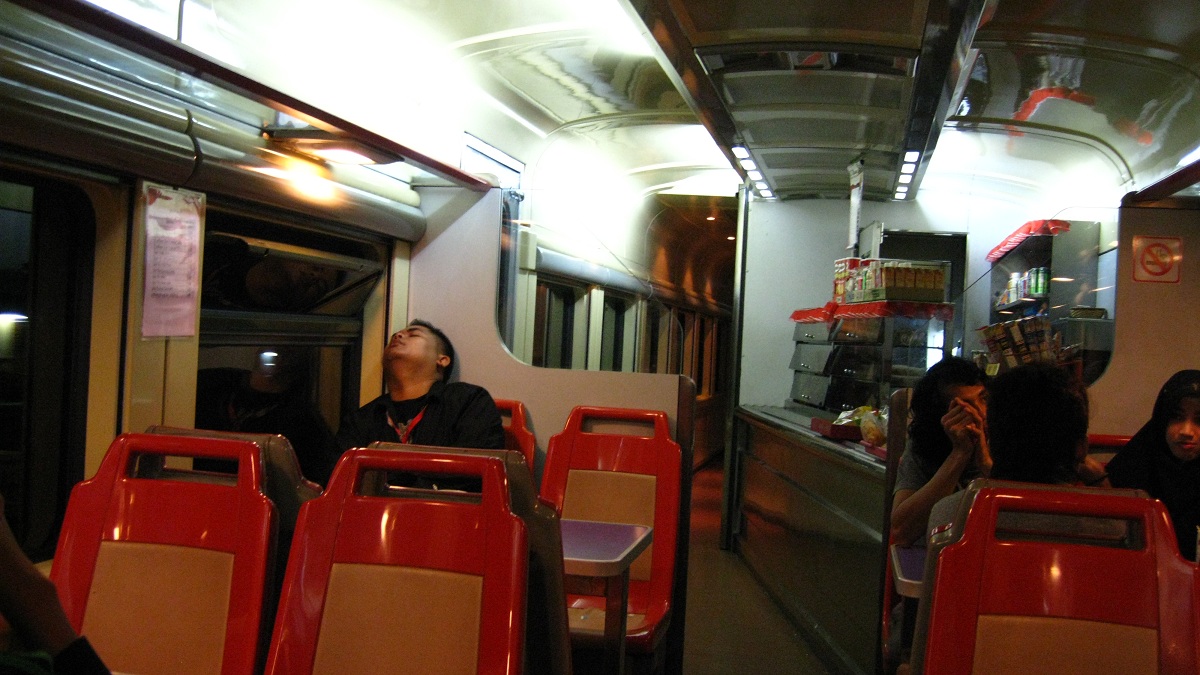
To the best of my recollection, excellent service can be found on air-planes and that only with certain airlines. On this train ride, I was awakened by these familiar words, “Kopi, Teh or MILO” spoken by an English-speaking stewardess. Her name is Miss Tuti. I have made comparisons of the KTM cabin service with those provided by some Asian airlines. Does it look familiar and unusual at the same time?
Let’s check out the buffet coach. In the past, KTM did not offer the full in-house dining experience. It was the usual tea tarik or kopi-susu in Styrofoam cups and even then it was not “panas”. The sandwiches were very much left to be desired. Today the standard of dining and cooking has improved. MALAYSIA BOLEH LAH!
Being the June holiday and “Salamat Jalan KTM” farewell, I shall be coming up with my PETRONAS Twin Tower experience; inside the tower and from the air. There is also the cross-border Malaysian-Thailand experience and my personal discovery of an important 1931 photo of the Tanjong Pagar Station.
Thursday, April 28, 2011
Last Train to Tanjong Pagar Waterfront - Peter Chan
Photo 1: Usually we don’t chance on this kind of situation inside the Tanjong Pagar Station. I had no hesitation because they were doing for a fashion magazine. Her mother told me she’s in Primary 2.
Photo 2: The Prime Minister of the Federation of Malaya, Tengku Abdul Rahman speaking to the press when he made a stop-over in Singapore. Tengku was on his way to London. On the right is Raeburn Park (c 1962).
Photo 3: Black smoke rising from the Tanjong Pagar dock area. The actual target at a large oil storage facility (bottom left) escaped the U.S. bombing but the passenger hall of the Singapore Station (old name for the Tanjong Pagar Station) took a direct hit. Photo courtesy – USAF Historical Studies Office.Because we are living in Singapore, architects out-live the buildings they designed. I can’t think of any building built in the modern era which survives longer than the life-span of the designer. So it will be not too long before Photo 5 will change. The Keppel Viaduct will stay as part of the Marina Coastal Expressway (MCE) but for the rest, I can’t be certain. Do revisit this place whilst you can.
Photo 5: Contrast the modern streetscape of Keppel Road with Photo 4Monday, November 23, 2009
Travel to Kuala Lumpur (KL) – Peter Chan
For me there were two memorable events that came as a result of a planned holiday; one took place in the mid-60s and the other in the early 70s. I start off with the early 70s event.
Just before my NS enlistment, my best friend “Fei Lo” Weng (buddies since Secondary Two) had to go to sea. Fei Lo completed his radio marine diploma course at the Singapore Polytechnic and like many others who took up flying or went sailing it was one way to financially support a family whilst conveniently to avoid NS. You see after Secondary Four, those who joined Singapore Airlines (SIA) – as commercial pilots and flight engineers, and Neptune Orient Line (NOL) – as marine officers – need not serve NS. This was highly unusual as most of us think of NS deferment for tertiary studies or part-time NS - in the Vigilante Corp or Special Constabulary.
Fei Lo knew that by working for NOL he was going to be away from home for 6 months to a year; in fact on the very first trip he went away for almost 5 years until we met again when I was in the university. During this period we kept in touch through snail-mail. Often when he returned to Singapore, he was on “stand-by”; ready to board another vessel in Singapore waters or fly to Nigeria to board a new vessel. He finally called it “quits” when he turned 33. Thus this trip to KL together was one way to spend our remaining days together.
Photo 1: Fei Lo, Aunty Ingrid and I in the Lake Garden (circa 1972). I took this hair-cut hoping that I could clear through NS Enlistment day but unfortunately failed to pass the actual test and ended up “4 X 2”. We took more photos at the National War Monument and an oval-shaped building in the Lake Garden.We arrived in KL by train and our accommodation was at his maternal grandmother’s house in Salak South Gardens, a fairly new residential estate in the early 1970s. Nearby was the Salak South railway bridge. Salak South Garden had rows of terraced houses on a hill-slope.
I tasted the best sui kow and char siew fan from a kopitiam in that estate; “Lampor Yan” friends tell me it’s still the best in the KL area even now. Sui kow was for breakfast, the other being yow chay kwai with “Pai Kuak Tong”. I was very impressed with the size of the sui kow because in Singapore I could only find small wantons. Malaysian kopitiams were unusual from those in Singapore; the suburban kopitiams had at the most two stalls and a drinks operator. Most times one stall stayed open. I learnt something about Malaysian morning breakfast habits; Nasi Champur for Malays, Roti Prata for Indians and noodles for Chinese. Singaporeans will definitely have a hard time adjusting to Malaysian breakfast habits because bread is not often served at kopitiams.
Aunty Ingrid and her boyfriend drove us to many places, Port Dickson (nearest place to swim in the sea), Port Swettenham, Lake Gardens, Kajang (for satay) and Genting Highlands. That was the first time we stepped into a casino but it really was not a pleasant sight. I saw squatting women in tears, women who went to this little small window to pawn their jewellery for cash, and men who aimlessly paced up and down the corridor outside the casino.
Fei Lo and I went out on our own on some days. We visited the Merdeka Stadium and Fitzpatrick Supermarket at Weld Road. We even had time to pop into Bukit Nanas Convent to see my friend. Little did we know that among my friend’s friends, one pretty Malay student was later destined to be an UMNO politician/Minister. On one visit to Petaling Street, Chinatown we shopped for “Kat Chye”.
Photo 2: Left; Father’s letter to us (circa 1964). Right; PAP election headquarters at Batu Road. Batu Road reminded me so much of South Bridge Road in Singapore with all the typical advertising signboards and Chinese inscriptions on pillars (circa 1964). By September 1965, when the party was de-registered, there were 1,700 party cadres in Malaysia.In 1964, I received my father’s telephone call from KL. As the trunk telephone link between KL and Singapore suffered “noise disturbance”, I heard him telling me he welcomed me to join him for a short holiday. My father was in KL because the PAP contested the Malaysian General Elections. So my mother sent me off at the Tanjung Pagar Railway Station for the train ride into KL and I had with me Malayan Dollar $20. It was a very enjoyable trip for this little young boy because his primary school textbook, “Malayan Geography Series” came “alive” about rubber trees, people at work, and valleys and hills. Interestingly I found many train employees were Indians and Sikhs, holding positions like train drivers, ticket inspectors and maintenance crew.
Photo 3: Left; Royal Selangor Club on the left of the Padang which in turn faced the Sultan Abdul Samad buildings (circa 1970), Right; The former Odeon Cinema@ Batu Road was also known as Jalan Tuanku Abdul Rahman in the mid-60s (circa 2007)I arrived at the KL Railway Station and walked along a road leading to the Padang and the Royal Selangor Club. After taking road directions from some adults, I came to a mosque at the confluence of two rivers; Sungei Gombak and Sungei Klang. This part of town was highly unusual; many buildings look like they came out of the story book, “Aladdin and His Magic Lamp”. I never had seen so many buildings with Middle East architecture. Even in Singapore the slight exception was “The Arcade” in Collyer Quay.
Photo 4: Left; Klang River and Gombak River meet here and history tells us that this was the original spot where Kapitan China Yap Ah Loy founded KL (circa 1974). Right; Mountbatten Road (circa 1970). Some KL street names could also be found in Singapore such as High Street, Cecil Street and Cross Street.When I met up with my father at Batu Road, I was not sure how to judge his facial expressions. I learnt a few things about politics; the bull symbol was for the Socialist Front, the boat stood for the Alliance Party, and “Sip Sip Ling” was PAP. As everybody was busy with the elections, there was a “Lee Suk Suk” who took care of me for the rest of my stay including making sure I boarded the Malayan Airways flight from the old KL Airport in Sungei Besi to Singapore. We went to see a Malay “silat” movie at the Odeon Cinema. Then off to Bukit Bintang for street-makan and playing the swings, merry-go-round and slides in BB Park (now Sungei Wang Plaza). Many years later I realised “Lee Suk Suk” was the DAP MP for Bukit Bintang. No wonder he knew Bukit Bintang so well at his finger-tip. Maybe “Lee Suk Suk” knew besides baby kissing, there was also baby-sitting.
Photo 5: Left; View of KL from Menara KL. Right; Tengku Abdul Rahman rode on this convertible on his way to the Merdeka Stadium to proclaim Malaya’s independence in 1957.KL has changed so much that I can hardly “connect” with her. It’s too urban. Even up on Menara KL, I cannot make out the landmarks because the “old” is gone. However I did have a bit of luck. I spotted the first Malayan Prime Minister’s car which was used during the 1957 Independence Day ceremony.
Thursday, July 09, 2009
Sawatdi Khap. Welcome to Bangkok (by Peter Chan)
Photo 1: From my hotel window watching the two trains meet on the BTS line. Times Square is on the left of the photo.
When I looked down from my hotel window at the two trains “passing each other” at the Asoke Station, it brought me back to the past. The school boy dream did indeed come true in August 1971. Twenty rugby players between ages 17 and 18, two male teachers from Raffles Institution made their way into Bangkok for this 12-day trip. The old boys association came up with S$5,000 to sponsor this trip. Each student took with him between S$50 and $150 of his parent’s money to spend.
We boarded the Malayan Railway morning train at Tanjung Pagar Station, arriving in the late afternoon in Kuala Lumpur with just enough time for the only proper bath (for the next 40 hours) before departing on the 9 pm train to Butterworth. Next morning at 10, we transferred to the State Railway of Thailand international train service to Bangkok. Initially the ride was pleasant with plenty of beautiful landscapes to see; e.g. rice fields, villages and mountains. This was also the Thai summer season for longans and rambutans. At each train stop, children with baskets on their heads sold Thai fried chicken and banana fritters. We were greedy or put it another way, there was absolutely nothing else to do besides pacing up and down the coaches, playing pranks, sleep and wake up, and singing “dirty songs”.
Photo 2: Left Photo; A Vajiravudh player holding the ball on his way to a touch down. No Raffles players in sight. Right Photo; I am the last man at the line out against Pre-Military Academy. Flat-top hairstyle had already become fashionable in Bangkok in the early 1970s.
Forty-eight hours later after we left Singapore, we entered the Bangkok area. We freshened-up and put on our school uniforms again with very little hygiene standard to show because we managed a face-wash, brushed our teeth, quick shave and “brylcream” the hair. How we wished we could shower but the train did not have shower facilities and water droplets came out of the faulty basin tap.
As the train pulled into the Hum Lampung Central Station on the dot at 8am, the Vajiravudh College welcome party was waiting and the brass band played our school anthem. There was the customary Thai greeting of clasped hands and “Sawadi Kap”. Before long we were packed into two bus coaches and escorted by out-riders from the Bangkok Metropolitan Police. During the bus ride, I noticed each of us was assigned a male student “GRO” and soon the conversation jokingly drifted to “How come got no girls in this school?”
As the triple-crown champions of Singapore for the Kiwi Cup, 15s and 7s, we took part in this inaugural game against Vajiravudh. It was hoped that this game could eventually develop into an annual series involving Raffles, Malaysia’s Malay College and Vajiravudh. Vajiravudh was considered the Eton of Thailand (
Photo 3: Left Photo; Raffles group photo session at Tanjung Pagar Station before boarding the morning train to Kuala Lumpur. Right Photo; The farewell function for Vajiravudh, King’s College, Thai Pre-Military Academy and Raffles players. Notice there are no girls in sight **gulp**Unlike athletes today, we were not boarded in a special games village or in a hotel. We stayed at one of the residential colleges within Vajiravudh’ school compound. After many decades, I took the opportunity on one of my business trips into Bangkok to revisit Vajiravudh just to check out how much has changed. I was greeted by Major Apirat, the sports convener who showed me around the place. I told Major Apirat about the wonderful Thai hospitality where we were fed on daily basis for lunch - Thai pineapple rice with huge portions of Thai Chicken Gai Yang, Kaeng Keiw Warn curry, Kai-lan and Thai Otak.
Photo 4: Left Photo; Group photo session with Vajiravudh. Vajiravudh students wear the blue bermuda and white shirt school uniform. Right Photo; The same building where the group photo session took place. It is now the Vajiravudh Assembly Hall.Our Thai host took us for sight-seeing of Bangkok. We visited the Grand Palace, the Benchama Temple, Bangkok Zoo (just across the school), river boat ride down the Chao Praya River, Crocodile Farm at Samut Prakan and Rose Garden. We went to a Thai Army-owned TV station to watch Thai Boxing and were interviewed over the sports channel – little did we realize that there was a confluence of military and private business interests in Thai society. At official dinners, we were entertained by Thailand’s top cultural troupes. I must add that all the places we went were strictly educational and cultural except probably for the only time when we were allowed to shop at Jim Thomson’s Silk Store. Fortunately or unfortunately, we didn’t get to see Bangkok’s pulsating night life; many thanks to Mr. Natahar Bava and Mr. Graham Pierce (teachers and guardians).
We missed pole dancing and cabaret shows although we did see from our coach the neon lights and attractions of the Soi Cowboys from Sukhumit Road and the ladyboys of Patpong. Even if we were allowed to go on our own in a “tuk tuk”, we had to have one of Vajiravudh College’s seniors; looking as if we could lose our direction in this city. We understood all 3 Thai schools were an all-boys school in every sense of the word - in and out of the school environment - but it was the Thai Pre-Military Academy boys who were more willing to educate us about “the other side of Bangkok”. Perhaps this might explain the difference between civil servants and the military in Thailand. Vajiravudh produced top men for the civil service and Thai Pre-Military Academy produced top generals for the “Brown Shirts” and “Green Shirts”.
Photo 5: Left Photo; The rugby field where we trained on alternate days when we didn’t have a game. Our training commenced at 4pm and ended at 6pm. Then it was time for dinner and curfew. Right Photo; The residential house was our home for the next 10 days. There is a road on the bottom left of the photo which leads to the back gate. This back gate was a “secret door” to leave the school for the bright lights of the city. I was told it is “still operational”.Now back to 2007. This time I was able to meet an old friend Suchai from King’s College for a social drink. We chat of the good old days and talked “who is where”, each minute serenaded by a live all-girl Filipino band at the Westin Grande Sukhumvit Hotel and serviced from attentive high-slit dressed waitresses. Too bad for you, I don’t have any female companions in my photo album to show you because it was 1971.

.jpg)