Sunday, August 31, 2008

More than 1 type of kampong in Singapore

My young friend PY of Oceanskies 79 once wrote an article about her visit to Sentosa where she learned about kampong life in Singapore in the old days. I pointed out to her that what she learned was essentially about a Malay kampong. Chinese kampongs like the one I grew up in were quite different actually. Come to think of it, not only were Chinese kampongs different from Malay kampongs, among the Chinese kampongs there were differences too. So I take this opportunity to tell you what I know was different. I consulted my good friend Chuck who grew up in the Hillview area next to a Malay kampong in nearby Bukit Gombak.

First of all there are the games. I believe that the games played by the Malay kids and us were quite different. In PY’s article, she mentioned games like gasing and congkak. But as you have probably read from my articles (you can click on the label Toys Were Us on the right side to read these articles) the games we played were quite different.

There were also a number of things in a Chinese kampong that you would not find in a Malay kampong. These were usually related to the difference in religious faiths; Malays being mostly Muslims. For example, in a Chinese kampong like Lorong Kinchir which I grew up in, pigs roaming freely was a common sight. Another thing which was mandatory in a Chinese kampong was the Tua Pek Kong temple and wayang stage. Depending on the size of the kampong, the size of these two features also tended to be different. During the Lunar 7th Month, opera shows would be performed. I have blogged about this before here.

This is what a kampong where pig-rearing was carried out looked like. Hard to believe that this was Singapore just one generation ago eh? Photo courtesy of Memories of Singapore

A typical Malay kampong house in old Singapore.


Another thing we had was the Chinese Medicine Shop. Practically all Chinese kampongs had one of these. Today, they are still a common sight in our HDB heartlands. Another thing I can think of is the village school. In our kampong, we had a small Chinese school called Chong Boon School (崇文). I spent one year there in fact doing primary one. But later I went to primary one again, but this time in an English school. In those days, they were not particular about ages and so even though I did two years of primary one, I was not over-age.

As I said before, even among the Chinese kampongs there were differences. This was mainly due to differences in economic activity. For example, compared to our closest neighbour which was Potong Pasir, we had more fish ponds whilst they had a lot of vegetable farms. We also had quite a bit of rubber estates. especially towards the Thomson end of Lorong Kinchir. Potong Pasir was to our south and separated from us by Braddell Road. It was mainly a Cantonese area. We used to refer to it as San Par. You can see some photos of the ponds of Lorong Chuan here.

To our west, was Kampong San Teng which is called Bishan today. They too were a Cantonese area and we referred to them as Pek San Teng (Pek San is the Cantonese pronunciation for Bishan). We were separated from them by the Kallang River. I am not sure about the economic activity in Kampong San Teng. What I do know is that they had a lot of cemeteries; and every Qing Ming we would go there for the ‘grave sweeping’ exercise.


I think the population of Kampong San Teng must have been considerably bigger than ours. As such their temple was much bigger and their annual wayang festival was a much bigger affair. My sister and mother used to go there to watch the Cantonese operas. But as far as the rest of us were concerned, the chief attraction of Kampong San Teng was the open air cinema called South Country Theatre (南国戏院) where we enjoyed many hours of watching black and white Cantonese movies. But I suddenly recall one English title. It is Seven Brides for Seven Brothers. Please don’t ask me what was so special about this movie. I remember next to nothing about it. I think it was a cowboy comedy. My older brother Chun Chew (Zen) might remember more.

In case you are wondering what an open-air theatre looked like, here's a photo of one in Somapah Village from the collection of the National Archives of Singapore.


Well I hope this short article helps to enlighten my young friends a little about the kampongs that your parents grew up in. Below are some photos from the Lam family album.

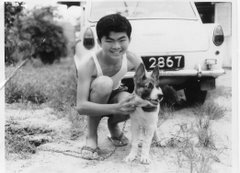
Photo of me (right) and my younger brother James. On the left is the pond where we caught our fighting fish. Do you see our dog behind us (butt facing camera).

1951 photo of my mother carrying my elder brother David. I was not born yet. The fish pond like this one was very common in Lorong Kinchir and Lorong Chuan area. So were the coconut trees which helped to bring in some income for us.

You can see more photos of bona fide Singapore kampong scenes at these websites:

Friday, August 29, 2008

Kampong Buangkok Videos

In one of my earlier articles, I mentioned that young Singaporeans simply have no idea what life in a kampong in the old Singapore was like. Well I have some good news. You can catch a glimpse of kampong life in Singapore from the videos below.

Last year, I was approached by three young ladies from the Nanyang Technological University's School of Communication and Information. They were doing a final project on Singapore’s last kampong at Buangkok and as part of their research, they wanted to speak to guys like me who had experienced life in a kampong in Singapore. I roped in my friends Chuck Hio and Peh Seng Ket to speak to the girls.

Good thing I still have their contact and I asked them to put their videos on YouTube to share with you. Altogether there are three videos. Here they are.


Part 1

Part 2

Part 3

Thank you Ms Sarina Md Rasol, Dayanna Md Tahir and Wong Po Fong for sharing your videos with us.

Monday, August 25, 2008

My Grandfather – Tessa Mitchell

My paternal grandfather, Lewis Williams, lived and worked in Singapore in the early years of the 20th century. He was employed by a company called Topham, Jones and Railton and worked in Singapore from about 1911 until about 1930. Topham, Jones and Railton were the civil engineering firm who built the King’s and Queen’s Docks and in 1922 began building the causeway linking Singapore to Johor Bahru.

Recently I was going through some photographs in my late Mother’s belongings and came across two large photographs from my grandfather of the newly built causeway in 1924. These have now been donated to National Archives of Singapore.

Causeway from North

Causeway from South

My father, Frank Ivor Williams, was born in Swansea, but spent his early years with his parents in Singapore. His younger brother, my Uncle Idris, was born in Singapore. Both boys were sent home to the UK at the age of seven or eight, only seeing their parents on their occasional ‘home leave’. Here is a photograph of my father at an early age with his Amah which is dated 3rd March 1911.


Photo of my grandparents

I know very little about my grandparents’ life in Singapore. My grandfather died in 1948 and although my grandmother lived until the early 1960s she did not talk about her past. I think life in Singapore must have been very luxurious in comparison to their later days. They lived in Cliff House (where my uncle Idris was born), a very large and well appointed house on Bukit Chermin Road between the Keppel golf links and Chermin Way. The house is still there and is now owned by the Port of Singapore Authority (PSA) who rent it out. It is apparently not possible to see the house from the road but it can be seen, situated above an oil jetty, from the north west corner of Sentosa. Here is a recent picture of the house taken from the sea.


View of Cliff House viewed from the sea. Photo courtesy of Peter Chan, 2007.

My cousin Martin visited Singapore in 1993 or 94 and was lucky enough to be shown around the house as it was between tenancies. He particularly noted the large and airy size of the rooms – one way to keep cool before the days of air conditioning. Here is a picture of the front of the house taken on that visit.

Photo of Cliff House car port. Photo courtesy of Martin Williams, 1994.

Later my grandparents moved to a large bungalow in Johor Bahru – close to the construction of the causeway. Here is a photo of my grandmother in front of that house.

After work on the causeway my grandfather worked on a geological survey for the new naval base at Sembawang and then on a hydro-electric dam project in Perak.
My family, my sister, Susan Tessier, my cousin Martin Williams and myself have very few artefacts from my grandparent’s life in Singapore. They lived a peripatetic life moving to various engineering projects and were bombed out of their home whilst living in Portsmouth in the 1940s. We have a few water colours of tropical scenes (my grandfather was also a water colourist) and among a few other photographs, this one dated 25th September 1922, of my grandparents and friends swimming at Pulau Ubin.

We also have a mahjong set, some bits of china and a big brass bowl but little else.

I shall be visiting Singapore in mid March 2009 with my husband Brian Mitchell who has also contributed to this blog. He will be looking for memories of his time there as a teenager in the 1960s and I will be looking for those long lasting signs of my grandfather’s time in Singapore – the causeway and Cliff House.

Tessa Mitchell

** More pictures of Cliff House here.

Friday, August 22, 2008

King’s Theatre @ Tiong Bahru

Although I know very little about the Tiong Bahru area, I am familiar with the King’s Theatre at Kim Tian Road. In the early 70’s when Taiwanese movies were a big hit, my older siblings, especially my elder sister and their friends were quite fond of watching this genre of romantic dramas. I used to tag along. Please bear in mind that in those days, we had no internet, no colour tv, no computer games - no pc in fact - and thus the most popular past time for young people was going to the movies.

The most popular of these mushy (picture boy in bell bottoms, girl with long hair running slow motion on beach with romantic song in background) movies were based on stories by a very famous Taiwanese novelist by the name of Qiong Yau (琼瑶). These movies usually starred the most famous Taiwanese actors of the day. The two male names that come to my mind are Alan Tang and Chin Siang Lin. There was a very popular actress but I cannot recall her name. At one time she was married to Patrick Tse Hsien.

One movie that I remember seeing in King’s was 一帘幽梦. Like most of such movies of that era, it had popular movie theme song. I think this one was written by the very famous song writer 劉家昌. I can’t remember the singer though. I don’t particularly like this song actually, but somehow, it sticks to my mind. I do like many of 劉家昌’s other songs; such as 爱的天地, 我家在那里 and this one which became a Taiwanese ‘National Day song’ - 梅花。Come to think of it, maybe I enjoyed the songs more than the movies. One other movie theme song which I liked was 在水一方 which was sung by the famous Theresa Teng.


Fig 1: This is a 1955 photo of King’s Theatre is from the National Archives collection.

Fig 2: The is a picture of a cinema ticket dated 1960. Notice the price of $1 and the words; “In aid of National Theatre Fund”. I believe this is not a normal ticket for a movie but maybe some kind of fund-raising concert. The J23 refers to the seat number. The Chinese words in those days were all 繁体。

When I was older and had my own car, I accompanied my parents and their friends to King’s occasionally. Like the theatres in nearby Queenstown or the Imperial theatre that I blogged about earlier, King’s Theatre is no more. I don’t know in which year it was demolished, but it must be in the 80’s because I could see it in my 1981 but not in my 1993 street directory. On the site where it once stood, they are building another ‘Plaza’.

Whenever I pass by this area, I remember the King’s Theatre.

Wednesday, August 20, 2008

“Tiong Ma-Lu” as the Cantonese would say (Part 2) – By Peter Chan

It was a strange phenomenon to see that every corner shop was a coffee-shop or a provision-shop except the one at the corner of Seng Poh Road and Eng Hoon Street. I recalled it was run by an English-educated shop-keeper who had a wife who was always heavily made-up with Elizabeth Arden cosmetics, bright red lipstick and dressed in a tight-fitting frock. Her husband sold sweets in big glass jars and office stationery. Next door was Kamy, the only music shop that sold cartridges, cassettes and single-records. It was here that I bought my first cartridge “The Carpenters” album. Further down Seng Poh Road was “Majid” and Yuen Cheong Provision Shop. Majid was Indian and the only shop selling fabrics such as Swiss Voile and was popular with Tai-Tais who came in chauffeur-driven Chevrolets, the Flamingo Night Club hostesses in Great World and the ladies who walked to the Seng Poh Road Wet Market. There was also a ladies hair-perm saloon and a dress-making shop on that street. If I am not wrong, Roland Chow, the famous hair stylist first started as a small saloon at Seng Poh Road. In terms of medical facilities, there was a Kwa Clinic; perhaps one of two clinics on Seng Poh Road.

For good reasons, property values vary between streets. Eng Hoon Street being more “commercial” earned a premium. Eng Watt Street was quieter and became homes of kept mistresses. Brighter academic students came from Moh Guan Terrace. If you check around, past government scholars and famous doctors came from Moh Guan Terrace. Tiong Poh Road boasted of fine artistes from educators to musicians. Even MM Lee’s wife, Madam Kwa Geok Choo was from the pre-war SIT flats. I guess the story should be very different today.

Fig 1: Hock Lee Bus #3 passed through Tiong Bahru Road from Outram Road. The building in the background is a boutique hotel today

Hock Lee Bus #6 served this estate from the Chulia Street terminus. I often waited at the Tiong Poh Road bus-stop for my grandfather because he brought home “The Malay Mail” newspaper, the English comics section was fantastic. The other bus-stops I believe were at Moh Guan Terrace in front of the Tiong Bahru School, Yong Siak Street after Bo Bo Tan Garden, Seng Poh Road (opposite Seng Poh Lane), and Kim Pong Road where there was a POSB branch. I knew this bus route very well because I went by bus with my grandfather to attend the Chinese night school at the Ning Yuen Wei Kun premises; Great Eastern Life Building today. For me, the fun began not in the classroom but behind Poh San Dance Studio. There was a small stream to cross and it required a fine balance with out-stretched hands on a narrow plank to get to Outram Road.


Fig 2: The open space between Block 59 and Block 66. Yours truly at the age of 3 years is standing at the spot which is now the red concrete steps. The car garages are now restaurants or catering kitchens. Block 82 Tiong Poh Road’s favorite red-brick façade as captured by photograhers can be seen in the leftmost photo

There were a few open spaces for play. The car park between Blocks 59 and 66 at Seng Poh Lane was a small playground with swings and slides at both ends. It was not elevated as it is now. Blocks 60 – 67 were car garages. Often I saw trishaw-riders at the car garages taking their breaks to play “Chiki” or smoked that long-awaited hand-rolled cigarette. The residents from Eng Hoon Street, Eng Watt Street and Tiong Poh Road had to compete for space; sometimes football was played in the midst of an archery game. Kite-flying was done on the roof-top of the post-war SIT flats at Lim Liak Street. Otherwise we walked over to the University of Singapore Medical School sports field next to the MacCalister Flats. Before the CTE acquired parts of the sports field, we walked through Keng Kiat Street, a route also taken by the Malaysian medical students who rented rooms in the pre-war SIT flats. We dare not go further to another sports field nearer to Jalan Bukit Merah because there was a Malay cemetery there.

I believe the Tiong Bahru pre-war SIT flats will stay the full course of its 99-year tenancy from 1967 because it is classified as a heritage site. Except for the block numbers which get me confuse, I prefer to reference the place by street names.

Fig 3: The original opaque olive glass was provided by the SIT (circa 1939). This type of glass was used for the internal and external windows. Since the Pre-war SIT flats were multi-storey, there was a need for a common area staircase like in this photo. What was really unusual was a glass panel door that was similar to the windows. After 1967, each house-owner decided to do away with the windows and today we have a mix of aluminium sliding window panels, louver windows and wooden doors.
Read more about Tiong Bahru Bahru at the Tiong Bahru Estate Blog.