Tuesday, November 29, 2005

About My Photos

Ever since Ivan Chew submitted this blog to Tomorrow.sg, I have received many visits from young Singaporeans. I am truly heartened and encouraged by their kind remarks. I particularly love this one by yl; “wahhhhhh!!!!!!! Uncle!! YOU ROCK!!!!”

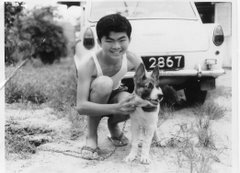
I think I need to explain a bit about the photos you see in this blog. You will notice that many of the old black and white photos had people posing (cham - my daughter is going to call me a ‘poser’). Please don’t think that people of our generation are so vain. It’s just that camera films those days were quite expensive; and thus it would be considered a waste if we took pictures only of scenery or buildings. It was thus customary to pose with the scenery as background.

Let me tell you a bit about the cameras we used those days. The earlier pictures were taken with our first camera - a Kodak Brownie. It was an ‘auto-focus’ camera, meaning you don’t need to focus - because there was no ‘focus’ function! It had small circular window behind for you to read the number of the photo you are taking. After taking 1 picture, you have to wind the film slowly till the next number appears in the window. Now if you forgot to do this, then the next picture you take will go on top of the previous one, and you have wasted 1 valuable photo plus whatever you took earlier is lost.
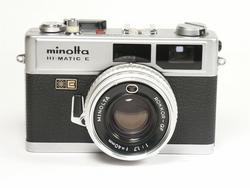


Our second camera was a Minolta Hi-matic. We bought it around 1969 (not 1967 as I said earlier). It of course had more features like focus, aperture etc. This time, to advance the film, you need to push a lever. But if you forgot to do it, there is an ‘idiot-proof’ mechanism that prevents you from taking the next picture. Interesting eh?


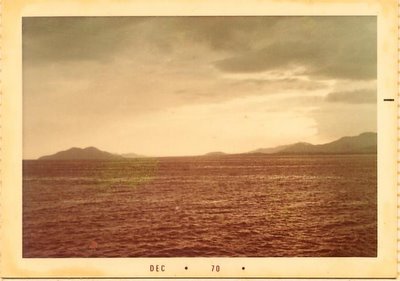
The photo below is my first colour photo. It was taken around end-1970 just after my HSC (A-levels) exams. I went on a tour to Malaysia with my parents and my elder sister. We brought along 1 roll of colour film. During the ferry ride across to Penang, we came across this beautiful scene of the setting sun and we decided that it was time to use our precious roll of colour film.
An interesting thing happened in Penang. At the hotel we stayed in, there was a stir in the evening around dinner time. It turned out that an up-and-coming teenage a-go-go star was also staying (or performing) at the hotel. Some of the girls in our tour group got very excited and wanted her autograph. Can you guess the name of the singer? Answer - Nancy Seet.


Today we are in the digital age. I am proud to say that this ‘uncle’ is quite familiar with digital photography. I was probably one of the earliest 'ah laus' to invest in a digital camera. My first digital camera was an Epson which cost about $700+. It didn’t come with an LCD screen, so I paid extra for an attachment; which was a mistake because I never got to use it. The reason was, the 4 pieces of AA batteries get used up so quickly, it was not practical to use the LCD screen; plus it was a bit clumsy to have a separate attachment. I have also learnt how to take and edit my own digital videos. I did all these not because I am a camera buff, but because my job as a consultant and trainer requires it. Actually I quite enjoy learning all these cool gadgets – only problem is people our age learn such things very slowly.

Sunday, November 27, 2005

往事只能回味

Hey! How come nobody could identify the singer of this song? Anyway, the singer was 尤雅. I believe she was popular in the early seventies.

My favorite Chinese singers from that era were 青山and 姚蘇蓉.


My favorite 青山song was 唯一爱的人. At one time, we had an EP (45 rpm record) with this song on 1 side. Not long ago, I came across a CD with this song in Rochore Centre. Cost only a few bucks.


My favorite姚蘇蓉song was 不得了. I once heard it being performed live by the famous ‘Laurel and Hardy of Singapore’, Wang Sa and Yeh Fong at a theatre located at the present Mustaffa Centre. I think it was called President Theatre. It was so hilarious we (as they say in Hokkien) ‘laughed until stomachache’.

At that show, a famous Taiwanese singer by the name of Chang Ti also performed. This guy could improvise the lyrics of any song given to him.


Actually, now that the brains start racking, there is another 姚蘇蓉 song that I liked very much. It's called 秋水伊人.The lyrics are very touching. So all you young people out there. I presume you have not heard this song before. I give you the opening lines and you try to guess what this song is all about.

望穿秋水,不见伊人的倩影, 更残漏尽,孤雁两三声; 往日的温情,只换得眼前的凄情.

Friday, November 18, 2005

More About Sago Street - Chu Chun Sing


(A)

These windows used to share the same room…was a large room indeed! Used to be occupied by [散 仔 ] - i.e. men who were odd jobbers and shared the monthly rental .. to cut cost. My grandmother was the rent collector /in-charge rather. They used to call her [包租婆]

(B)

This lane which links Smith street to Sago Street, holds many, many memories; and is witness to numerous incidents and events.

Wednesday, November 16, 2005

On The Street Where Chun Sing Lived

My friend Chun Sing's description of life in Sago Street and Sago Lane is so interesting, I could not resist going down there this afternoon to take a look. Good thing I am self-employed and so no worry of being scolded for taking a 2-hour lunch break. Besides taking some pictures of the area, I also helped myself to a nice bowl of beef noodle from the Chinatown hawker centre.

View of Sago Street from the hawker centre end


This is house no. 6


Can you spot Sago Lane? Looks like the Street of the Dead has become a dead street. But it also appears that the govt is trying to resurrect it.

Sunday, November 13, 2005

My Memories of Chinatown (Part 2) - Chu Chun Sing

Victor commented that Part 1 was an anti-climax. I did promise that I would share later why I was morbid of the Sago Lane (沙莪巷 ). Indeed as the colloquial name spelled, Street of the Dead [死人街] where funeral parlours (Cantonese clan) were housed speaks much for itself. Incidentally did you know that the colloquial name for Sago Street where I lived is also known as ‘ 庙仔街’ ? Sorry, not to digress your thoughts.

There was one incident I recall happened when I was on my way home (I was 7 or 8 then). I took the challenge to myself of walking past Sago Lane one evening. Funeral parlours were located on the ground floor of this colonial 2-storey terrace blocks along that street. The upstairs were converted as hospice where the dying was housed till they depart. Immediately the corpse would be removed to the floor below and the necessary procedure to be addressed by the undertaker.

The old Singapore under the British colonial rule then, offered no proper hospice-type of premises for the dying, and Chinese migrants were not favoured to die in their homes. Hospital treatment was not popular among the traditional Chinese migrants in those days so the only place they could utilise was the upstairs of these funeral parlours. If these people could afford they would prefer to return to China (where their home land was) to retire. But after the communist regime had taken control of the whole of China after the 1948, the Chinese in Singapore had no way but to stay behind instead of returning to their home land. This also explains why the Chinese cemeteries were left empty all those years till the 50s came along. This was observed by my late father. I remember him telling me that the Pik San Teng [ 碧山亭坟场] cemetery ( located off Thomson Road and Braddell Road) was generally scarce and scanty with graves but beginning from the early 50s it began to get crowded. That Pik San Teng had now become the land for the living…the Bishan housing estate, and the mass rapid transit (underground subway) runs through it, geographically dissecting through the whole area.

Ironically enough, the ex-occupants of this area were underground. Now the MRT runs through it above ground, in fact, this is the first train station where it begins to surface above ground after all the city stations that are underground. This route winds its way round the north and western part of the island of Singapore (all above ground) till it returns to the city area in an almost anti-clockwise format. Again this is just an observation.

Looking at the upstairs of one of the parlours that evening I saw this old woman with her frail sickish looking face starring at the people on the street and probably so, looking at me. I was not the only soul on the street, of course, but probably the only person who took attention at her dying state. One side of the street was arrayed with hawker stalls while the other side was lined with these parlours including a coffin sellers. In fact it was a busy evening as usual while the hawkers were busy setting up their stalls on one side while the other side (the parlours) was busy at their activities.

In my recollection there were at least 2 coffin shops. Some of you who may not have seen what a Chinese coffin would look like. Tell you, it is not the best looking sight of all.

I dared not take the second look after that…but walked hurriedly straight on for home, which was just the next street anyway. But that sight till today I have not forgotten one least bit. It was a morbid thought that this woman was passing away. I did not want this woman to leave this world because I was not sure where she would go and neither did I know any one would go then.

That woman seemed to be telling me to treasure this life because her life was ending and she would not know where she was going too. She may have thought to herself how wonderful it would be if she could rewind the clock to go back to the age where I was then, a child of 8 years old so that she could start life all over again.

I promised myself not to ever walk that street again…but I did in fact in my later life to attend my aunt’s funeral wake in 1979 and in between I missed several of my relatives’ funerals for that reason! I was grown up then…so that was all right.


This is a photo of Sago Lane in the 60's. On one side, you will see the parlour which they have a nick name .... “convalescence centre”. On the other side are hawker stalls. I will narrate an experience with one of the stalls in next episode.

I used to recall what my own mother described her experiences while wake watching in our relatives’ funeral wake. Like what Victor mentioned, if it was your relative or loved ones for that matter, you would sit through the night till day break either in the parlour or along the street placed with tables and stools munching either ‘Wan-Li-Wang‘ groundnuts (with husks) [万里望花生 ] or quazhi [瓜子 ] (dried melon seeds) and sipping green spot (an orange flavoured drink served in glass bottle) [绿宝 ]

She said of morbid experiences of ‘sighting’ spooky figure hanging about in the toilet located at the back of the parlour and to get to answer your nature’s call one had to walk past the bodies some were not even placed inside the coffin. Accordingly there were usually more than one funeral wakes all held in the same parlour in order that the owner could make a few dollars.

In funeral wake of the Cantonese tradition, Taoist monks who were generally odd-jobbers during the day would gown themselves with the deep yellowish Taoist attire and chanted their due for a couple of hours accompanied with drum and cymbal and even Chinese flute with their usually litany and who knows what they were chanting. For all we know, they may not even understand what they were chanting about.

I had once witnessed a ritual procession in the middle of Sago Street which accordingly the Taoist monks (about 5 or 6 of them in all ) were ‘enjoying’ themselves in this so-called sacred act of ‘por-de-yu’ (break through the nether world to rescue the dead) [破地狱]。  There were lines of little oil lamps lid up with a tiny flame on the floor each lamp was aligned with some ceramic-like roof tiles which we were supposed to take it as ‘gates of the nether world’ [ 鬼门关 ] My contemporary, Ah Fei [ 阿辉] (who was of the same age hence my regular playmate at that tender age told me that if I wanted to see the dead coming to life, all I needed to do was to get near to these make-shift monks and wipe my eyes with their gowns. To be honest I was very much tempted to do that but guessed that I did not have sufficient guts to do that then.

But what really caught my eyes was one of the ‘dancers’ (monks) was giggling embarrassingly. So were they serious or having fun instead? Mind you they would walk away with a hefty sum that evening, paid by the family of the dead whom they were supposedly to be chanting the know-not-what litany.

I heard from older folks that according to the traditional Chinese folklore, there are 18 levels of punishment in the nether world and each level is facilitated with its respective gadget of punishment to the dead who did unjust things while they were alive. These monks were supposed to rescue that dead from the darkest level of hades in order to reduce the amount of suffering.

No one wants to die or perish eternally yet we all have to die one day. That thought used to frighten me … just as the Bible says..’ as it is appointed for men to die once, but after this the judgement’.

I can honestly say that I have found the answer to this life-long question of life after death…..

See you in the next episode; if you bother to stick around for more stories…