Friday, September 15, 2006

Tribute to a Humble Profession

It was raining heavily this morning when I happened to see someone rush by outside my house. The poor chap must have forgotten his umbrella, I thought. Then I realized that the guy was actually a rubbish collector. He was removing the trash from the big plastic bins ahead of the rubbish truck. If you have seen these guys at work, you will know that it is a pretty tough job. Most of the time they had to rush because the truck may be holding up the traffic; and we know how impatient Singaporean drivers are. Furthermore, they have to be cheerful and friendly to us the customers.

Needless to say, this gentleman was not a Singaporean. Nowadays, no Singaporean would take on such a dirty and lowly job. Whilst so much resentment has been generated in the blogosphere about the foreign talents in our midst, I am sure many Singaporeans appreciate foreign workers like this rubbish collector who perform an essential service for our society.

This reminds of yet another lowly profession from my kampong days which has since become extinct in Singapore. Many years ago, I read of a survey about the ‘respectability’ of different professions. Right there at the bottom of the list was a profession known as The Night Soil Carrier. I wonder how many young Singaporeans even know what that is, let alone have seen one of them in action. So while others blog about Singaporeans’ favourite subject –
food, I will play the ‘contrarian’ role and write about something at the other end of the food train instead.

nightsoil1

The night soil carrier is a man who collects human waste. Back in the days when many of us stayed in kampongs, the so-called Bucket System was the most modern and hygienic method of waste disposal available. In those days, the family toilet was usually built several metres to the rear of our homes, away from the public view, as well as to keep away the smell. Thus if you needed to answer nature’s call when it rained, you would need an umbrella. Each day, we would deposit our ‘stuff’ into a metal bucket and the next morning, the night soil truck would come around to pick up the buckets. The night soil carrier would bring along an empty bucket to replace the full one. He would then attach a metal cover to the old one and carry it, 2 at a time to the truck. The truck looked a bit like the armoured vans used by our banks today. It had several rows of ‘deposit boxes’ for the buckets. These were brought back to the sewerage centre where they were emptied of their contents and the buckets cleaned. And all this was done manually!

nightsoil2

nightsoil3
The above 3 photos are Property of National Archives of Singapore

According to the PUB
website, the bucket system was phased out in 1987. But actually, the bucket system was not the most primitive system. Even in my days, it was not uncommon to see what PUB calls ‘overhanging toilets’ built over fish ponds. (Photo on right taken by my friend Peh S K in Pulau Ubin). In fact if you go to Malaysia, you can still see these in some rural areas. I am sure many Singaporeans who have visited the fishing village of Kukup in Southern Johor and stayed at the holiday chalets there have experienced what it was like to ‘do your business’ directly into the sea.

And that reminds me of yet another interesting system which only our NS (national service) boys would have experienced – the Taiwanese army camp system. For those army boys like my friend Victor who missed out on this unique experience, I shall describe it below. Unfortunately I do not have any photos to illustrate.

Basically the toilets were made up of 2 rows of cubicles built over 2 long narrow drains over which you have to squat. The partitions were only about chest high, and so sometimes, when you and you neighbour happened to finish your missions at the same time, you would get bit of a shock to see another person face to face when you stood up. There were no individual flushes. Occasionally, somebody would turn on the tap and the water would flow from one end of the drain to the other. If you happen to be occupying the last cubicle, you would be treated to quite an unforgettable sight. I hope this is sufficient to motivate some of our reluctant young men to look forward to their NS.

It’s been about one year since I started this blog. Occasionally I find young people commenting that they wished they could be living in my kampong days. Frankly, I doubt they would want to do that if they fully appreciated the conditions that I have deliberately described in a nostalgic and light-hearted way.

Wednesday, September 13, 2006

More "Strange Fruits" - Chuck Hio

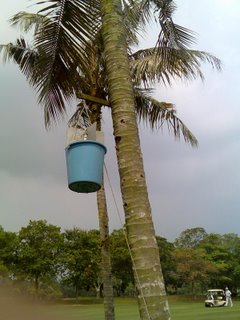
Last week, I brought some clients to the Ponderosa Golf and Country Club in JB and saw something very interesting. It reminded me of Chun See's earlier blog aboutthe Strange Fruits we saw at Braddell Road.

I wonder if there is any relationship between the two cases?


Saturday, September 09, 2006

Remembering September 11th

September 11, 2001 is undoubtedly the most famous date this century. Whilst the world remembers September-11 as a day synonymous with hatred and violence, my siblings and I associate it with love and family devotion. You see, September 11, 2001 was the day my father passed away. In fact, I can still remember that evening when we were at the funeral parlour in Sin Ming area and speaking to my brother in Perth about his travel arrangements to return to Singapore, when he informed us about the attacks on the World Trade Center in New York.

My father was born in Singapore in 1918. We don’t know much about his younger days, except that it was quite tough during the pre-war days. One thing I know is that my grandmother placed great importance on English education and so my father was sent to the Anglo Chinese School for his education. Thanks to her, my son as well as my nephew are now in ACS.

Altogether, my parents had 7 children; 5 sons and 2 daughters, but unfortunately, 2 of them passed away quite young, before I was born in fact. The oldest, a boy, died as an infant during the Japanese Occupation; what of, we do not know as my parents did not talk about it; but I recall some mention of Malaria. The fourth, a girl died of sickness shortly before I was born. My father was very fond of girls. I learned only recently that this was the reason why I was named Chun See. The character See (思) in Chinese meant to think or reflect. I guess he still missed her badly at the time I was born. Both my parents didn’t like to talk about these 2 departed children; but on one occasion, my father remarked that my youngest daughter, who was a toddler at that time, looked like my departed sister.


1950 Photo of my dad with his darling pet daughter, my elder sister Pat


My father got to know my mother through his good friends, the Ng brothers including my seventh uncle, the badminton champion. The Ngs were a huge family of 11 children, mostly boys and only 2 girls I believe; my mum being one of them. She was number 5.

During the war time, my parents must have stayed in Segamat for a while because their second son, my present eldest brother Chun Chew, was born in Segamat in 1945. (This part I am a bit confused because I also recall my father telling me about an incident with the Japanese soldiers in the Padang area. He was with one of my uncles. Apparently, they did not bow properly to the Japanese soldiers and got slapped and punished to run backwards until they fell.)

(Latest: My sister just told me a near disastrous brush my mother had with the Japanese soldiers in Segamat, which should be of interest to my young female readers. Apparently, she only narrated this to my sister and not to the rest of us. On one occasion, they received news that the Japanese soldiers were on their way looking for women. So my mother, and some of the other girls, including one of my aunts, went hiding in the woods. Whilst they were hiding in the bushes, they saw the Japanese soldiers go by. She remembered they wore yellow colour socks.)

After the war, they returned to Singapore and moved to Nelson Road near the Singapore harbour. Subsequently, they moved to Geylang Lorong 14, before finally settling down in Lorong Kinchir, also known as Chui Arm Lor in Hokkien where I was born. It was a mainly HoKKien kampong and my family was one of the few Cantonese families there.

My father was quite well-known in our kampong. The villagers called him Sam-Kor (三哥) because he was the third in his family. My uncles, the Ngs, called him Kou-Kow (or tall dog) – but actually he wasn’t extremely tall. He was also one of the few English-educated men in our kampong. As such, our neighbours often came to him for help in official correspondence with the authorities. We frequently saw him banging away at his Underwood type-writer. I taught myself to type in secondary three using that same type writer. We remember one case where he helped this widow by the name of Ba-li who had many children to apply for a license to operate a drinks stall in a school canteen. She got her stall and subsequently became quite well-off. Every year, we got a free crate of glasses of famous soft drinks brands.

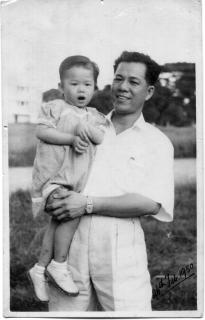
My father was also quite strong physically. He often rode a bicycle and carried water from our well. He was quite a good swimmer too. The photo below is taken in 1948 at a place known as the Tiger Swimming Pool. I heard that it was located next to the sea near to the Haw Par Villa. The kid in the photo was my present eldest brother Chun Chew.

My father was also active in community service. He held the post of vice-president of the Naval Base’s trade union. He worked for many years at the Naval Base in Sembawang as a senior clerk and was retrenched at about age 50 when the British forces withdrew from Singapore. He was also involved in the early years of the NTUC (National Trade Union Congress) labour movement. He was also a member of the Serangoon Gardens Citizens Consultative Committee for a number of years. In fact, I recently met an 80 year old gentleman at the Lentor Residence who claimed to know my father from the days when he too was on the Serangoon Gardens CCC. He said my father was one of 2 representatives from our kampong in the SGCCC. I am confident that he remembered correctly because he was able to give the name of the other gentleman from our kampong. I will interview him one of these days for the full story.


Fortunately, after my father was retrenched in 1968, my eldest brother Chun Chew and my elder sister Pat had already completed their secondary four education and started to work and contribute to the family income.Thanks to their sacrifice, my elder brother David (no. 3) and I (no. 4) were able to get a university education.

I always felt that in addition to a Father's Day and a Mother's Day, we should have a Elder Sibling's Day. I suppose September 11 is as good a choice as any other.

Duty Honour Country

Two days ago, I wrote about the ongoing discussions about National Service and foreign talents at Mr Wang Bakes Good Karma: Rethinking NS - Part 1. I said that I was surprised that after 35 years, the resentment against NS has not changed much. I also said that I did not want to participate in the discussion because I sensed that the generation gap was too big.

Meantime, the discussion at Mr Wang’s site rages on. Last time I checked, there was a whopping 90 comments posted. This being such an important topic, close to the hearts of young Singaporeans, I think it is simply wrong for older Singaporeans like me, who have gone through the entire NS experience, not to share our thoughts. I hope some of the other ‘lau pengs’ like Chris, Victor, Frannxis and Peter will say something too.

Firstly, I want to tell these young men I understand your feelings of resentment, frustration and even sense of betrayal. When I was in the university, surrounded by Malaysians, I felt exactly the same. While my friends were charging up Peng Kang Hill, feeding the mosquitoes in the jungles of Mandai, and going through all the extra drills and change parades, these guys were enjoying the privileges that have been provided through our parents’ hard work and sacrifice. Before long, they will graduate and take away our choicest jobs, and when we finally join the working world, they will become our bosses. Plus they are taking away our girls too! (which was why I decided to take back one of theirs by marrying a Malaysian girl .. .. Haha .. just kidding lah). So criticizing our government was a favourite past time in those days; and the situation was not helped by the presence of some very persuasive and eloquent student activists like Tan Wah Piow. But strangely, I felt very angry when I hear my Malaysian friends criticize our government.

But that was 35 years ago. I thought that things would have changed by now. Today’s NS enlistees are children of first generation NS men themselves. How come so many of them still do not accept NS? How come there is still all this foolish talk about engaging foreigners to defend our country? Maybe there is a weakness in our national education. But to be honest, I think the problem lies with the parents. I think we fathers have the duty to explain to our sons the meaning of NS. Maybe we should all follow the example of Yue Fei’s mother and tattoo the words Duty, Honour, Country on the backs of our sons, because this is what the whole issue is all about.

It has nothing to do with the foreign talents, or the shabby way in which our government appears to be treating us, while pandering to the foreigners. It has to do with the relationship between you and your country. Yes, you may feel angry that our government has cheapened this country by making Singapore citizenship so easily available to foreigners who do not share the same love you have for it; but it is still your country. You were born here, you grew up here, your girl friends live here and your parents will grow old and die here.

So first ask yourself this question. Is Singapore your country?


If it is, then whose duty is it to defend Singapore?

Finally, do you love your country? If you do, then it is not an obligation, or a ‘necessary evil’, but an honour to defend it. Somebody has to defend it; if not you, who? And that involves sacrifice. It has to cost you something doesn’t it?

And how can you defend it if you are not trained? Do you think that with 3 months of NS without live bullets, like what our friends in Malaysia are doing, you can acquire sufficient skill to keep yourself alive during a war, let alone drive away attackers?

Let me end by sharing a story my pastor once told us. He was a medical doctor, and he had a Jewish friend who was a brilliant and very successful doctor in the United States. Once he met this Jewish doctor at an annual conference in New York. He told my pastor that he would not be attending the following year’s conference.

Why? Because he was migrating.

Where to? ……Israel.


My NS Stories

A Jog Down Memory Lane
What Melvyn Missed
The Dangers of NS
Pay Correct Sir
My Commanders
The Dangers of Kenging
I Remember Gillman Camp

Thursday, September 07, 2006

Discussion About NS

There's an interesting discussion going on about NS and foreign talents at Mr Wang Bakes Good Karma: Rethinking NS - Part 1

Strange that after 35 years, the issues are exactly the same. When I was balloted out and had my NS disrupted and joined the University of Spore in 1971, I was surrounded by mostly Malaysians in the U. (I was in the Engineering Faculty, and thus very few Spore girls). The kind of sentiments, resentment etc. were exactly the same as those expressed by many of Mr Wang's readers.

Reminds me of the words of a song, "Some things will never change, that's just the way it is."

Anyway, I did not participate in the discussion because I sense the generation gap is too big. Maybe some of you would like to go there join the discussion.