Every adult male Singaporean remembers that dreaded day. (No I am not blogging about weddings). I am referring of course to the day when we were called up for national service.
For me that day happened thirty-five-and-a-half years ago. A very long time ago indeed. But I remember clearly gathering at the CMPB (Central Manpower Base) in Dempsey Road, and boarding the three-tonner which brought us to this huge complex called SAFTI (Singapore Armed Forces Training Institute) in Pasir Laba Camp along Upper Jurong Road. My kampong friend by the name of Tor Koon (pronounced in Hokkien) was called up on the same day but he was posted to a different camp. His mother was crying as they said farewell. But my mum was not emotional. Maybe it was because my elder brother David had gone in the year before. He was posted to 6 SIR, or Tanjong Gul Camp in the farthest Western corner of Singapore. 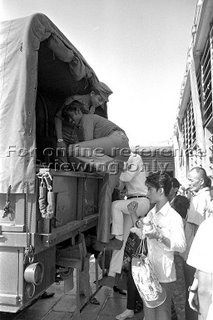
This is an old photo from the collection of the National Archives of Singapore showing fresh-faced 19-year olds being herded onto a 3-tonners, probably from CMPB in Dempsey Road, looked on by anxious parents. It reminds me of movies scenes of Jews being sent to their concentration camps in Nazi Germany
As a recruit in 1971, our pay was $90 a month. The army called it ‘allowance’. Since we toiled practically 7 days a week, this worked out to about $3 a day. Life of a recruit was tough. Practically anyone could ‘tekan’ (bash up) us; and training was tough. On days when the going was particularly bad, we used to lament; “kia ji sa kor pai tan’ (today’s $3 is hard to earn). Pay day for most people is a happy time. But for us lowly recruits, it can be a stressful time, fraught with dangers. We had to queue up in front of the company 2IC’s office and await our name to be called, then march up to the pay officer’s desk, ‘berhenti’ (halt) and salute sharply. For some, this simple process had to be repeated several times at the whim of those in charge. When the money was handed to us, we had to put out 2 hands to receive it smartly, check the amount and then salute and say; “Pay correct sir!” (Hey – shouldn’t that be “Allowance correct sir!”?) Some childish officers liked to trick us by deliberately keeping back one $10 note. Those who did not count properly became a source of more amusement for our 'dear' leaders.
(Just in case you didn’t get it the first time) Life of a recruit was tough. Practically anyone could ‘tekan’ us. From day one, we were taught this simple principle in the army. The screw travels in one direction only … downwards. Right at the bottom of the pile is the recruit. There is nothing else below except his bed.
We had a CSM (company sergeant major) by the name of Royston. Personally, I think he was sadistic. . His policy was “punish until drop”. On days, when he was on BSO (battalion orderly sergeant or something like that) duty, he looked particularly fearsome with his ‘walking stick’ and red sash. Us innocent, fresh out of school, 19-year olds learned the meaning of fear from this man.
Once my friend (I shall not reveal his name) was having lunch in the cookhouse when he was summoned by staff Royston. I do not know what big crime he committed, but when we returned to company lines after lunch we saw Royston still working on him until he threw up his lunch.
But I was quite lucky and never got into any serious trouble. Both my platoon and section commanders were reasonable gentleman. I shall blog about them another time. Minor brushes of course there were a few.
Once I was caught drinking Pepsi in my bunk during training hours. I was made to run around the parade square with my Pepsi bottle lifted up like an Olympic torch. When I ran past Juliet (I think that was Lee Hsien Loong’s company) and Kilo company, everyone cheered and clapped.

This is an old photo of the Safti parade square (from the collection of the National Archives of Singapore). The block in the background is the block of my company, Romeo Company, later renamed Lima Company. To the right, behind the troops, is the cookhouse.
Another occasion I was caught eating noodles in the bunk at night. Occasionally, when we got sick of the cookhouse food, we took a bus from Safti (now Pasir Laba Camp) to Tuas seafood village and ate the famous the fried prawn noodles (only 70 cents per packet if I remember correctly). Once someone ‘tar powed’ a packet for me and I was caught by a corporal who came around at night to do a spot check. He put my helmet on the floor and asked me to put one finger on it and then run in circles around it until I got giddy.
But the ones who suffered most, in my opinion were those who were physically unfit. Those days, they do not downgrade you from ‘combat’ vocation so easily. I had a section mate who was quite plump (for guys of our era) and I saw him suffer every time we went for runs and other types of physical training for the entire 6 months of our basic and section leaders training. I resolved that my son should not suffer this type of torture and so I encouraged him to take up sport. Thankfully, he is active in kayaking and so I have one worry less.
 I hope the person who discarded this dead cat into the canal did not get the idea from reading my blog.