Monday, March 13, 2006

Oldest Cat on the Blog

I notice that many Singapore bloggers liked to put up pictures of their cats ( Example). I too have some pictures of my family cat, Mimi. I dare not say she is the prettiest but I am pretty certain that she is the oldest; at least her photos are.

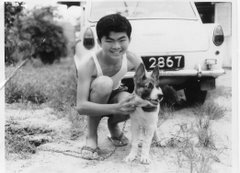
You see, Mimi was the our cat we kept back in the 1960’s to early 70’s when we lived in our kampong in Lorong Kinchir. I mentioned and showed a photo of her when I blogged about our kampong dogs during the Chinese New Year holidays (as part of the celebration of the Year of the Dog).


Mimi liked to sleep in warm places. One of her favourite places was on top of our television set. Often our visitors mistook her for a stuffed cat. One visitor got a shock she awoke and moved.

She also liked to sleep on our beds. No matter how much we tried to kick her off, she would climb back; until we gave up. Those days, some of our school buddies liked to visit and stay overnight in our kampong house. One night, my brother’s good friend, Raymond got a shock when Mimi jumped up and snuggled between his legs in the middle of the night.


Mimi was more fortunate than our last dog Barney. When we moved out of our kampong in 1974, we had to leave Barney behind in the care of our cousins. But we brought her along to our new HDB flat at Farrer Road.

Initially we had some problems with her and she kept defecating in our living room. But later, we managed to train her to do her business in the toilet floor; and on the grating cover too. Wasn’t she smart.

Unfortunately, when she became too old, we had to bring her to the vet’s to have her put down. But all in all, I would say she had a pretty good life for a kampong cat.

Friday, March 10, 2006

Toys Were Us (3): Kledek – By Chuck Hio

My friend, Chun See has labeled me a ‘weapons expert’. So today I will teach you a simple game that is somewhat less violent. It’s called kledek. 2 to 5 persons can play this game.

1. Draw 2 parallel lines on the ground at a distance of about 10 to 15 feet apart. One line is the starting point and the other is the target point.

2. Each player, get yourself a piece of flat, round stone of about 2 inches in diameter. Our time, we usually used broken cement.

3. Standing behind the start line, try to cast your stone as near to the target line as possible. The one nearest is the winner and the one furthest is the loser.

4. As a penalty, the loser must carry the winner piggy-back from the start line to the target line and back. The last will carry the first, the second last carries the second and so on.

5. Next the winner will throw one of his slippers to a distance of 10 to15 feet away, and challenges the loser to throw his slipper to hit the winner’s slipper.

6. If he accepts the challenge and succeeds, the ‘punishment’ is ended. If he misses, he has to carry the winner for another round and the same thing is repeated.

7. If the loser chooses not to accept the challenge, then the winner will throw his second slipper to try and hit the first slipper. If he succeeds, then the loser has to carry him for another round, and the same thing is repeated. If he misses, the ‘punishment’ ends.

For the girls who find piggy-ridding too unladylike, they can pull ears instead.

Wednesday, March 08, 2006

Toys Were Us (2): “Lastic” – By Chuck Hio

Hi, my name is Chuck. I am an old friend and business associate of Chun See's. Today I want to share with you (especially the younger ones) about a toy that I used to make and play with during my childhood days. Unfortunately, I don’t have Chun See’s skills in blogging. So I will ‘tumpang’ this article in his blog.

First a bit of background about myself. I was born in 1960 and grew up in a kampong that is located at the Hill View area off Upper Bukit Bukit Timah. Like Chun See, I have fond memories of the games and pastimes that we enjoyed as kampong kids. Those days, we kids have to design and make our own toys.

One of those toys is the catapult. We called it the ‘Lastic’. I will explain to you how we make the lastic but please just learn this for knowledge only; and do not go and make one and do naughty things with it. It can be turned into a pretty nasty weapon.


Step 1:

Select a good tree branch. Look for a tree branch that has a Y-shape. The 2 arms should be roughly of equal size. Chun See says he and his friends used to make their lastic from the Sendudok, or Singapore Rhododendron, but I prefer the Tembusu tree which was easily found in our kampong. The Tembusu wood is stiffer and stronger and thus provide a more sturdy frame.


Step 2

Trim of the excess materials but leave sufficient length of the arms to be tied together with a binding wire. Trim off the bark.


Step 3

Roast the branch over a fire for about 10 to 15 minutes to remove the sap. We usually placed the it over 2 bricks and build a fire with dry twigs.

Step 4

Untie the arms. You will find that the arms now will retain a beautiful curved Y-shape. Now we can trim off the excess lengths from the arms.

Step 5

Get 2 strips of rubber of about 8 to10 inches long to form the slings. We usually cut them from the inner tubes of bicycles.

Step 6

Cut a small rectangular piece of leather and make 2 slits at the ends.

Step 7

Tie one end of the rubber strip to the lastic arm and the other to the leather. Use rubber bands to fasten them.

Step 8

Repeat for the other arm and there you have your completed lastic.


What do we use the lastic for? We used it to shoot at toads, birds and fruits. For practice we shoot at lamp posts and tin cans. Chun See says he used his to shoot at his neighbour’s pigs which roam into their compound. For the ‘bullet’ we used small stones or pebbles. Sometimes we even use glass marbles, but it is a bit expensive.

I hope you have learnt something new today. Again, I want to stress. This catapult can be quite dangerous. Please do not make it.

Acknowledgement: My special thanks to the management of Cititech Industrial Building for permission to chop off one of the branches of their many Tembusu trees.

Saturday, March 04, 2006

Tragedy Lies in Waste

In his book Youngblood Hawke, Herman Wouk wrote these words:

Death is only a sadness.
Tragedy lies in waste.


Although he was referring to the death of a young man, I think his remark applies to some extent to all living things. Those of you who are nature or animal lovers will find what you are about to read a tragedy of no small proportions.

Ever since I took up brisk walking as an exercise, I have frequently walked past a huge piece of vacant land not far from my home. Can you guess where this place is by looking at the pictures below. (Hint: This area used to be heavily wooded. A narrow and winding road once ran through it)


A short stretch of the old road still remains, though not in use

A narrow winding side road used to link to this temple


Give up? It is called Old Holland Road. It joins Ulu Pandan Road to Upper Bukit Timah Road.

About 7 or 8 years ago, they cleared this huge swathe of land – apparently for a housing project – and since then it had been lying vacant. Every time I walk past this place, I feel a certain sadness because I am reminded of Mr Wouk’s words. I think of all the hundreds, maybe even thousands of trees and shrubs which provided a habitat for countless insects, birds, lizards, snakes and squirrels that have been needlessly destroyed.


I am also reminded of an animated movie called Watership Down . Anyone of you remember this rather sad movie? It was produced in the late 70’s. The story was about a family of rabbits which were forced to leave their homes because the field they lived in was being developed for a housing project. The movie’s theme song, Bright Eyes, sung by Art Garfuunkel was also one of my favourites.

But an even greater tragedy happened here slightly more than 20 years ago. I wonder how many of my readers remember the rape and murder of a Catholic Junior College student who was jogging along this lonely stretch of road. I believe this case has not been solved up to this day. Let’s pray that the long arm of the law will catch up with the wicked perpetrator of this evil deed some day.

He prayeth best, who loveth best
All things both great and small;
For the dear God who loveth us
He made and loveth all.
Samuel Taylor Coleridge, The Rhyme of the Ancient Mariner


Footnote: I hope none of this girl’s loved ones are reading this blog. In case they do, I apologize for stirring up sad memories.

Tuesday, February 28, 2006

Memories of Ford Factory


I read in the papers recently that the Ford Factory at Bukit Timah has been preserved as a national heritage site. Reading some of the blog articles about this place brought back memories of the 2 months of practical training I spent in Ford Factory as a university undergrad back in 1975.

There was another student with me but I cannot remember his name as he was from another department. At that time they built mostly the Ford Cortina and Ford Escort models plus some vans for the local market.

The Ford Escort was popular with Mindef and the Police Force


Although I can still remember most of the manufacturing processes, being an industrial engineer and all, I do not intend to bore you with those details. Instead I would like to blog about some of the very friendly and interesting people I met during my 2 months there.

The first person I remember is a small-built Malay man by the name of Mohammed who worked as a quality control inspector in charge of final inspection. Every morning, he would randomly select one of the completed vehicles and do a final inspection. I remember riding with him to test-drive the new cars at the deserted Lorong Sesuai that led up the Bt Batok hill just behind the factory. Watching him test the brakes and do figure-8 turns was great fun.


Lorong Sesuai today is part of the Bt Batok Nature Park

Another interesting character I met was an elderly gentleman who worked in the final assembly line. He was a funny and friendly guy. He was in charge of assembling the wheels and tyres to the car. He told us that at its peak, the factory used to assemble about 20 cars a day. That meant that he had to assemble 100 wheels a day; 5 per vehicle, including the spare tyre. But by the 1970’s, the motor car assembly industry was on the decline, and they only did about 4 or 5 vehicles a day.

One day, he taught us how to assemble the rubber tyre and inner tube (I suppose tubeless tyres were not in use then) to the tyre rim. This was a manual process which required considerable strength. First the steel rim is mounted on a fixture. Next the rubber tyre with inner tube is positioned over the rim. Then comes the difficult part of assembling the tyre into the rim. Nowadays, this is done effortlessly with the help of a machine, like the one in the picture here, which you can see in any tyre shop. But back then, you have to manually connect a steel arm to the fixture and rotate it manually to force the edges of the tyre into the rim. Although it looked so simple when he was doing it, my friend and I had to struggle like mad to do it. Some of the younger workers who witnessed us struggling with this task laughed at us. They were probably telling themselves, “Just look at these 2 wimpy book worms from the university.”

Then this elderly worker told them; “Don’t laugh. If you think it is so easy, why don’t you come and give it a try?” So the young workers took up the challenge. And to our pleasant surprise, they too had a tough time. After that incident, we became friends.

The reason I remember this incident so clearly is that I often quoted it when I conducted Ergonomics lectures at the National Productivity Board’s Industrial Engineering courses, when touching on the topic of designing work for older workers. Contrary to popular belief, physical strength is not the most serious obstacle for older workers. Their biggest problem was information processing.

I remember an amusing incident involving my new friends. One day, the elderly worker observed that, because my face and hands were quite ruddy, I must be a lucky fellow. They jokingly asked me for some 4D numbers. So I showed them my matriculation card. My matriculation number was 1075, I can still recall. Suddenly they got very excited. Apparently, this number came out first prize in the 4D lottery just the week before. “Why didn’t you give us earlier?” they said. Then they took down practically every number they could find on me, from my NRIC number, to my birth date and even the serial number on my watch. Unfortunately, none of these numbers turned out to be 'lucky'.

One weekend towards the end of my attachment, they brought me fishing at the Kranji River mouth area. We went to one of the guys’ kampong home at the Bukit Panjang area where we dug for earthworms. We caught several tilapias that day, but they tasted so horrible that even my cat Mimi did not want to eat them. I borrowed my family’s car for that occasion and fetched the elderly worker home after our fishing trip. When we reached his home at Stirling Road, he asked me if I would like to come up for a cup of coffee. He wanted to introduce me to her daughter!!! (who apparently was still schooling) I shyly declined. But I wonder how my life would have turned out if I had accepted his invitation for that cup of coffee.