Friday, September 29, 2006

Kampong Fruit Trees (Part 2)

After I moved out of our kampong, I stayed in an HDB (Housing & Development Board) apartment for about 12 years. Then in 1986, I moved to my present home, a terrace house in the Bukit Timah Sixth Avenue vicinity. One night it rained, and I realized that one of the things I missed most about living in a kampong was the sound of rain drops falling on the roof.

In my present house, we too have a guava tree in our backyard. But because we are too lazy to wrap plastic bags around the fruits (yes my kids did not inherit my tree climbing skills), they tended to be infested by insects. My neighbour also complained about the mealy bugs that made him itch. He liked to relax bare body in his backyard which faced ours.
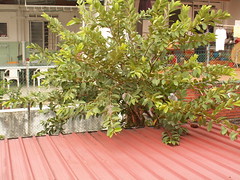
Guava tree
Photo of our guava tree taken from my bedroom window. Just a few months ago, we trimmed it bare.

That of course is the problem with land-scarce Singapore today. Even if you are fortunate enough to own a landed property, your home is likely to have very small compound; and if you wanted to plant fruit trees, you would not have much space left for other gardening activities. That was exactly what happened in my case.

One of the things that attracted me to my present house was this mango tree in the front garden, with huge fruits dangling at face level. For a several years, we enjoyed the huge tasty mangoes, which were so abundant that we used to give the extras to our relatives and friends. But about 5 years ago we had to chop it down because it grew too big and became quite impossible to maintain. Let me explain.
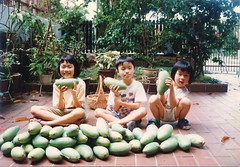
mangoes1

You see, for mangos, you have to spray pesticide when the tree is flowering. Otherwise, the insects will lay their eggs on the flowers and the insects will grow inside the fruit. So by the time you harvest the fruit, it may look very nice outside, but when you cut up the fruit, you will be startled by the crawling insects (weevil bugs) that emerge. Thus when our tree became too big, every time we sprayed pesticide on it, the wind would carry the poison into our neighbours’ homes. After a few seasons of harvesting fruits that were nice to look at but impossible to eat, we decided to chop it down.
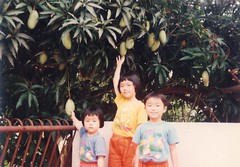
mangoes2

Our mango tree also attracted pests. I am not referring to the fruit bats, but the two legged kind. Often, we had taxi drivers who parked their vehicles outside our house and helped themselves to our fruits when my wife and I were at work. It’s very strange. Most of the fruits seemed to be found on the side facing the road. Maybe it’s the morning sun. We even had one filial man who came in his van one Sunday afternoon, equipped with poles and nets. I know he is filial because when I yelled at him from my balcony, he replied that his mother loved mangos. In the face of such unabashed filial piety, what could it do but desist. Anyway, I doubt he would believe me if I told him that, his mother was going to be treated to quite a sight when she cut open the fruits and see some crawling insects.
bananas1

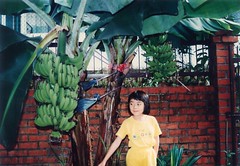
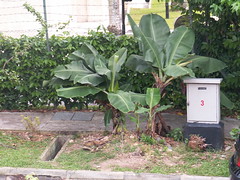
Banana tree
At first we planted these banana trees in our backyard. But as the kids got bigger and we ran out of space, we decided to plant them across the road from my house. The Bangladeshi workers from the nearby construction sites (all year round there are upgrading/renovation works in my neighbourhood) would certainly agree with our decision.

Wednesday, September 27, 2006

Kampong Fruit Trees (Part 1)

One reason why I enjoy driving in the countryside of Malaysia is that you can get to see a lot of fruit trees growing in the compounds of people’s homes. Recently, my family made a trip to Kukup, a fishing town on the South-Western tip of the state of Johor. It was rambutan season, and we saw many trees fruiting by the roadside. We also saw many roadside fruit stalls, and it reminded me of Singapore in the 50’s and 60’s.

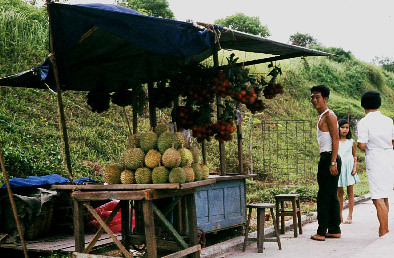
durian_stall_farrer_rd
A 1960's Photo of a roadside durian stall along Farrer Road, courtesy of Memories of Singapore

In our kampong, we used to have lots of fruit trees. Tree climbing was one of our favourite pastimes. Do you know which tree is best for climbing? The guava tree - because of it’s strong branches. We called the guava fruit ‘pak kia’ in Hokkien and ‘kai see kor’, (literally, chicken shit fruit) in Cantonese. We had 2 types of fruits; one with white and the other with pink flesh. The seeds of the guava fruit are extremely hard and indigestible. The result of eating them was that we tended to, as they put it so nicely in the army, ‘shit bricks’.

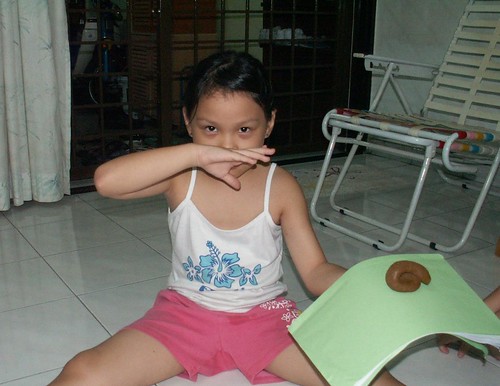
yunyi
My naughty niece with a piece of toy shit

My favourite fruit from the kampong days was the soursop. Our tree was very fruitful and produced huge fruits which were much bigger and tastier that those you can buy in the market today. Soursops are quite costly these days, and many fruit vendors do not like to stock them because they ripened very quickly, and cannot be stored for long. Talking of the soursop tree always reminds me of the fat, green caterpillars that tended to breed on it. I think they are from some kind of moth.


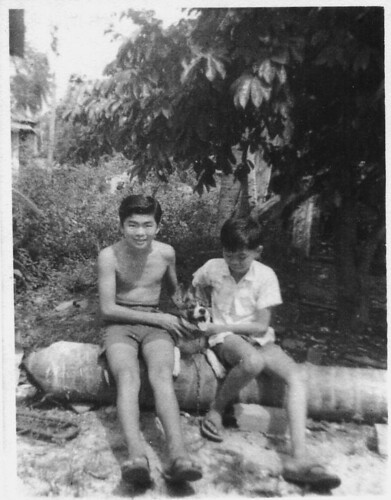
soursop_tree
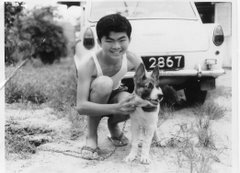
Me (left, aged about 14 or 15) and my brother James and our dog
Nappie sitting of a coconut tree trunk. Behind us is our soursop tree.

We too had a durian tree which I have already blogged about
here.

Of course we also had a few rambutan trees. I remember my mum brought three saplings all the way back by train from a visit to her relatives in Kuala Lumpur on one occasion. Apparently these were special and did not grow to be very large. I had a godmother in the kampong. In her house, they had a tree which produced yellow colour rambutans. Besides that they also had star fruits.

Another fascinating tree was the coconut tree which I have also blogged about
here. I recall climbing up a young coconut tree once. The young tree tended to be curved and quite easy to climb up. But climbing down was a totally different ball game; and I remember having a scary time doing that.

The coconut tree is also interesting because it had a huge root base. There was one occasion when we got people to chop down a full-grown coconut tree. To save money, we decided to dig up the tree stump ourselves. I remember what a tough job that was. All the 4 males in the family, except for my kid brother James, were involved, and I think it took us a whole day to complete the job. In the process, we saw many centipedes. Maybe that’s why the Hokkiens called the centipede ‘yar kang’. (yar as in coconut, kang – I don’t know what that means)

The husk of the coconut makes a very good fuel and can burn for a long time. My father taught me how to use it to produce burnt earth for our gardening purposes.

Apart from the above fruit trees, we also had pomeloes – small ones unlike those from Ipoh, Tambun. They had long, sharp, needle-like thorns. We also had water apples (in Cantonese we call sui yong) and of course, papayas.

…….. to be continued


Friday, September 22, 2006

Next Change: Kampong Fruit Trees

Older Singaporeans will be familiar with terms like Akan Datang and Next Change.

I have been busy with work lately so not much time to blog. But in order not to disappoint my regular readers, here's a preview of what's coming up next.


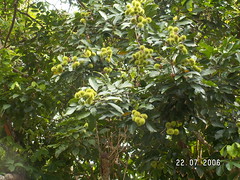
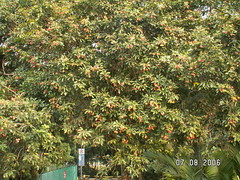
This photo of a rambutan tree was taken on 22 Jul 2006 at the MacRitchie Reservoir.

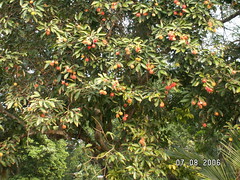
Rambutan Tree (2)

Here's a photo of the same tree about 2 weeks later on 07 Aug. when the fruits were beginning to ripen. Too bad, I have lost my tree climbing skills. Anyway, I don't want my picture to appear in the Straits Times for the wrong reasons.

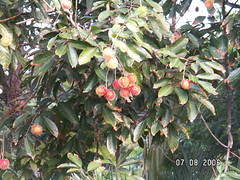
Rambutan Tree (4)

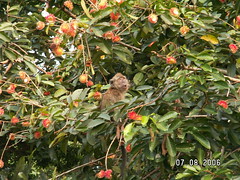
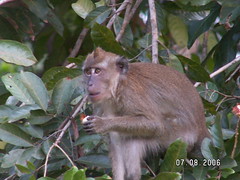
But do you notice that the fruits looked a bit strange? Some of them appear to have been peeled. Maybe someone beat me to them.

Rambutan Tree (5)

Rambutan Tree (6)

And here's the culprit. I bet my friend John Harper envies this chap.

Rambutan Tree (13)

Rambutan Tree (10)

Click on the photos to go to my Flickr site for more photos of this monkey.

Friday, September 15, 2006

Tribute to a Humble Profession

It was raining heavily this morning when I happened to see someone rush by outside my house. The poor chap must have forgotten his umbrella, I thought. Then I realized that the guy was actually a rubbish collector. He was removing the trash from the big plastic bins ahead of the rubbish truck. If you have seen these guys at work, you will know that it is a pretty tough job. Most of the time they had to rush because the truck may be holding up the traffic; and we know how impatient Singaporean drivers are. Furthermore, they have to be cheerful and friendly to us the customers.

Needless to say, this gentleman was not a Singaporean. Nowadays, no Singaporean would take on such a dirty and lowly job. Whilst so much resentment has been generated in the blogosphere about the foreign talents in our midst, I am sure many Singaporeans appreciate foreign workers like this rubbish collector who perform an essential service for our society.

This reminds of yet another lowly profession from my kampong days which has since become extinct in Singapore. Many years ago, I read of a survey about the ‘respectability’ of different professions. Right there at the bottom of the list was a profession known as The Night Soil Carrier. I wonder how many young Singaporeans even know what that is, let alone have seen one of them in action. So while others blog about Singaporeans’ favourite subject –
food, I will play the ‘contrarian’ role and write about something at the other end of the food train instead.

nightsoil1

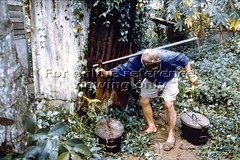
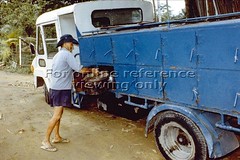
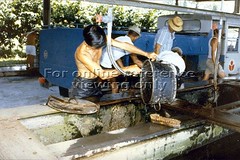
The night soil carrier is a man who collects human waste. Back in the days when many of us stayed in kampongs, the so-called Bucket System was the most modern and hygienic method of waste disposal available. In those days, the family toilet was usually built several metres to the rear of our homes, away from the public view, as well as to keep away the smell. Thus if you needed to answer nature’s call when it rained, you would need an umbrella. Each day, we would deposit our ‘stuff’ into a metal bucket and the next morning, the night soil truck would come around to pick up the buckets. The night soil carrier would bring along an empty bucket to replace the full one. He would then attach a metal cover to the old one and carry it, 2 at a time to the truck. The truck looked a bit like the armoured vans used by our banks today. It had several rows of ‘deposit boxes’ for the buckets. These were brought back to the sewerage centre where they were emptied of their contents and the buckets cleaned. And all this was done manually!

nightsoil2

nightsoil3
The above 3 photos are Property of National Archives of Singapore

According to the PUB
website, the bucket system was phased out in 1987. But actually, the bucket system was not the most primitive system. Even in my days, it was not uncommon to see what PUB calls ‘overhanging toilets’ built over fish ponds. (Photo on right taken by my friend Peh S K in Pulau Ubin). In fact if you go to Malaysia, you can still see these in some rural areas. I am sure many Singaporeans who have visited the fishing village of Kukup in Southern Johor and stayed at the holiday chalets there have experienced what it was like to ‘do your business’ directly into the sea.

And that reminds me of yet another interesting system which only our NS (national service) boys would have experienced – the Taiwanese army camp system. For those army boys like my friend Victor who missed out on this unique experience, I shall describe it below. Unfortunately I do not have any photos to illustrate.

Basically the toilets were made up of 2 rows of cubicles built over 2 long narrow drains over which you have to squat. The partitions were only about chest high, and so sometimes, when you and you neighbour happened to finish your missions at the same time, you would get bit of a shock to see another person face to face when you stood up. There were no individual flushes. Occasionally, somebody would turn on the tap and the water would flow from one end of the drain to the other. If you happen to be occupying the last cubicle, you would be treated to quite an unforgettable sight. I hope this is sufficient to motivate some of our reluctant young men to look forward to their NS.

It’s been about one year since I started this blog. Occasionally I find young people commenting that they wished they could be living in my kampong days. Frankly, I doubt they would want to do that if they fully appreciated the conditions that I have deliberately described in a nostalgic and light-hearted way.

Wednesday, September 13, 2006

More "Strange Fruits" - Chuck Hio

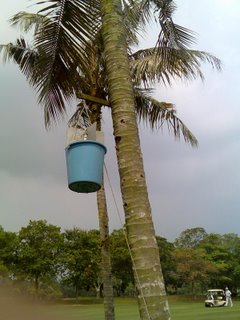
Last week, I brought some clients to the Ponderosa Golf and Country Club in JB and saw something very interesting. It reminded me of Chun See's earlier blog aboutthe Strange Fruits we saw at Braddell Road.

I wonder if there is any relationship between the two cases?