Wednesday, May 23, 2018

I remembered wrongly


Sigh … I realized that I made a mistake in the very first sentence of my book ☹.
I wrote in my Introduction that many years ago, I saw a Taiwanese movie by the title of; 一个平凡人的故事, or An Ordinary Man’s Story.

I think this is incorrect. That movie, whose title I still cannot recall, was about the struggles of a man who tried all his life to achieve something extraordinary. Finally, he realized that that was unrealistic and it only made him and those closest to him miserable (something to this effect). In the end, he wrote a book with that title I quoted.

I hope someone can confirm my recollections.

Saturday, May 19, 2018

Return to Blogging


Yesterday, I was invited to give a talk to a group of Secondary 1 students at NJC (National Junior College), my alma mater. They were attending a seminar on Place-Writing and learning how to write essays and poems about places they remember. Although I know nothing about writing poetry, that topic was covered by two professors who came after me. My task was simply to share my experience of writing about the places that I remember.

And so I shared with the children my experience in blogging about the Singapore that I grew up in. Due to time constraint, I focused mainly on the schools I went to (click on the label “schools” in the column on the right of this page); especially NJC, seeing that I was in the pioneer batch in 1969. Gave them some details of the old campus and shared about how we had to trudge across a big field, which is today’s Nanyang Girls School, and climb 103 steps to go for lunch at the Dunearn Secondary Technical School during the first few months when our own canteen was not ready. The irony is that the ground that DSTS stood on was the very same place that today’s NJC occupy.


1981 Map of NJC and vicinity

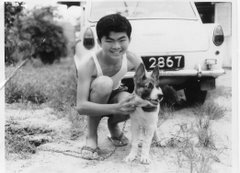
I also shared my fondest memories of my two years in NJC. Showed them some photos of our Adventure Camp in Pulau Tekong in April 1969. Not surprisingly, the photo which most intrigued them was this one of me standing in front of a tobacco farm.


I should apologize for neglecting this blog - which had given me my much satisfaction and even a bit of fame – for so long. I haven’t blogged regularly since I discovered Facebook in 2014. Anyway, I have decided that I would try to resume my blogging here, even if it’s on a less regular basis. So do keep tuned.

Friday, June 24, 2016

The Moon Between the Coconut Palms (by Edmund Arozoo)


Digital Photography has indeed simplified the task of producing quality images of the moon. The ability to mount my old 600 mm manual mirror lens to the body of my DSLR has allowed me to capture some good images indeed. However to push the challenge further I have for past few years been a keen “Moon transit” photographer i.e. capturing aircraft as they fly across the face of the moon.  I am fortunate that where I now live the Moon’s orbit and most of the commercial flight paths make it easy for me to set up my gear in my back balcony or backyard to achieve this. In addition there are many on-line apps that allow real time monitoring of flight paths. However this quest requires lots of patience and luck. Often there are long periods of waiting in-between flights. During these breaks I find myself staring at the moon and my mind wanders back to my kampong days in Singapore.  I start thinking of the significance the moon played then and the beliefs both religious and superstitious of the various races and groups of people in my kampong.

Copy of an old slide image taken in Jalan Hock Chye digitally post processed
One colourful memory that I always chuckle when I think about it is the ritual that my Chinese neighbours undertook during the eclipse of the moon.  I remember as a kid suddenly hearing the din of pots and pans being struck constantly. Even the large kerosene tins would be brought into play. Most of the Chinese households would be involved and I learnt that the belief was that a Dragon was swallowing the Moon and the noise created was to scare the dragon from completely removing the Moon from the sky. This ritual did go on regularly whenever there was an eclipse for most of my early years but as society became educated the practice faded away.

When I relate this to some of my friends a few remember this practice but others think I made it up.

The significance of the moon is central in Chinese culture. Most if not all festivals are tagged to the lunar calendar

Likewise the Indian celebrations are also pegged to their own lunar calendar. The two main ones Deepavali  which occurs  during the New moon of Ashvin (Hindu calendar) and  Thaipusam which  is celebrated during  the full moon day of the Tamil month of Thai

In the past the Malay Hari Raya dates were determined by the sighting of the new moon by local religious authorities. During those pre mobile phone years the method of relaying the successful sighting was by the use of carbide cannons. Carbide was mixed with water in the hollow of a bamboo cylinder and when the fuse was lit a small explosion took place and this could be heard for miles in the quiet of the evenings. When this was heard in a kampong one of the Malay families would then in turn fire a cannon and the message would then spread from kampong to kampong until the entire Malay community across the island would be informed to start celebrating the following day.

For the Eurasian and Christian households the main festival linked to the moon was Easter which is held on the first Sunday after the first full moon occurring on or after the vernal equinox. The other Holy days of Lent are adjusted accordingly. As kids when we were brought by our parents for the traditional “visitations of churches” on Maundy Thursday we often noticed the bright nearly full or full moon as we walked along the Queen Street / Victoria Street area. The significance of the moon was unknown to us or rather we were more focussed on the treats that we were rewarded with for being well behaved. Treats like freshly baked Hot Cross Buns from the two well-known bakeries around the vicinity “Ah Teng” and “The Red House Bakery”. The other treat would be the Kueh Putu Piring (or Kueh Tutu as it is now known as).

Similarly the dates of Ascension Thursday and Pentecost Sunday vary each year. The former celebrated forty days after Easter, and the latter ten days after the Ascension (50 after Easter).

When Armstrong landed on the moon in 1969, you can just imagine the reaction from the different families in the kampong. There was disbelief, taunting and scepticism.

The full or near-full moon was often a blessing if you came home late at night because it lighted your way home. There were no street lights in the lanes leading to our houses. With the moonlight we could avoid the portholes and on rainy days the resultant puddles that were ever so present.

However the moonlight also did cast numerous shadows from the trees and bushes. With movies like “Pontianak” on our minds combined with the fragrant scent of the newly blossomed frangipani flowers walking home usually turned into a quick paced trot.

I guess these days in Singapore, the Moon between coconut palms is only a recollection of some of the older generation. Moonlight between high-rise would be the norm.


Saturday, April 16, 2016

LESSONS FROM THE TUCK SHOP (SCHOOL CANTEEN) – by Edmund Arozoo

Greetings from Adelaide!

I started to write my memoirs of life in a kampong more than fifteen years ago but had put it on the back burner numerous times. However through Facebook I was fortunate to become friends with persons with similar interest in Singapore’s nostalgic past. On my visits back to Singapore I was privileged to meet and chat with two bloggers who have inspired me not only to contribute with posts and comments on fb but also rekindled my interest to finish what I had started. I like to extend a big THANK YOU to Jerome Lim and Lam Chun See. I also found Chun See’s book “Good Morning Yesterday” an inspiration. Here is a snippet that I penned recently that I like to share on their blogs. 

With Lam Chun See when I visited Spore in Dec 2013

For the past month or so I have been watching an interesting TV series – “The Brain”. This series from China showcases the unbelievable potential of the mental abilities of the contestants.  Witnessing their mental recall capabilities was jaw dropping for me!  Fast approaching seventy my memory recall does pale in comparison – only a slight fraction of theirs indeed.

Often I do question my memories of the “old days”.  I deliberately left out the adjective “good”. I acknowledge that life was simple but challenging then, especially for those of us from humble beginnings. Reading the many posts and comments on the various Facebook group pages, I realised that there are many out there who remember their own “rustic” years. However nostalgic emotions sometimes do tend to colour our memories. Maybe we were young and saw things through childhood innocence.

Perhaps too as kids we were protected by our parents, who in their little ways tried their best, as we were growing up, not to make us feel that we were poor.  I may be wrong but I also feel that the society then was different. I don’t recall being snubbed by “the rich”. Maybe we knew our places and accepted each other.  A leveller at that time if I recall correctly was the beach.  The rich would drive their cars right up to the beaches like Tanah Merah, Changi etc . The other families would arrive by bus with their home cook meals and simple unchilled drinks etc.  But all the kids would have the time of their lives till it was time to return home either by car or bus, all sunburnt.

Having spent twelve years in the same school I should have more vivid memories of my school days. But all I have are snippets here and there and a few photographs as reminders. But what I clearly remember is that the majority of my schoolmates came from similar “rustic” backgrounds. Personally I was taught not to feel sorry for the limited “pocket money” I took to school each day being often reminded that some of my classmates had to contend with so much less. Looking back I often chuckle when I recall that if you dropped your coins through the holes in your pocket that were caused by the marbles you carried – the response would be “tough”. You learnt the hard way to cherish the few coins you were given. When the time came for school fees to be paid, the notes were carefully wrapped in a knot tied at the corner of a handkerchief. This was to ensure we did not lose the money easily.

For sure there would have been more memorable moments of those carefree schooldays but I cannot recall as much as I would like to. However there is one incident that has always been dominant in my mind and I am reminded of it whenever I witness poverty either first hand or on TV.

This occurred while I was in primary school. It was a normal “recess” break and the “monitors” or prefects were diligently performing their duties to ensure order and that we were safe in getting our hot meals to the tables in the tuck shop / canteen.  We were all having our meals when suddenly there was a shout followed by a commotion.  Looking out we saw the prefects running out and chasing a student. They soon caught him and brought him back to the canteen. Then we realised what had happened.

The student was a classmate and his family, if I remember correctly, had a farm in Ponggol. On that day he did not have any money for a meal and probably did not even have breakfast at home. Unknown to us, this perhaps could have been the norm for him for most of his school days. But on that day the pangs of hunger overcame him and drove him to snatch a large triangular “curry puff” from the Indian stall that also sold bread, Indian cookies and of course our favourite “kachang puteh”.

As he was brought back to the canteen I witnessed the humiliation on his face and that expression I will never never forget! He was made to face the Indian stallholder probably to apologise and perhaps make arrangements for reimbursement for the curry puff. This was witnessed by everyone in the canteen.

What ensued always stands out from this unfortunate incident. I witness compassion. The Indian kachang puteh man, who possibly was by no means rich, looked at the poor unfortunate boy and saw the anguish on his face. Then in a typical Indian manner with a slanted twist of his head and a wave of his flat palm rolling at the wrist he signalled that it was okay – he did not want any payment and allowed the boy to keep the curry puff. The boy was then marched to the principal’s office and what happen after I cannot recall.
These are two striking lessons I learnt from this unfortunate incident that I will always remember.  Firstly how hunger can drive good persons to do things in desperation. I can understand when I read about people doing things they normally would not do, when they become desperate especially on seeing their children crying in hunger.

On the other side I also learnt that day that you do not have to be rich to be compassionate, understanding and benevolent. Perhaps this is in fact the essence of the “kampong spirit” that in our memories was prevalent in those days. I must confess that I often chuckle when I read of attempts to recreate this spirit which I feel was lost with the eradication of kampongs. It was the environment of the rustic surrounds and firsthand observation of the everyday struggles of most families that were the basis of this spontaneous compassion. Observing the elders of the household – our parents, grandparents etc. and their empathy for the neighbours perhaps also does flow down and shape our own behaviour towards others. In addition experiencing the kindness our neighbours extended to our own family completes the cycle of goodwill.


The whole world has changed and with the current abundance of affluence and affordability the plight of those in need are often not obvious. The average person cannot relate to this and thus perhaps the spontaneous responses that were around in the past are not forthcoming. These are my perceptions. I may be right or completely wrong so I will leave you, the reader to make your own judgement. In my heart I will always cherish the lessons I learnt in the tuck shop.

Monday, April 13, 2015

My Queenstown Heritage Trail – Dawson & Alexandra Tour


Last Saturday, I was invited to the Media Preview of the newly-launched Dawson + Alexandra Guided Tour. This tour is part of the My Queenstown Heritage Trail.


We assembled at the Queenstown MRT Station at 8.30am. I was happy to see several Foyers (Friends of Yesterday.sg) like Pei Yun, James Seah (Thimbuktu), Philip Chew and KL Lee. After the usual greetings/briefing by the organizers, Kwek Li Yong and Mr Jasper Tan of My Queenstown Community, we were divided into 2 groups led separately by volunteer guides, Mr Choo Lip Sin and Huang Eu Chai. We were each issued with a copy of the very well-produced My Queenstown Heritage Trail booklet which contained 67 pages of photographs and historical information about Queenstown. We were also handed a very cool gadget called Vox Radioguide. This device enabled us to listen to our guide’s explanation via normal earphones even when he was some distance away.


Briefly, the itinerary of our tour was as follows: (Due to time constraint, we did not cover all the places listed in the official flyer).

1) Church of the Good Shepherd at Dundee Rd

2) Former Forfar House at Strathmore Ave

3) Princess House at Alexandra Rd

4) Walk along Dawson Rd, Margaret Dr to Bunkers at Kay Siang Rd

5) Take coach to Tiong Ghee Temple at Stirling Rd

6) Butterfly Block (Blk 168)

7) Walk to Alexandra Hospital, passing the Alexandra Fire Station and Queensway Shopping Centre

8) Back to Queenstown MRT Station by coach.

Here’s my brief report on some of the more memorable places for me.

1) Queenstown Driving Centre.  Although this was not part of the tour, this place was highly visible from the MRT Station. It held special memory for me as I took my driving test here more that 40 years ago when I was still an undergraduate. I blogged about it here. I was quite sad to learn recently that this place will be demolished soon to make way for yet another condo.


2) Former Forfar House.  Actually, I am not familiar with this place or its history, although the name Forfar House was quite well-known in the old days. I came to know about it from a book titled, From the Blue Windows, written by a former resident, Tan Kok Yang, who I met at the My Queenstown Symposium held at the Queenstown CC on 26 May 2013.

3) Princess House. Our next stop was the Princess House. This building is a prominent landmark along Alexandra Road. It was gazetted for conservation in 2007. Besides the information given by our guide, my friend Philip Chew also shared some of his memories from the early 1970s when he worked at the Ministry of Environment which was housed here. He also told us about the nearby Consumer Co-operative Club.


4) World War 2 Bunkers at Kay Siang Road. The next event on the itinerary was to see two World War II bunkers at Kay Siang Road. They were hidden amongst the thick vegetation just next to the former Hua Yi Secondary School. To get here, we had to walk along Dawson Rd and parts of Margaret Drive and Kay Siang Rd. It was sad for me to see that Margaret Rd has been changed beyond recognition. It has recently been realigned to join Kay Siang Rd. Previously these two roads were not linked as you can see from the 1981 map below.


I was also saddened to see that the Hua Yi School had been completely demolished although we could still see remnants of the school field and running track. I had driven pass this place many times, and had often wanted to stop and take some photos. But as usual, I kept procrastinating, and now the opportunity is lost forever.

It was interesting to note that there are still some black and white bungalows along Kay Siang Rd although they are not visible from the main road. By the way, mention of Kay Siang Rd always brings to mind my first visit to the MOE (Ministry of Education) in 1968 to obtain the application forms to enrol in the Singapore’s first junior college, NJC, which opened its door in 1969.


This does not look like a bunker to me. I suspect it’s an ammo dump; probably to service the nearby Buller  Camp. Buller Camp was built to house Japanese prisoners of war. It was located at Buller Terrace (see map)

5) Tiong Ghee Temple. Our next destination was the Tiong Ghee Temple nestled among old HDB flats at the top of Stirling Road. Did you know that this used to be a hill known as Hong Lim Hill because the land originally belonged to philanthropist, Cheang Hong Lim?  We met two elderly former residents who shared their memories of life in this part of Singapore. As expected, this used to be a kampong known as Boh Beh Kang. Across the road were Singapore’s first point block flats.

6) Butterfly Block. A stone’s throw away was the famous Butterfly Block of Queenstown. This is Block 168, which is easily seen from Queensway, a road I have travelled frequently for decades. Here we met Mr Fernandez who had been living here for 45 years. I was happy to hear him confirm my memories about the Rumah Bomba Circus which lay at the junction of Queensway and Alexandra Road. I remember going to having my haircut at a road barber shop which was located at the edge of this roundabout. We also shared fond memories of the attractions at Queensway Shopping Centre, especially Jumbo Coffee House. I too have blogged about Queensway Shopping Centre here.

Butterfly Block at Stirling View

With Mr Fernandez - resident of Butterfly Block
7) Alexandra Hospital. We proceeded on foot to our final destination -  Alexandra Hospital. On the way, we passed the busy traffic junction where the Rumah Bomba Circus used to stand. Of the four landmarks that surrounded this junction, Alexandra Village, Safra Clubhouse, Archipelago Brewery Company (which I used to know as Anchor Brewery) and Queensway Shopping Centre, only the last one was still standing. It will be a sad day indeed, when the bulldozers come along and do what they are so good doing in ever-changing Singapore – tear down memories of the Singapore we grew up in.


At Alexandra Hospital, which was originally known as the British Military Hospital, our guide gave a lengthy explanation of history and events that took place in that area during the war; such as the massacre of British troops by the invading Japanese army. I was happy to see that many of the old buildings have remained untouched externally; but my attention was drawn to what lay across the fence; an open piece of land that used to be home to several blocks of SIT flats. This was Queen’s Crescent. During my NS days, I used to date a girl who lived here.


I have enjoyed this tour very much. I thank My Community for organising this tour and advise our who are interested in Queenstown to sign up of this and other tours in the My Queenstown Heritage  Trail series.