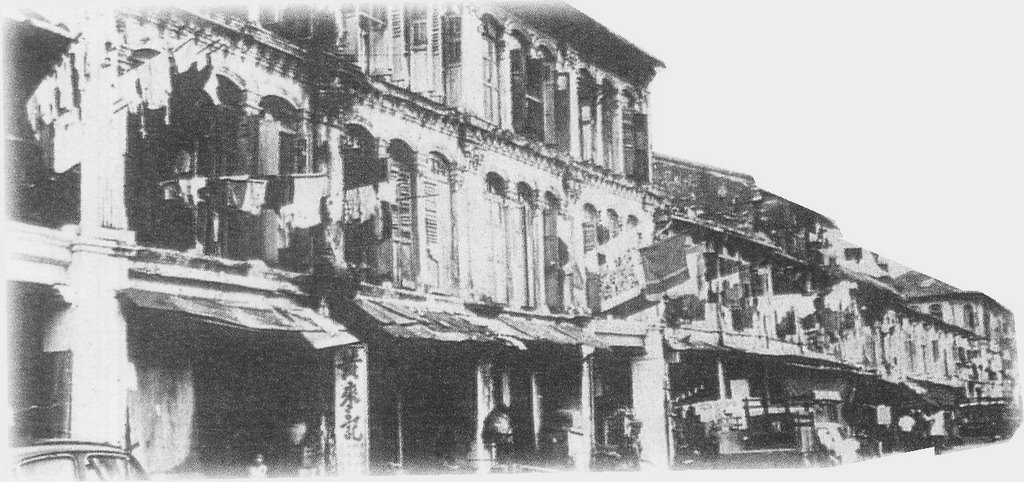
Hi folks, I like to talk about the lane which flanks between Sago Street and Smith Street. That is where my childhood home in Chinatown was and that was also my playground for several years until my late father decided to shift out of Chinatown. Certainly there were many memories and each comes with diverse flavour on its own.
I am just thinking here. Since there are so many heartlanders each sharing his experiences and observations on Chinatown whose square area does not span beyond 4 square miles geographically, I like to take my subject title with a different flavour. I like to talk about the intangibles. I like to touch upon the sound and the atmosphere when each of the events that took place.
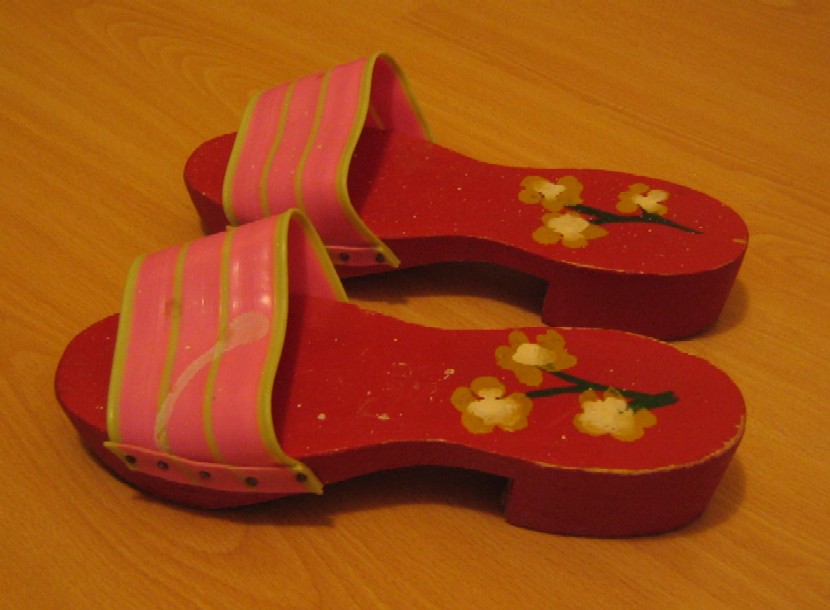
For example, some of us may have seen the wooden slippers (or clog) or ‘cha-kia’ in Hokkien. Do you know that back in the 50s (i.e. my time) most of the women wore this type of woo
 den slippers….and what you often heard on the street is the ‘tic-tac-tic-tac…tic’ sound. The Japanese rubber slippers were just gaining popularity then and I had a pair of rubber slippers apart from the regular pair of ‘chak-kia’. I wish I have a recording of such sound …..But you can imagine what it would have been like anyway. Walking about with a pair of such ‘cha-kia’ on the tarmac and imagine that there are more than 20 people walking about with the same type of footwear…boy! That is what it was like on the streets in Chinatown…..not missing out the loud hailers blasting through the mini van where the various retailers were pushing their sales….
It was a different atmosphere all together especially in the late of the night (almost mid-night) when the noise level had died down and less people walking on the street below (the lane I was talking about) What you heard was the ‘tic-tac-tic-tac’ sound. But what that I reminisce most was the call of the laksa man who would show up usually after 11 o’clock with 2 loads of stuffs – one side was the earthen pot of laksa gravy with a charcoal stove and other side of the tilt was the case where he kept his ingredients and serving utensils….He was a man in his 40s (may be)?
Dressed in the traditional coolie attire and possibly a hat (that was all I could remember). I wish I had a picture of how he looked like then. You know, back in those days not many people who lived in Chinatown could afford a camera, and the only best things our parents could do was to send us to the photo salon to catch a few shots together.
People who knew of his arrival at that expected hour would crowd around him for a nice bowl of laksa and his blachan (sampal chilli paste) was the best in those days! Till today I do not think I would be able to find another laksa recipe that is better than this laksa supper man.
The nightly 11 o’clock atmosphere was also unique in another sense. Rediffusion was popular then and it was through the rediffusion that I got acquainted to Li Da Sar [李大 傻 ] story time on the now famous martial art classics like [ 神雕侠侣,射雕英雄传,天龙八部 等等]。
Listening to the Rediffusion was our only past time. That was before the television was introduced to Singapore. The nightly 11 hour was the time when the ghostly stories would be broadcasted. A few times, my mother would despatch me to go to Smith Street to pick up some supper for her and inadvertently, I got to share the fruits of my hard work too…Why hard work? I had to brave the loneliness of walking to Smith Street (now where the Chinatown complex is) to buy a pack of white-cook chicken drumstick. The store I used to buy from was known [亨记 ] If I could recall distinctly a white cook chicken drum-stick was less than a dollar, like 30 cents. My Mum would enjoy her chicken meat with a sip of the wincarnis [ 文加宜红酒 ] as I shared in my previous episode we were sharing the same room together with the rest of my family and my father was always fast asleep by then. My next room neighbour tenant lady nicknamed [大声婆 ] would join in with my Mum and myself and her son (also my contemporary play mate) [亚辉 ] in listening to the ghost story broadcasted by Rediffusion.
In some way I took delight during that moment of just 60 minutes…..when I could relax with some supper and getting the thrill of excitement and in the company of familiar people.
There were few occasions I remembered that I had to run as fast as I could after buying the nightly supper, along the Smith Street shop houses corridor. The term for that kind of corridor is five-foot way [五卡基 ]。This term was derived from amongst the early Chinese who came to South East Asia and coined the name from the Malay term, kaki meaning foot.
That part of the Smith Street is now as busy as before in the evenings when train of food stalls are flooding the road with hoards of patrons enjoying the individual stall’s culinary delight. The street looked short and narrow to me unlike those days in the late 50s when every thing looks tall and huge.
On that lane where I grew up with, there were embarrassing moments too in reminiscent of it all. As described in the 1st episode there was only one toilet facility to serve the 12 families. One can imagine that when there are more than one person who is urgent for it, tough luck! To tackle nature’s call, I often found myself doing it at the side of the lane, right into the drain in the night! To me, quite frankly, it was an experience and somewhat an adventure! Mind you there were no street lights in that lane which is no more than 70 metres?


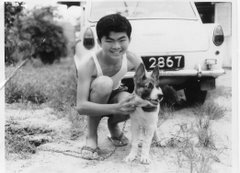
 Our last dog was called Barney. I cannot remember how he got this name. This was around the late sixties when we bought a new Minolta camera. So we had many pictures of him. Unfortunately, we had to leave him to the care of our cousins, the Ngs when we shifted to our new 5-room HDB flat in Farrer Road in 1974