Sunday, December 04, 2005

Accidents

Cuts, bruises, falls, bee stings and scalds were quite common place when we were kids. Today, I would like to share about some of the not so pleasant stuff that happened to us as kids - accidents. I want to issue a warning though. Many of the things that we did in the name of fun were downright stupid. To the kids out there: DON’T EVER TRY THIS; AT HOME OR ANYWHERE ELSE!

The most common injuries were stepping on broken glass bottles. Apparently, there were quite a lot of broken bottles lying around. How they got there I have no idea. Kampong kids our time liked to run around bare-footed. So it was inevitable that we occasionally stepped on broken glass (as well as pig dung which was also in plentiful supply because we had a neighbour who reared pigs and let them roam around). When that happens, of course our mother would do the bandaging using gauze and iodine. Sometimes, she would grind a white tablet called ‘luk-kou-sum’ in Cantonese or 693, into a powder to apply to the wound together with yellow lotion. But I believe it was a kind of anti-bacterial medicine.

Occasionally we also stepped on thumb tacks when we walked around the house barefooted. How on earth could thumb tacks be lying around so that kids can step on them, you may wonder. Truth is; I am not sure. What I am sure about is the pain that it caused. My own suspicion is that, it had to do with the rugs that we used to cover the wooden floors in the house, and these were held down by thumb tacks.

We also had a couple of pretty serious accidents. Regrettably they all seemed to happen to my younger brother Chun Meng. There was this one occasion when my older brother Chun Seong and I were playing with an empty condensed milk can. I don’t know what got into our heads to play such a stupid game. We were tossing it back and forth when Meng happened to get into the line of fire. He suffered a nasty cut on head. The culprit who threw the can was not me.

An even more serious accident happened to him when Seong and I played with spears which we made from the spine of attap leaves. We sharpened one end and hurled them at pile of freshly plucked coconuts. If you look at the photographs that I posted in the earlier article on Our Kampong, you would have seen that there were lots of coconut trees in our kampong. Many of them actually belonged to us. Once or twice a year, buyers will come around with sharp scythes tied to long bamboo poles to harvest the coconuts. It really was an amazing sight. We liked to watch if the coconuts would fall the workers’ heads. The plucked coconuts were then stacked into a tidy pile of maybe a couple of hundred to await other workers to come and de-husk them.


This was another interesting process. It’s a bit hard to describe but I try. Basically, they embed a huge knife in the ground with the blade pointing upwards to about the groin height. The workers, wearing leather aprons will then slam a coconut into the blade and push the coconut downward and forward with both hands to remove the husk in one swift motion. This they repeated swiftly and with great skill until all the husk is removed. Subsequently a lorry will arrive to load up the de-husked coconuts. One guy is stationed on top of the lorry while his partner will toss the coconuts 2 at a time up to him, which he caught with practised ease. We kaypoh kids would stand around to help in the counting to make sure that we did not get cheated. Then they would pay our parents and drive off.

So there we were, Seong and I, throwing our sharp spears at the pile of freshly plucked coconuts, and our younger brother Meng was happily seated on top of the pile. Unfortunately, my elder brother’s aim was not so good (remember the tin can?) and his spear hit Meng on the left thigh. We will never forget the sight of the spear dangling from the poor kid’s thigh. Nowadays, we occasionally joke that if the spear had landed a couple of inches higher, today we would have 1 niece and 1 nephew less.

Another accident that took place at our house happened to our cousin Chee Keong. The guy was climbing up our guava tree to pluck guavas. Lost his footing and had a nasty fall. We learned a couple of lessons from his misfortune. One, we learned the meaning of the ‘chim’ word “dislocation” because he suffered a dislocated shoulder (or was it elbow?). We also learned what a cast looked like when he returned from hospital. Anyway, that accident did not prevent him from getting an econs degree and subsequently rising to become a top dog at PSA.

Finally let me tell you about the time my brother Chun Seong stepped on a rusty nail. One night, we decided to sneak out of the house, he and I, to follow some of the other kampong boys to catch crickets at a deserted house nearby. It was very dark, and we had to use torch lights to hunt for the insects. Suddenly he gave a yell, and on examination, we found that he had stepped on a rusty nail which penetrated right through his rubber slippers. We were in a dilemma because we did not dare to tell my mother for fear of getting a thrashing. Fortunately, there was a budding doctor in our midst. He told us to use the slippers to slap the sole of the foot to dissipate the ‘poison’; and then to bandage the wound with ‘ti tan heok’ or iron-nail leaves in Hokkien. I believe the correct name for the plant is (落地生根), you know the type where, if you toss a leaf to the ground, days later, many small plants will grow from the edge of the leaf. I don’t know which hospital the kid is now practicing in, but his treatment apparently worked, and today, my brother Chun Seong is happily enjoying his retirement in that beautiful country down under.

There were many other accidents here and there and most of us have the scars to prove it; but I have only selected a few of the most dramatic ones for mention here. Maybe my brothers, on reading this blog may be able to add some more details.


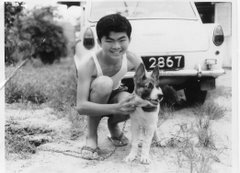
My brother Meng who suffered because of our stupidity with me
(holding the Kodak Brownie camera case)


My brother Seong, who can’t aim straight trying to light a fire-cracker. Behind him is our durian tree.

Tuesday, November 29, 2005

About My Photos

Ever since Ivan Chew submitted this blog to Tomorrow.sg, I have received many visits from young Singaporeans. I am truly heartened and encouraged by their kind remarks. I particularly love this one by yl; “wahhhhhh!!!!!!! Uncle!! YOU ROCK!!!!”

I think I need to explain a bit about the photos you see in this blog. You will notice that many of the old black and white photos had people posing (cham - my daughter is going to call me a ‘poser’). Please don’t think that people of our generation are so vain. It’s just that camera films those days were quite expensive; and thus it would be considered a waste if we took pictures only of scenery or buildings. It was thus customary to pose with the scenery as background.

Let me tell you a bit about the cameras we used those days. The earlier pictures were taken with our first camera - a Kodak Brownie. It was an ‘auto-focus’ camera, meaning you don’t need to focus - because there was no ‘focus’ function! It had small circular window behind for you to read the number of the photo you are taking. After taking 1 picture, you have to wind the film slowly till the next number appears in the window. Now if you forgot to do this, then the next picture you take will go on top of the previous one, and you have wasted 1 valuable photo plus whatever you took earlier is lost.


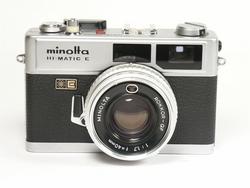
Our second camera was a Minolta Hi-matic. We bought it around 1969 (not 1967 as I said earlier). It of course had more features like focus, aperture etc. This time, to advance the film, you need to push a lever. But if you forgot to do it, there is an ‘idiot-proof’ mechanism that prevents you from taking the next picture. Interesting eh?


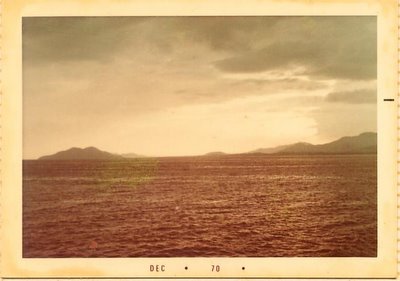
The photo below is my first colour photo. It was taken around end-1970 just after my HSC (A-levels) exams. I went on a tour to Malaysia with my parents and my elder sister. We brought along 1 roll of colour film. During the ferry ride across to Penang, we came across this beautiful scene of the setting sun and we decided that it was time to use our precious roll of colour film.

An interesting thing happened in Penang. At the hotel we stayed in, there was a stir in the evening around dinner time. It turned out that an up-and-coming teenage a-go-go star was also staying (or performing) at the hotel. Some of the girls in our tour group got very excited and wanted her autograph. Can you guess the name of the singer? Answer - Nancy Seet.


Today we are in the digital age. I am proud to say that this ‘uncle’ is quite familiar with digital photography. I was probably one of the earliest 'ah laus' to invest in a digital camera. My first digital camera was an Epson which cost about $700+. It didn’t come with an LCD screen, so I paid extra for an attachment; which was a mistake because I never got to use it. The reason was, the 4 pieces of AA batteries get used up so quickly, it was not practical to use the LCD screen; plus it was a bit clumsy to have a separate attachment. I have also learnt how to take and edit my own digital videos. I did all these not because I am a camera buff, but because my job as a consultant and trainer requires it. Actually I quite enjoy learning all these cool gadgets – only problem is people our age learn such things very slowly.

Sunday, November 27, 2005

往事只能回味

Hey! How come nobody could identify the singer of this song? Anyway, the singer was 尤雅. I believe she was popular in the early seventies.

My favorite Chinese singers from that era were 青山and 姚蘇蓉.


My favorite 青山song was 唯一爱的人. At one time, we had an EP (45 rpm record) with this song on 1 side. Not long ago, I came across a CD with this song in Rochore Centre. Cost only a few bucks.


My favorite姚蘇蓉song was 不得了. I once heard it being performed live by the famous ‘Laurel and Hardy of Singapore’, Wang Sa and Yeh Fong at a theatre located at the present Mustaffa Centre. I think it was called President Theatre. It was so hilarious we (as they say in Hokkien) ‘laughed until stomachache’.

At that show, a famous Taiwanese singer by the name of Chang Ti also performed. This guy could improvise the lyrics of any song given to him.


Actually, now that the brains start racking, there is another 姚蘇蓉 song that I liked very much. It's called 秋水伊人.The lyrics are very touching. So all you young people out there. I presume you have not heard this song before. I give you the opening lines and you try to guess what this song is all about.

望穿秋水,不见伊人的倩影, 更残漏尽,孤雁两三声; 往日的温情,只换得眼前的凄情.

Friday, November 18, 2005

More About Sago Street - Chu Chun Sing


(A)

These windows used to share the same room…was a large room indeed! Used to be occupied by [散 仔 ] - i.e. men who were odd jobbers and shared the monthly rental .. to cut cost. My grandmother was the rent collector /in-charge rather. They used to call her [包租婆]

(B)

This lane which links Smith street to Sago Street, holds many, many memories; and is witness to numerous incidents and events.

Wednesday, November 16, 2005

On The Street Where Chun Sing Lived

My friend Chun Sing's description of life in Sago Street and Sago Lane is so interesting, I could not resist going down there this afternoon to take a look. Good thing I am self-employed and so no worry of being scolded for taking a 2-hour lunch break. Besides taking some pictures of the area, I also helped myself to a nice bowl of beef noodle from the Chinatown hawker centre.

View of Sago Street from the hawker centre end


This is house no. 6


Can you spot Sago Lane? Looks like the Street of the Dead has become a dead street. But it also appears that the govt is trying to resurrect it.