Sunday, September 13, 2009

Edward Williams remembers Sembawang Hills Estate Part 4

Freddy Neo wrote that during the period 1958-1970 about 25% of the houses in Sembawang Hills Estate were rented out to British servicemen and their families. I don’t think his family’s experiences with their British neighbour were typical of the social relationship between the British and the locals. From my observation, most of the British families kept to themselves. I cannot recall any social interaction between them and the locals in the estate. I think Freddy was fortunate to have a neighbour who is keen to socialise with the locals.

It was true that the British families were quite intolerant of us during our Chinese New Year celebrations. At the stroke of midnight we used to let off firecrackers to herald the advent of the New Year. One family in our street would set off between 20 to 30 rows of fire crackers, so the noise would go on for about 45 minutes. This was obviously a very expensive extravaganza. We were told that the man of the house was a very superstitious person (and, of course, rich as well). So what were the typical reactions from the British families? They always rang the police to complain. The patrol car would come and go. There was nothing the police could do – after all it was Chinese New Year and firing crackers were one of the many ways we celebrated the event.

I remember a few noisy parties hosted by the British families. They carried on way past midnight, singing and yelling loudly in an intoxicated state, in the garden (outside the house). Yet none of the locals in our street would complain to the authorities. I don’t think this was because we were more tolerant. This could be partly explained by the hangover from the colonial days when the British were our masters.

The English seemed to like our hot weather. I have seen the women lying on the front lawn in their bikinis, reading a book, under the hot sun. Sometimes they had their tops off, but lying on their front and facing towards the front of the house, so the locals could only see their bare backs. At least they were sensitive to our feelings about nudity (or partial nudity) in public.

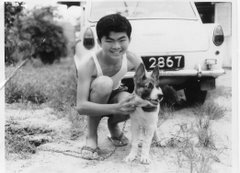
One English man who lived alone in Jalan Lanjut would create a scene every evening when he returned home drunk. You could hear him from a distance as he walked down Jalan Chengam, calling out loudly. The commotion caused all the dogs in the nearby homes to bark. As he approached his house, his dog would dash out to greet him. It was an amusing scene, to watch him sitting on the pavement with his dog licking all over his face. That’d always give us a good laugh.

We had the same experience at the provision shop as Freddy’s maternal grandmother. This shop, located at or near the corner of Jalan Leban and Jalan Kuras, catered mostly to the British families and treated the locals with some disdain. I think both of us remember the name of this shop, but we’re discreet enough not to publish it.

It’s true that many of the British families had servants to do the domestic work in the house. Even some of the locals also had live-in servants. I realise we used the term “servant” in the old days, but I still find it somewhat derogatory. I’d have preferred “domestic hand”. Many o f the local homes had their laundry done by a woman from the village. An old lady called “Ah Sim” used to come in every morning (except on weekends) to wash our clothes. I remember the brown jagged plank that Ah Sim would scrub our clothes on. She used 2 large basins, one of which had a continuous flow of water. Once the clothes were washed, they were hung on bamboo poles (tek koh) to dry.

The practise of collecting leftover food, vegetable peelings etc was not confined to the British families. My mother used to have a tin of leftovers hanging outside our gate. Someone from the village would collect it every evening. I am sure other locals did likewise. The collected stuff was fed to the pigs and poultry. Once or twice a year we received gifts of eggs from the villager as a thank-you response, which I thought was very nice and generous. Ah Sim also brought us Chinese cakes during festivities. As a Christian my mother would only accept the cakes that have not been offered to the gods in prayers. Ah Sim always made sure that the cakes she brought conformed to my mother’s wishes.

I must relate one almost-tragic incident that happened in the 60s. One afternoon, during a heavy downpour, an English woman was running down Jalan Chengam, screaming frantically. When it rained heavily, the monsoon drain was filled with a torrent of gushing water. Apparently her child was missing, or had fallen into the monsoon drain. I think she was following the flow of the water down the drain, towards the end of the street. At the point where Jalan Chengam meets Jalan Lanjut, both monsoon drains connect to a short tunnel which runs across the road and opens up at the other side of Jalan Lanjut, continuing towards Jalan Mengkudu. A Chinese woman came out of her house and looked at the drain where the tunnel began. I was there with one or two others, witnessing the whole spectacle under the pouring rain. The distraught English woman could only stand there helplessly, crying her heart out. At the entrance of the tunnel was a mesh of branches that must’ve been dumped in the drain by some locals. These had collected at the entrance of the tunnel. Tangled in this mesh of branches was a tiny English child, probably about 1 year old. The Chinese woman carefully waded in the drain towards the front of the tunnel and grabbed the child. The flow of the water in the drain was still quite strong. The child was handed over to the English woman, who was still sobbing uncontrollably. She was clearly engrossed by the shock of almost losing her child. She hugged the child and left immediately. The child had only suffered minor cuts and bruises.

How lucky it was that the entrance of the tunnel was blocked by a few branches. The branches could have been easily pushed into the tunnel and out towards the other end. Who knows what the fate of the child would be if this was the case.

I was told that the English woman returned in the evening to thank the Chinese woman who had braved the gushing water in the drain to retrieve her child. If my memory is correct, the drain would be at least 4 feet deep. The English woman would be about 70 today. That lucky boy would be in his late 40’s. We were all relieved that the outcome was a happy ending.

Lam Chun See continues …

If I may, I would like to make a comment regarding our relationships to our “servants”. I think generally the British families seem to treat their ‘amahs’ as they called them with more love and respect. I have come across many cases where British kids, now all grown up, tried so hard to reconnect with their amahs. A very good example is of how Lynn Copping she flew all the way to Singapore just to meet her long lost Amah.

Friday, September 11, 2009

Edward Williams remembers Sembawang Hills Estate Part 3

When we first moved into Sembawang Hills Estate in 1958, the newly built homes had the old style “squatting” toilet. It wasn’t until about 10 years later that we installed the modern toilet, which allowed users to be comfortably seated while “doing their business”.


The houses had no hot water system. I was told that today most homes in Singapore have a hot water system installed. To shower with warm water, we had to boil a kettle of hot water and pour it into a plastic pail of cold tap water. This mixture of warm water is then poured over your head with a cup or bowl. As kids, whenever we come home drenched by the rain, my mother always insisted that we immediately shower with warm water. If you are recovering from an illness, you’d probably prefer a warm shower too.

The middle of the house was not covered by the roof. It was an exposed, open top which allowed sunlight and ventilation through. In the event of rain, the top is covered by pulling a rope which dragged a sliding corrugated zinc panel into the “closed position”. In its “open position” the panel is allowed to slide backwards to the end, where it is now seated above the toilet and shower. We call this part of the house the “air well”.

A small drain ran through the “air well”. This drain is connected to a bigger drain outside the house. The exterior drain leads to a large monsoon drain along the boundary of the property. In the event of heavy rainfall, water could be seen gushing along the small drain in the “air well”. Occasionally, the drain overflowed and the floor of the “air well” is filled with rain water. However the surrounding areas (the hall, kitchen and rooms) were never flooded as they were elevated about 4 inches above the “air well” floor.

All the windows had grills on them as a safety feature. The front door of most houses had a door and a collapsible gate as well. Most of the terraced homes in the estate do not have space within their property for parking. The local residents parked their cars along the streets, outside their homes. The homes have either terrazzo or mosaic tiled floors. It is not uncommon for the hall and perhaps the kitchen to be tiled, while the rest of the house has plain cement floors.

Most homes had ceiling fans in the hall and in one or two rooms. I cannot remember any homes with air conditioning. I do recall a house that was "converted" into a barber salon which had air conditioning. This was in the early 60s. I think this salon was situated in Jalan Leban. I liked this place because it was so cool inside. As a kid this was probably the only place where I experienced air conditioning. There were 3 or 4 barber seats in the hall of this house which fronted as the parlour. I also liked the smell of the shaving cream. At the end of your haircut the barber would give you “cracks” or “slaps” on your back of your shoulder with clapsed palms. This was supposed to relax your shoulder muscles.

Related posts:


Tuesday, September 08, 2009

Edward Williams remembers Sembawang Hills Estate Part 2

Today many families buy their fresh food from supermarkets. In the 60’s we got our meat, fish and vegetables from Hum Min who lived in the village at the back of our estate. Each morning he’d push his 3-wheel cart along the estate selling not only fresh meat but also some preserved foodstuffs like tan chye or chye poh. Everything you purchased was wrapped in old newspaper. My mother loved to haggle with Hum Min over his prices. It was a friendly “battle” between vendor and customer each day. Hum Min also operated on a credit system – all transactions were noted in a small notebook and payments were made at the end of the month.

Early one morning Hum Min was robbed by 2 knife-wielding men on his way to the market to buy fresh supplies. He suffered some cuts on his hand – I can’t remember how serious his injury was. After this incident Hum Min “retired”. It was a sad end to many years of service to our estate. However Hum Min still had his shop in the village. Occasionally my mother would send me on errands to buy sugar, msg (bee cheng) or salt from his village store.

Hum Min’s business was taken over by another villager. The new vendor drove a van around the estate with his fresh supplies, stopping at street corners for his morning trade. You could say that this was progress in the high tech direction – from pushing a 3-wheel cart to driving a van. I still miss Hum Min and his push cart. As a kid I particularly enjoyed it when he bent over to push the door of the cart open, to bring out more food stuffs. The inside of his cart always held some mysterious connotations for me. I’d strain my eyes to peer into the dark interior, to see what treasures were in store.

We had other street vendors touring the estate too. The knife and scissors sharpener who’d call out loudly “Chin char koh ah boh kar tay” as he pushed his bicycle along. The cockle shell (chee hum) man with a big basket on his bicycle, who walked bare footed in spite of the hot bitumen road. The ice cream and lollies van, the otak man with his nonya cakes. Otak is grilled fish in coconut leaf. There was also an Indian who carried his cakes (e.g. pakoras) and spicy nuts on a circular tray balanced on his head. At night the mee goreng, satay and chestnut (kow luck) vendors paid us regular visits. The satay man lived in Old Upper Thomson Road. The mee goreng seller parked his cart on the street and knocked his wok with the frying spade to signal his presence. I always enjoyed watching them cook. In the early 60’s we even had a “fish and chips” van that toured the estate. This business was run by a family in Jalan Rukam. It didn’t last long though. It was probably geared towards the British servicemen and their families in the estate.

Related post: Itinerant food vendors of yesteryears

Friday, September 04, 2009

Gordon Sargent remembers Mowbray Camp

Recently I received a letter all the way from Bulwick, in the UK, from an ex-British serviceman by the name of Gordon Sargent. Gordon took the trouble to write out his letter the old-fashioned way in beautiful cursive handwriting. He shared with me about his time in Mowbray Camp in Ulu Pandan Road from way back in the 50’s. He even included photo copies of two photos.

So thanks to Gordon, you will be able to learn a bit about the history of one of the few remaining British army camps in Singapore. Thanks to contribution from Gordon and other readers, I shall be able to start a new series about old British Army camps in Singapore.

***************************************************

Dear Lam Chun See,


I discovered your photograph from your kampong days when I was doing a little research on Singapore. I spent 19 months at Mowbray Camp a little before your kampong days. I was stationed there from July 1957 to February 1959, so I left Singapore fifty years ago. Amazing where the time goes.

In 1957 the camp was called No. 3 AWDU (Army War Dog Unit). The name was changed some time in 1958 to No. 3 AGDU (Army Guard Dog Unit).
At that time the unit was the base of the Royal Army Veterinary Corps comprising around 150 officers and men with 80 to 100 dogs. Our job was to guard all the army supply bases on the island, including the base ammunition depot which was at Kranji area.

Please find enclosed photo copies of photographs of barrack block.

In 1957 when I arrived at the unit, there were 4 tents in front of the barrack block. We spent the first month in tents. The mosquitoes were hell! The 1957 photo shows 3 tents, so the one I was in had been removed and I had graduated to the barrack building.

I had not been able to establish who in in the camp at present but it is still recognizable on the Google Map.

I hope the enclosed is of interest and would like to hear from you. I am hoping to make a trip to Singapore before I get much older to see several sites I did not see whilst in service.

Yours sincerely,

Gordon Sargent

** Today this Mowbray Camp is known as the Police KINS (Key Installation Protection) Training Camp.

Akan Datang (Coming Soon): Reader Karunakaran shares about his time in the Army Depot Police.

Wednesday, September 02, 2009

Edward Williams remembers Sembawang Hills Estate and Upper Thomson Road

Edward is a new reader of Good Morning Yesterday. He recently posted some very detail descriptions of his memories of the Sembawang Hills Estate in the comments section of Freddy Neo’s article about this area. Since they are quite lengthy, I thought it would be more appropriate to post them here as a separate article.

**********************************

I lived in Sembawang Hills Estate for 2 decades. Like you (referring to Freddy Neo), my family shifted there in 1958. I remember Jalan Batai well – it is situated on the top of a hill, so you could go down a slope to get to Upper Thomson Road. Jalan Batai connects with Jalan Leban where a row of shops operated. One of them is Radiant Store, which sold shoes, comics and magazines. There was a bar at the corner called Sembawang Café, which was a popular hangout for the Maoris, British and Australian servicemen (members of the ANZUK forces). Besides Radiant Store (which was owned by the Chia family), there was also a store selling fishing rods, reels, hooks, etc. I used to buy my fishing gear from this store. A coffee shop (kopi tiam) is yet another shop in this strip. I remember a cobbler who had his little space outside this coffee shop. He sat on the ground and mended shoes on that spot. He was a very religious man and I have seen him at the Sembawang Baptist Church at night when I happened to go past. Once I saw him having his lunch – which was just one piece of tau pok (a square of fried tofu) with soya sauce. He was obviously very poor and had a large family to feed. A taxi stand** operated outside this row of shops.


There were some hawker stores opposite this strip. Ah Seng was the noodle vendor and Ah Tiam the coffee seller. I loved Ah Seng’s chilli noodles. Another store sold char kuay teow. In the early 70’s this area was converted into a hawker centre.

There were stores selling rojak, gnow hiam, char hor fan etc. You had to pay 5 cents to use the public toilet in this hawker centre. Further up, towards Jalan Kuras there was yet another row of shops. At the corner is the provision store called “Soon Huat”. A few stores away stood a bar called “Kasbah” and yet another bar is situated at the corner end (can’t remember its name). Kasbah was owned by a Sikh family. Mrs Singh ran the bar in the early 70’s, assisted by her daughter Muni. This bar served Indian cuisines. The corner end bar was more western oriented where fish and chips and steaks were mainly served. I also recall a Bak Kut Teh restaurant here. I am not sure if this was the same store where Kasbah used to be.

This part of Sembawang Hills Estate would have many fond memories for the local residents. In the early years the noodle seller would send a kid walking around the estate knocking 2 small bamboo sticks to call out for orders. Tik tok tik tik tok …

I also remember an old lady from the village who wore a sharp pointed straw hat and carried 2 huge pots at the opposite end of a long bamboo pole. One of the pots had soon kwei (steamed bamboo shoots) and the other had char bee hoon. Everyone liked her soon kwei. It costs 10 cents each. This old woman would walk along the estate and call out “tan kwei kwei!” All the kids would rush to their parents for money, to buy her soon kwei. It was so yummy, especially with chilli sauce. I don’t know if she ever ventured far out to Jalan Leban or Jalan Batai.

One of the highlights of the week for us was our Sunday night market or pasar malam. On Sunday night temporary stores stretched for over a mile along Upper Thomson Road. The market offered toys, textile, clothing, footwear, jewellery, records, cooked food etc. Most of the stores were simply wooden tables and makeshift stands where goods were displayed. It was a magical experience, to walk the entire stretch lit by hurricane lamps and immersed yourself in the spirit of the environment. I can still remember “Silver Thread & Golden Needles” sung by Susan Lim as I strolled along the stores. This was one of the popular hits of the time and the record was played repeatedly throughout the night. Of course there were other well-known groups as well, such as Naomi and the Boys, Rita Chao, Sakura Teng, the Crescendos, Thunderbirds and the Quests. This trip down memory lane is making me so nostalgic. Those were the days (no I’m not doing a Mary Hopkins) when only the record existed (EP and LP). The tape recorder was not yet invented.


Our favourite snacks were han chee pang and tutu. Tutu is a small circular steamed cake filled with either peanuts or coconut stuffing. You could also get hot “soup” like chin tung, ang tao tung (red bean soup) and tao swan (usually served with yew char kwey).

A number of gurkhas sold jewellery, seated on the ground with their precious stones placed on a piece of cloth. You could always see a kris-like dagger on the cloth. People knew that the gurkhas were not to be trifled with. There were rumours that the vendors paid protection money to the local gangsters but the gurkhas were left alone.

Most of the vendors traveled there by van. So they were like a “caravan of traders” who moved in on a Sunday evening, set up their stores, traded and broke camp around midnight.

In later years the pasar malam shifted to Old Upper Thomson Road (correct me if I am wrong). I cannot remember how long the Sunday night market lasted. I think it was still operating in the early 70s.

** YG sent me this photo of the of the Sembawang Hill Estate Taxi Stand and wonders if it's the same one that Edward talked about. Edward, are you reading this?