Monday, February 20, 2006
Is This How They Promote Sports Excellence In Singapore?
So you can understand my disappointment when I could not find a single paragraph about the event in the 5 full pages of today's Straits Times Sports Section. They even had room for a lengthy report about the likely identities of 2 gay English Premiership footballers, but they cannot fine the space to report on a national level local sport event.
I wrote to them to complain but I doubt they will publish my letter.
The TODAY was slightly better. They had a report of the event with a photo of the male winners in the senior section. But nearly the entire report was devoted to the guest-of-honour's speech, with only 1 paragraph explaining the event towards the end. Right at the very end, there was 1 sentence giving the names of the male and female winners of the main event.
I think that if they want to promote sports excellence in Singapore, they should do more to encourage our young athletes as well as their parents.
Friday, February 17, 2006
Joys of Eating
In my previous article, I reminisced about the famous Indian sarabat stalls of Waterloo Street. Then I read of Chris' indulgence over the Chinese New Year holidays. It set me thinking about the joys of eating.
Some years ago, my job involved regularly dining with towkays in expensive (by my standards) restaurants in many countries. Once, I was seated next to a sixty-something businessman. I noticed that he wasn’t eating much and asked him why. He unbuttoned his shirt and showed me a huge scar from a heart bypass operation. When we were young, he lamented, we could not afford the good stuff. Now that we have the money, we don’t have the health to enjoy it. Sigh.
My job also frequently brings me to Singapore’s industrial heartland, to places like Tuas, Jurong, Ang Mo Kio and Macpherson. I often ate my lunches in factory canteens, alongside factory workers in dirty overalls. It was a pleasure to see how they wolf down huge plates of rice with lots of gravy and cheap ingredients. I could not help telling myself; compared to the wealthy towkays and their expensive dishes in the fancy restaurants, these guys seem to really relish their food. They really expereinced the joys of eating. Ironic isn’t it?As for me, I think the company that you eat with is very important. I fully agree with the guys who wrote this advertisement.
Footnote:
I drove up to Putrajaya last week with some church friends for a short visit to recce the venue of our church camp. On the way up, we stopped in Yong Peng for lunch and tried their famous ( 西刀鱼) fish balls. Very nice, but not really that fantastic, but still beats eating at those crowded, flies-infested stalls along the ‘hentians’ operated by Plus. Try it the next time you are driving up. Exit at Yong Peng Selatan (South) and then proceed northwards into the main street of Yong Peng. There are quite a number of coffee shops advertising their fish balls. After that you can continue in the same direction, turn left and re-enter the N-S Highway through Yong Peng Utara (North); all in all a very short detour. And you guessed it – on the return trip, we went for an encore.
Monday, February 13, 2006
Fort Canning - Simon Chu
The primary school I went to (Anglo-Chinese Primary) was located at that spot where it is now the National Archives. The building structure is still erect and operating and the National Archives has done a great job in retrofitting it to suit their purpose.
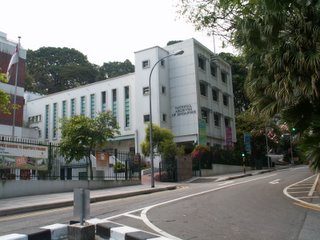
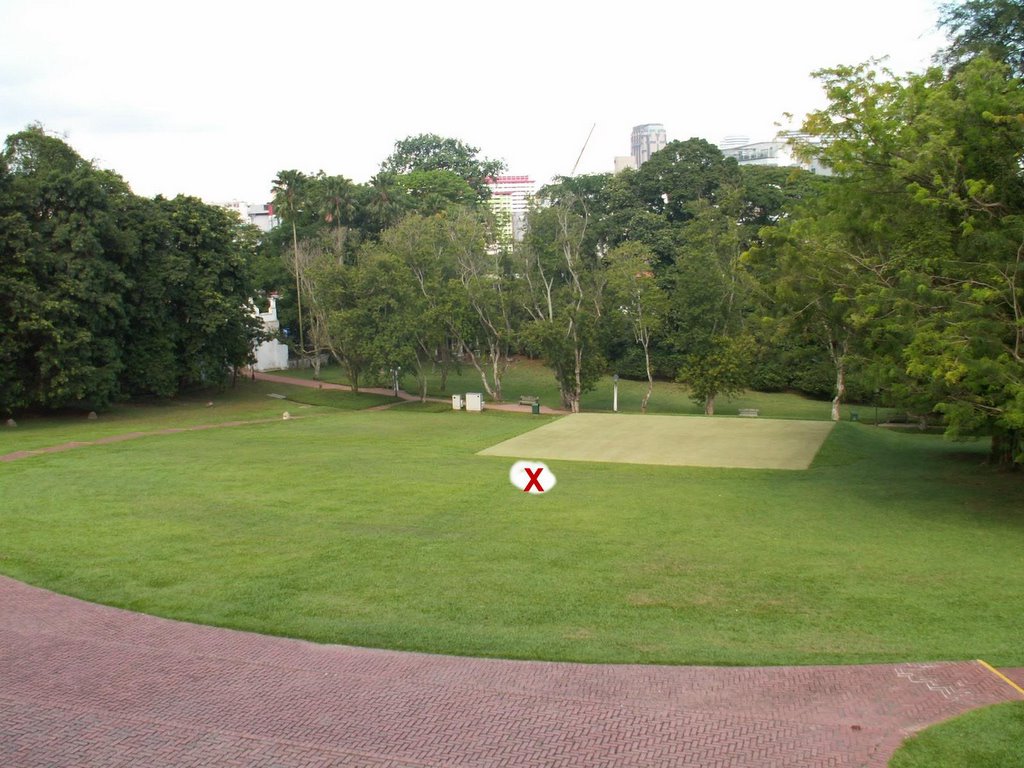
While there are many vivid memories about that school, I like to bring ourselves back to the 1st half of the 60s to the cemetery that was (still is I hope) just a 200 metres uphill from the school location. I hope Chun See will be able to take a snap-shot of the cemetery gate. I told myself that if I ever go back to Singapore again I will surely make a trip to that cemetery (if it is still around) to see how ‘spacious’ it is. The last time I went there was with my late father some 15 years ago! I remember reading on one inscription on a grave that goes like….’ A good soldier who lost his life at sea….unknown ’ circa. 1800s.
It was indeed very spacious to me when I was a child in the 1st half of the 60s attending the school nearby. That was the formative time of my life, to say the least. We used to hold our Saturday junior scout meetings in that cemetery. We were known as wolf-cubs then (and I guess it was heavy British influence back in those days) Our cub leader (called Cub Mistress) Mrs Hannah Chia and with other teachers (I remember Mr Bao, Miss Chen and Miss Ng) preferred the cemetery for the obvious of its spaciousness so that we could conduct our activities.
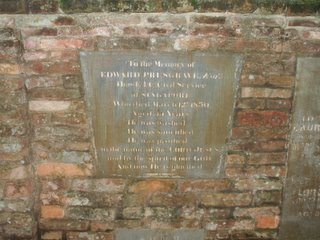
One of the many grave plaques mounted along the wall of the Fort Caning area.
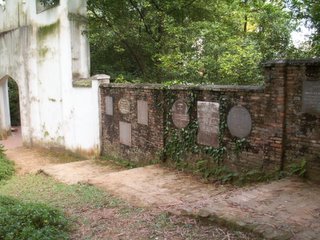
There are many grave plaques mounted along this wall. Most are faded and not legible.
Some of the activities I recall included the ritual of gathering in big circle to pay salute to the cub mistress and followed by the personal hygiene inspection, such as checking on our finger nails and uniform tardiness. We cubs had to say our vow, ‘Akela we’ll do our best!’ Then we all had to do a hoop like what a real wolf cub would do. We learnt the basic wood craft like tying various types of knots with the rope. The 1st knot I learnt was the reef-knot and the bow-line?
I used to arrive early at 9.00 on Saturday mornings before everyone else. I was curious enough to wonder who were buried beside these tomb-stones that dotted around the cemetery and strange as they seemed, these are large grave stones and there was one in particular that was located right in the middle of the field. It measured something like 3 ft x 6 ft and 3 ft high. I have never noticed the inscription on it….we simply used it as our convenient table to land our personal bags. I sometimes wondered who was buried right beneath the slabs. We were asked to come in dressed in our cub uniform, I remember.
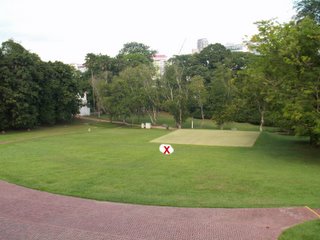
That's the approximate spot where we placed our belongings
I think there were about 20 of us in those days and in fact there is a picture of us taken right at the staircase of the school building where the car park was. All in all, we had great time as wolf-cubs.
Back in 1963 the cub mistress Mrs Chia’s husband was introduced to us and he took us on to higher ground in the scouting adventure!
He started a sea scout troop and we were all invited to join in and indeed we did. We were the first batch of his intake (in fact the only intake he took) and we even had our 1st meeting in his home at Wilkie Terrace. I was only primary 5 then. I experienced my 1st outdoor camping on Pulau Tekong. That experience till today still rings well in my memory! We had to take a bump-boat at the Changi Point to get across to Pulau Tekong. I remember doing it the same way when years later I was enlisted into the national service. Although I had my recruit training (boot camp) at Jalan Bahar under the School of Artillery, I was posted to Pulau Tekong to train recruits when after commissioning.
We recited the Lord’s prayer in our first night during our first camping experience.
A storm started in the middle of the night and we were feeling pretty unsettled as I recalled. For obvious reason that prayer meant so real to my heart!
Sarabat Store
There were times when after the cub meeting which usually ended at around 11ish we would adjourn to the cub mistress’ home at Wilkie Terrace which is by all standards not far from Fort Canning. We would take the wooded path (cut out by excessive walking by many users ) that led us from the cemetery through the car park of the National Library. From the National Library we would cross the Stamford Road overlooking a large monsoon canal, then crossed the Waterloo Street where Chun See spoke about the scenic spot of row of Indian rojak stalls.
I drew this sketch from memory
That is not what I like to talk about. I want to bring us to a particular and in fact the only sarabat stall that was set up at the fringe of the Fort Canning along the wooded path under a huge angsana tree. That was where I tasted my first roti-prata with curry sauce in my life and with a glass of teh-tarik all under 20 cents! That was 1963!
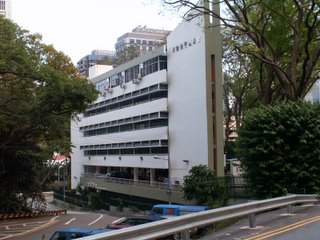
Bible House Viewed from Canning Rise
The Indian guy who served us I remember wore a bonny-tail. I could not grade his roti-prata to be the best but to me it was certainly affordable! My mother only gave me 40 cents for the Saturday outing. 10 cents each way for my transportation fare by bus from Thomson Road all the way to Hill Street. It was the good old STC Number 1 bus. Looking back it was a memorable time when we all would crowd round his stall to enjoy a morning tea break under the cool shading of those trees. I have the feeling that those trees were probably the primary jungle the Singapore had since its founding in 1819 by Stamford Raffles. By the way the back of the National Library was just across the Fort Canning Road to the cemetery!
I could not afford to treat myself to the Waterloo Street Indian rojak though they all looked very tempting to me each time I walked past them. As said 20 cents was all I could afford back then. But of course when we went to the Cub Mistress’ home I would only need to spend 5 cents for my bus fare home by riding the Tay Koh Yat bus at the then Rex Cinema along Bukit Timah Road (Opposite to the TekKa market ) [竹脚巴刹 ] Can’t remember what number it was.
Talking of the Rex Cinema, some of us will remember the chendol stall behind the Cinema building lined with food stalls and this chendol was located right at the very first beside the Bukit Timah Road. I could treat myself with an icy cold glass of chendol, of course. What stays in my memorythough, is not the tasty chendol, but the person who dished out the chendol. He was a short, stocky fellow, which gave me the impression that he was a weight lifter. I used to marvel how he managed to accumulate all those muscles.
Tuesday, February 07, 2006
Armenian Street
I parked my car at the public car park next to Armenian Street and took the opportunity to walk around the area. Although I do occasionally drive past this area, this was the first time in years that I actually strolled along this area. It struck me that many of the familiar icons and landmarks have disappeared from the area.
Most missed of course, is the National Library building. I heard that it has moved to a spanking new building in North Bridge Road. But somehow I am not too keen to go there. Maybe deep down, I have not forgiven our government for destroying something so dear to my generation; something that is so integral to our collective memory of our youth. It seemed like only yesterday that they were debating furiously whether or not to tear down the old building. I did not follow the debate closely because I believe that once our government has decided on something, it is near impossible to get them to change their minds. This reminds me about a documentary I saw recently on Channel News Asia. Entitled, Get Real, and hosted by Diana Ser, this episode explored our people’s readiness to discard old things. I did not catch the whole show, and thus not sure if they mentioned about discarding old buildings, but I suspect not – for obvious reasons.

This photo was lifted without permission from Victor’s Blog on Vanishing Scenes of Singapore
Gone also was the part of Waterloo Street that used to house the Indian rojak and mee rebus stalls. It is hard to find an adult Singaporean who cannot relate to how we used to be waylaid by the aggressive vendors when we made our way to the library from Bras Brasah Road. Long gone too were the second-hand book shops along Bras Basah Road where we bought our Minerva Guides. I wonder if they still publish this type of exam guides written in flowery English which none of us really understood.

Where have all the sarabat stalls gone? Gone to the SMU everyone.
I remember buying my first badminton racket from a sports shop there. It was a Dunlop Maxply, a branded product of the day, made of wood and cost me a whopping $30. You also needed to buy a press to clamp down on the face of the racket to prevent it from warping. When the racket strings broke, we would bring it to a sports shop located in Maju Avenue in Serangoon Gardens (facing the Paramount Theatre) for repair. I think the shop was called George-something. I remember seeing a tablet of the Ten Commandments in the shop –probably not the Old Testament Ten Commandments, but the Customer Service ten commandments. It was really fascinating to watch how they replaced the broken strings. After a while, we were able to do it ourselves using our geometry set dividers to hold the strings in place.

Gone too were the MPH Bookstore and the US Embassy with it adjacent USIS Library. I wonder how many Singaporeans reading this blog have heard of the USIS along Hill Street. I did not check what is standing there now. Maybe my new friends from NHB (National Heritage Board) can enlighten us. Good thing though, the Armenian Church was spared.
But to my pleasant surprise, the Wilmer Clinic is still there. This place really holds some special memories for me. When my siblings and I were still very young, my parents used to bring us there for consultation with a Dr William Heng. I remember especially a vendor selling toys at the entrance of the building. I dearly wanted a red fire engine but I guess my parents could not afford it. There was one occasion when I was terribly sick and had to be warded at the sick bay located above the clinic. I remember clearly 2 things about that evening when I woke up on the sick bed. Somebody had placed a wet towel on my forehead, so I must be having a high fever. I also saw my beloved red fire engine beside me.
My thanks to Shaun of NHB for helping me to take these pictures of Wilmer Place and Wilmer Clinic
By the way, I had some difficulty locating the Stamford House in spite of directions from Shaun of NHB. We met at a restaurant called the Moon River. That of course reminded me of Andy Williams’ signature song and his very popular TV show. He always began the show with Moon River and ended it with May Each Day. But I doubt any of the yuppies dining there that evening were familiar with these songs.
I will end by sharing with you the nice lyrics from his second song. Stanza 2 is specially dedicated to my friend Victor (whom I have yet to meet).
May each day in the week be a good day. May the Lord always watch over you. And may all of your hopes turn to wishes.And may all of your wishes come true.
May each day in the month be a good day. May you make friends with each one you meet. And may all of your daydreams be mem'ries. And may all of your mem'ries be sweet.
The weeks turn to months, and the months into years. There'll be sadness and joy, there'll be laughter and tears. But one thing I pray to heaven above. May each of your days be a day full of love.
May each day in the year be a good day. May each dawn find you happy and gay. And may all of your days be as lovely. As the one you shared with me today.
May each day of your life be a good day. And good night.
Monday, February 06, 2006
My Memories of Chinatown (Part 3) - Simon Chu Chun Sing

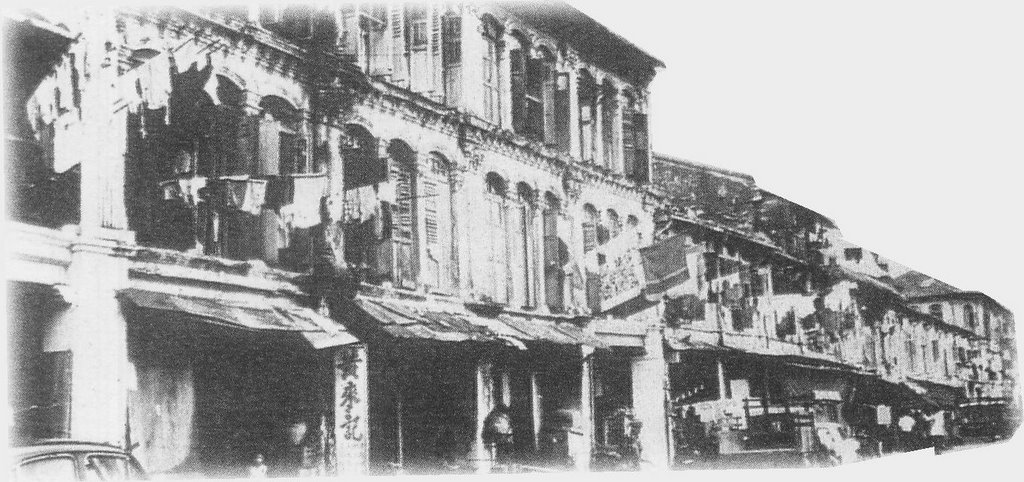
Hi folks, I like to talk about the lane which flanks between Sago Street and Smith Street. That is where my childhood home in Chinatown was and that was also my playground for several years until my late father decided to shift out of Chinatown. Certainly there were many memories and each comes with diverse flavour on its own.
I am just thinking here. Since there are so many heartlanders each sharing his experiences and observations on Chinatown whose square area does not span beyond 4 square miles geographically, I like to take my subject title with a different flavour. I like to talk about the intangibles. I like to touch upon the sound and the atmosphere when each of the events that took place.
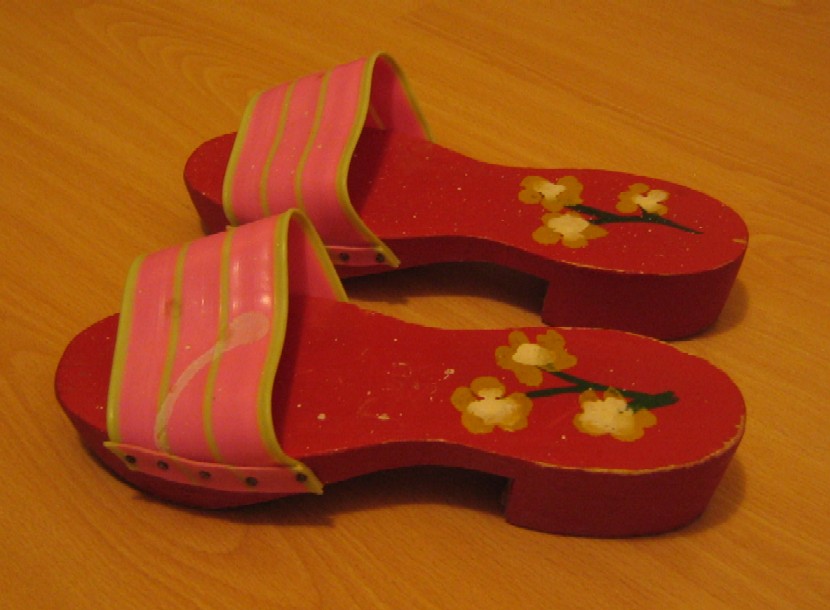
For example, some of us may have seen the wooden slippers (or clog) or ‘cha-kia’ in Hokkien. Do you know that back in the 50s (i.e. my time) most of the women wore this type of woo
den slippers….and what you often heard on the street is the ‘tic-tac-tic-tac…tic’ sound. The Japanese rubber slippers were just gaining popularity then and I had a pair of rubber slippers apart from the regular pair of ‘chak-kia’. I wish I have a recording of such sound …..But you can imagine what it would have been like anyway. Walking about with a pair of such ‘cha-kia’ on the tarmac and imagine that there are more than 20 people walking about with the same type of footwear…boy! That is what it was like on the streets in Chinatown…..not missing out the loud hailers blasting through the mini van where the various retailers were pushing their sales….It was a different atmosphere all together especially in the late of the night (almost mid-night) when the noise level had died down and less people walking on the street below (the lane I was talking about) What you heard was the ‘tic-tac-tic-tac’ sound. But what that I reminisce most was the call of the laksa man who would show up usually after 11 o’clock with 2 loads of stuffs – one side was the earthen pot of laksa gravy with a charcoal stove and other side of the tilt was the case where he kept his ingredients and serving utensils….He was a man in his 40s (may be)?
Dressed in the traditional coolie attire and possibly a hat (that was all I could remember). I wish I had a picture of how he looked like then. You know, back in those days not many people who lived in Chinatown could afford a camera, and the only best things our parents could do was to send us to the photo salon to catch a few shots together.
People who knew of his arrival at that expected hour would crowd around him for a nice bowl of laksa and his blachan (sampal chilli paste) was the best in those days! Till today I do not think I would be able to find another laksa recipe that is better than this laksa supper man.
The nightly 11 o’clock atmosphere was also unique in another sense. Rediffusion was popular then and it was through the rediffusion that I got acquainted to Li Da Sar [李大 傻 ] story time on the now famous martial art classics like [ 神雕侠侣,射雕英雄传,天龙八部 等等]。
Listening to the Rediffusion was our only past time. That was before the television was introduced to Singapore. The nightly 11 hour was the time when the ghostly stories would be broadcasted. A few times, my mother would despatch me to go to Smith Street to pick up some supper for her and inadvertently, I got to share the fruits of my hard work too…Why hard work? I had to brave the loneliness of walking to Smith Street (now where the Chinatown complex is) to buy a pack of white-cook chicken drumstick. The store I used to buy from was known [亨记 ] If I could recall distinctly a white cook chicken drum-stick was less than a dollar, like 30 cents. My Mum would enjoy her chicken meat with a sip of the wincarnis [ 文加宜红酒 ] as I shared in my previous episode we were sharing the same room together with the rest of my family and my father was always fast asleep by then. My next room neighbour tenant lady nicknamed [大声婆 ] would join in with my Mum and myself and her son (also my contemporary play mate) [亚辉 ] in listening to the ghost story broadcasted by Rediffusion.
In some way I took delight during that moment of just 60 minutes…..when I could relax with some supper and getting the thrill of excitement and in the company of familiar people.
There were few occasions I remembered that I had to run as fast as I could after buying the nightly supper, along the Smith Street shop houses corridor. The term for that kind of corridor is five-foot way [五卡基 ]。This term was derived from amongst the early Chinese who came to South East Asia and coined the name from the Malay term, kaki meaning foot.
That part of the Smith Street is now as busy as before in the evenings when train of food stalls are flooding the road with hoards of patrons enjoying the individual stall’s culinary delight. The street looked short and narrow to me unlike those days in the late 50s when every thing looks tall and huge.
On that lane where I grew up with, there were embarrassing moments too in reminiscent of it all. As described in the 1st episode there was only one toilet facility to serve the 12 families. One can imagine that when there are more than one person who is urgent for it, tough luck! To tackle nature’s call, I often found myself doing it at the side of the lane, right into the drain in the night! To me, quite frankly, it was an experience and somewhat an adventure! Mind you there were no street lights in that lane which is no more than 70 metres?