Thursday, November 10, 2005

My Memories of Chinatown (Part 1) - Chu Chun Sing

My pal, Chun See asked me to an contribute articles of my childhood days in the Chinatown of Singapore (牛车水). I have actually compiled a series of episodes from recollection of my early formative days as a child in the Chinatown, which many called it - ‘a land where snakes and dragons mixed’ (龙蛇混杂之地). Sadly I had accidentally deleted all these articles in my pc system…really heart-breaking!!!

Yes, I grew up in that sort of place where many exciting yet undesirable habits and incidents came my way and had to this day set my personality and more so caused me to see what’s beyond what this life could bring.

I stayed at No. 6 Sago Street, right next to the famous Sago Lane (沙莪巷 ) where the funeral parlours were housed (also known colloquially as Say Yan Gai [死人街] or ‘Street of the Dead’). That street has always been a taboo to me….never dared to tread in the night not even during the day. Tell you why later….. However when people asked you in those days where you lived I was taught to say, ‘The floor above Zhou Hoong’(周鸿), and not No.6 Sago Street as one would normally do.


Sago Street In the 60's


Zhou Hoong (周鸿) was a Chinese chiropractor (跌打医师) who owned the shop below my place, and supposedly everybody would know him because of his practice in the chiropractic. I used to loiter around his shop and of course nobody took attention of my presence then. I was small-built but with big eyes and you know what? I had double eye-lids. No a bad looking kid but even so…..

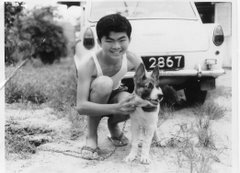
Zhou Hoong had a vehicle, a dark green one I remember. He had to wind the torque at the front to start up the car engine every evening when he had to display his mobile store all over the Chinatown or other parts of Singapore then. He had his son to help him; a polio-infected lad walking about with steel structure on one of his legs. We are talking of the 2nd half of the 1950s.


Sago Street Today


The place where I was brought up was not as exciting as many of the present generation would imagine…where the average-income family would put up in a HDB built apartment of 3-4 rooms with ensuite bathroom and a common bathroom. I think, in today’s terms, it can be regarded as ‘ghetto’?


It was just a single room where I had to share with my parents and my 2 younger sisters, and later my 2 brothers came along. There were 10 rooms on that wooden floor, and that meant 10 families all shared the same toilet facilities infested with cockroaches and centipedes. The kitchen was filled with charcoal-burning stoves and some used the kerosene fuel stoves. Hence, every evening during meal time, smoke and soot would fill the air. If during the rainy season (monsoon), tough! Black soot would drop onto your food, condensed from the black ceiling, falling like stalagmites.

It was then that my father decided it was time to move out of Chinatown. The other reason was that he did not want me to engage with the bad influence where the triads and gangsters roamed the streets, either asking for protection money or other devices.

We had no fan in the room and one day my father bought his first electric fan home and got my next room neighbour Ah Kuan (阿坤) to install it. I experienced what it was like to feel hot! Just as the saying goes, ‘When you do not have it, you don’t miss it’. The brand I still remember was KDK, a Japanese make.

Come to think of it, my father who later in life explained to us the reason he had to fetch us (me and 2 sisters) to the Clifford Pier and the Esplanade on some evenings was to get cooled…i.e. chill out! That had always been my highlight because I liked being out to watch the harbour front and the night sky. And when walking past the Fullerton Building it was always filled with twittering sound of sparrows or swallows nesting at the roof crevices. This sound still rings clear in my memory till this day. That area was not as glamorous as we see of it today. It was dimly lit with fluorescent and sodium street lights….Still it was my highlight of the week when being taken out for a walk to the harbour front. I would always pester my father to get us to the kachang puteh man (Indian origin with a tray of assorted nuts above his head). We would pick our choice served in a rolled up conical used paper pack at a cost of just 5 cents and if you wanted cashew nuts that would cost….probably 10 cents, I guess. Not sure because we hardly bought that. May be that is the reason why I like cashew nuts because I missed it as a child.

I had always wondered since I was about 5 -7, where old people came from when I loitered along the side lane below the window of my room. I asked where would these people go to one day ? In my recollection these people never spoke the Cantonese that I knew… they spoke a foreign dialect and they were dressed in black traditional Chinese attire. Looking back they must have spoken their country side dialect known ‘Say Yup Hua’ (四邑话) which is part of the Cantonese county in GuangDong (广东省) province of southern China.

My father could understand them because he spoke to his parents in that dialect while in China. I have never met my grand parents as they passed away while in China when my father had to return to Singapore at his late teens just before the war!

Today my father has moved on in life too and joined those forgotten ones down the memory lane. So what is life I used to ask myself! I remember asking my father that question while he and I were both waiting at the Tan Tock Seng hospital 4 years ago just before he passed away suddenly.


I shall like to continue in the next episode if Chun See would allow me on his blog.


Wednesday, November 09, 2005

Blogging Is For Kids Only?

Recently, I attended a training workshop on e-Commerce. During the break, I took the opportunity to ask the trainer to teach me how to insert a counter to my weblog. Yes, I know it's child's play for the youngsters, but for a 53-year old newbie to blogging, it is quite a challenge.

Anyway, one of my fellow course participants, a 30-something looking lady, overheard us and remarked, "Hey, I thought blogging is for kids only?"

"I don't think so." I replied; "Anyway, I enjoy it".

Actually, as I far as I know, very few Singaporeans of my age blog. I came a across only a handful, including Frannxis, Victor Koo and Mr Tan Kin Lian of NTUC Income (please see links on right side of this page ). I think more older Singaporeans should blog.

Firstly it is good for our aging brains. Putting your thoughts into words is great exercise for our brains. You also get to learn new things - like how to create a blog, how to insert pictures and links etc. Last year I attended a seminar by Tony Bunzan - he recommended continuous learning and lots of exercise for the brain as an effective way to keep away dementia.

Secondly, you get to meet people with similar interests. I have found a few new friends like Frannxis, Victor and Chris - By the way, thank you Victor for teaching me how to insert link.

Lastly, people like me like to write; plus digging up those old memories is great fun.

PS - I like that snippet they play on the radio which ends with the line, "See - you do learn something new everyday". The other day I learnt the meaning of LOL. I often see it in other people's blogs. I always thought it meant Lots of Love.

Monday, October 31, 2005

Memories of Pulau Tekong

After reading my earlier post on our kampong , a fellow blogger, Ms Ikan Bilis said she missed her kampong days in Pulau Tekong. I too have some fond memories of P. Tekong.


Actually, I only have 2 sets of encounters with this little island. The first was from attending a 1-week camp organized by the National Junior College Outdoor Activities Club in April 1969. The second was from a couple of in-camp training sessions in the eighties. Surprisingly, I have more memories from the first encounter.


The 1-week camp in 1969 was very enjoyable and memorable. We did a lot of trekking and I remember seeing many rubber plantations and small Chinese temples. We also heard stories of people being bitten by hornets.

One of the most interesting sights was that of a hill full of tobacco plants. You must be surprised to know that tobacco was actually cultivated right here in Singapore. Fortunately, I still have a photo of this place.


The other thing I remember was the canoeing. We were assigned in pairs, 1 boy and 1 girl to a wooden boat, (unlike the modern fibre-glass kayaks that our kids enjoy today) and we had to row round the island. At one point I was so exhausted that I just had to stop. Just at that moment, one of the instructors came along and scolded me; “Do you want the lady to row for you?” And boy, did that bruise my ego?

(By the way, the chap on the extreme left is me)

Anyway, to continue with the story, that night we camped near a Malay kampong. The kampong folks were kind enough to let us use their well for our baths. Next morning, when I woke up, every muscle in my body ached.

Our base camp was at one of the schools. When we were not out on expeditions - they called them land, canoeing expeditions and so on - we had our meals there. On the last night, we had a big camp fire.

We were grouped into teams that had names like Andies, Rockies and Pyrenees. My team was called Rockies. Below are some members of my team.


As for the few in-camp training sessions in the 1980’s, I don’t have much recollections. The one thing that sticks to my mind was the incessant howling of dogs at night. Strange thing is that, the next morning, we couldn’t find any dogs around. According to the soldiers, the island was haunted; but then you know soldiers lah - they like to say things like that.

In fact, I have more memories of the trip to and from the island than the actual training in Tekong. For example, I remember returning to camp one Sunday night. We had to take the bumboat back from Changi Point. They were playing a song by Teresa Teng (你怎么说) on the bumboat.

It’s very strange. Somehow, when I was on the way back to camp on Sunday nights, the brain seemed to be especially receptive to surrounding stimuli. I remember another occasion, when I took a pirate taxi from Bt Timah, 7th Mile (the old Beauty World) to camp in SAFTI. That was in 1971 during my recruit or section leaders training days. We didn’t have much choice actually – so many soldiers going back to camp (Safti and 6th SIR in Tuas) and so few bus service 175’s. The pirates did our nation a valuable service if you ask me. I remember the song being played in the taxi was 心上人 by a local singer ( 张 小 英). There were several other occasions, in other camps; somehow the memory is very clear.

But nothing really beats the feeling of seeing the lights of SAFTI appear as our bus rounds the bend on old Jurong Road. Your heart simply sinks to the floor of Green Bus number 175.

Once, I brought my family to Changi Beach on a Sunday evening. We saw many army recruits returning to camp at the SAF ferry terminal. I wanted to tell the boys, “Guys, I know exactly how you feel.”

Wednesday, October 26, 2005

Catching Eels and Other Animals

My brother David, writing all the way from Perth, recalls how he used to catch eels during our kampong days.

" Now that the memories are starting to return, let me recall how we used to catch those yellow fresh water eels. There were 2 methods:

The first and more adventurous one is as follows:

We will first catch the ordinary garden worms, hook one on a small hook tied to a short nylon line trace of about 12-18 inches long. This trace in turn is tied to a short thin bamboo stick. We will then wade along that famous river and look for the "homes" of these yellow eels. Usually, when we see a hole at the banks of the river, and such holes are at about water level. We will then use another bamboo stick to push the hook (with the worms on) into the hole. Since we do not know how deep the eel is hiding in the hole, we will make "muck, muck " sounds with our pursed lips to attract them out. Its quite effective.

The second method is easier but usually end up with smaller eels. We will look for small rocks lying in the shallows of the ponds on our land (2 of them ) or the 2 adjacent to ours belonging to our neighbour. Usually, we can find eels hiding beneath such rocks. However, they tend to be "baby" size.

All eels caught based on above 2 methods were always sold to a traveling "fisherman". He comes along in his 3-wheel motor bike. The eels are sold based on weight, but I cannot remember how much we could fetch. Rather, what I could remember is one type of cooked fish that he sells: a sort of steamed cooked fish, very salty, and ready to eat ..... probably some kind of Teochew style of cooking.

The spiders catching and fighting fish, fresh water prawns (including catching and rearing of
guppies) , end of the year catching catfish and Aruanas on dried ponds were definitely more interesting. Also the way we catch our "Luai " (aruana) fish from the neighbour's ponds were pretty interesting. Unfortunately, you and Meng were too young then. I am not sure who were with me doing those stuff except No 7 auntie's son (Ah Tee) who was quite into spiders.

I will include cuckoo catching and the home made catapults (and shooting of birds) in the next e-mail. But both these activities are very cruel ways and I would rather forget such episodes. "


Yes, catching fish and other animals was indeed one of our favourite past times those days.

Talking about catfish, I remember how we caught them at this small pond with lots of water hyacinth. (Hyacinth is harvested to form part of the feed for pigs). It was very different from the usual method of holding the rod and waiting for the fish to bite. We would usually use a short bamboo rod and short fishing line, and coil the line around the water hyacinth and then go away. When we come back after a couple of hours, we can see the catfish hooked to the line. We had to be very careful in unhooking the catfish because its sharp pectoral fins (I think that’s what they are called) were reputed to give a painful prick. The catfish also tended to bleed a lot.

Earlier this year, during the Chinese New Year gathering at our cousin Chee Keong’s house, we were reminiscing about the kampong days, Our cousin Chee Kean recalled one interesting fishing episode.

Usually, our neighbour who owned the pond, would allow us kids to fish anywhere in the pond except for a certain fenced off section where he bred red tilapias for sale. However, he and David apparently decided to venture into the forbidden territory and managed to catch a big red tilapia. When our neighbour spotted them, he gave chase all the way until my uncle’s house. I cannot recall what punishment, if any that the kids suffered as a result of this daring raid.

The ‘luai’ fish that David referred to above, I believe were tomans or snake heads (san yu in Cantonese). The Americans call it the ‘franken-fish’ because it is carnivorous and have a ferocious appetite. We saw some of the older kampong boys use frogs as bait to fish for it. But for us younger kids, we would catch the babies from the shallow edge of the pond. How? – by clasping our hands to form a semi-circle to encircle the fish; then slowing moving backwards before sweeping them to the shore in one quick movement.

I often tell my kids about how we caught the baby tomans in this way as well as fighting fish using the ‘punki’ or rattan basket. Maybe that explains why my teenage son has fallen in love with fighting fish and tomans. Our house is now filled with jars of fighting fish which he breeds; although he wouldn’t dream of letting them fight. We even have a toman which he bred from a baby. He bought it from the aquarium which sells them as feeders for arowanas at $2 per packet.

Wednesday, October 19, 2005

Our Kampong

Chui Arm Lor

The kampong where we used to live in was popularly known as Chui Arm Lor in Hokkien, meaning Water Pipes Road. It joined Lorong Chuan to Upper Thomson Road. On the way, it crosses the Kallang River 9 times; hence it was also called Kau Tiao Kio or 9 Bridges
.
Before Lorong Chuan was constructed, it was a mud track that joined directly to Braddell Road. At that time our address was 288 Ang Moh Kio. In order to get to our school, Braddell Rise Primary which was located next to Mt Alvernia Hospital, we had to cycle from our house out to Braddell Road, chain it to a lamp post or roadside railing, and take a bus to school. Usually, my elder brother, David would do the cycling and I would ride on the back seat. I remember one very yucksy incident that happened one morning. As we overtook a bike in front of us, the chap decided to turn aside and spit. Guess where the projectile landed – yes right on me; exactly which part of the anatomy, I cannot recall. But you can understand why it was an unforgettable experience.

I cannot recall which year Lorong Chuan was built. It joined Braddell Road to Ang Sar Lee. I think most adult Singaporeans know that’s the Hokkien name for Seranggoon Gardens. At the time when construction was nearing completion, many Ang Mors liked to use it for go-kart practice. That was quite an eye-opener for us kampong kids. With the completion of Lorong Chuan, we did not have to go to the market at Lim Tua Tow Road at Gor Ko Chio (5th Mile, Upper Seranggoon) to do our marketing. Instead, we did our marketing at the Seranggoon Gardens Way Market , located opposite the post office. Sometimes I was tasked to do the marketing alone; which meant I had to cycle to SG and back. I picked up some skills in selecting pork and vegetables then.

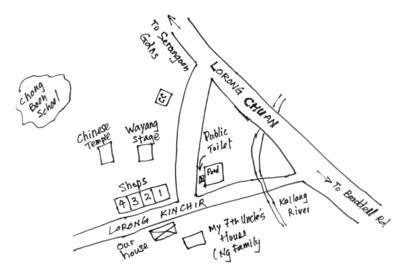
After Lorong Chuan was completed, our village was renamed Lorong Kinchir, and our house address was also changed to 21-A Lorong Kinchir. Below is a sketch of our neighbourhood. After some consultation with my eldest brother, Chun Chew who has an uncanny ability to remember all sorts of details about our childhood days, I believe the diagram below is more than 80% accurate.


Say Kai Hor

Now, can anyone guess what is that?

It is the Cantonese name we gave to the Kallang River. Literally, it means Dead Chicken River – no prize for guessing how it earned such a colourful name. Every time we crossed the bridge, we had to hold our breath because, not only chickens, but dogs and pigs were discarded into the river. Better not go into any more details.

Would you believe that we have actually seen kids frolicking in the waters of the Sai Kay Hor. We ourselves have waded in, occasionally to catch blood worms for our fighting fish. We do this by running a metal wire through the sand. When the wire emerges, some blood worms will be found handing to it. We have also seen men with big cans and nets catching blood worms on a bigger scale. By the way, my teenage son who regularly goes for kayaking training at the Kallang River often jokes about the stench and filth. Wait till he reads this blog.

The recent news about the Katrina Hurricane in US, reminded me of an incident concerning the Dead Chicken River. I saw a news report in CNN concerning the floods in New Orleans, where people were warned to be on the lookout for alligators. One year, there was widespread flooding in Singapore; and many of us were also warned to look out for a crocodile that had escaped from the crocodile farm in Lorong Chuan. The location would be near the present junction of Ang Mo Kio Avenue 1 and Lorong Chuan. If you have been to Lorong Chuan those days, you will know what I am talking about. The stench from the crocodile skins can be detected from miles around.


Our House

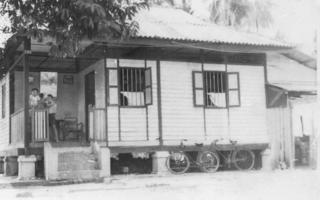
Below is a picture of our house. The design was quite unique. If fact, one year, it was featured in one of the primary school geography books. Our house was also one of the few houses that had a well. Before tapped water became available, many of our neighbours came to our house to help themselves to the water which was probably of the highest quality in the whole village. The well was located just to the right of the photo.

To the left of the picture was a very old durian tree with lots of dragon scales growing along its trunk. Before you start to envy us, I must tell you that this tree was really not very fruitful. Each season it only bore a couple of very small fruits. Every time, the thud of the falling durian was heard, we children would race each other to get to the fruit. Perhaps it was due to the scarcity of the harvest that our durians seemed to be especially tasty.


This photo was taken using our very first camera - a Kodak Brownie. It must be taken around 1957 or 58 becaue I (the kid on the left) looked no older than 5 or 6.

The drainage those days was quite bad. Hence there were mosquitoes every where. At night, we needed to sleep with the mosquito screen all around. Even then, when morning came, you can find yourself in the company of several swollen, lazy mozzies, which was why our screens tended to have patches of blood on it. Mosquito breeding was so rampant that we could easily catch mosquito larvae from the drains to feed the fighting fish which we caught from the nearby ponds. However, we never knew of anyone catching dengue fever.

Our Neighbours

The main road, Lorong Kinchir ran in front of our house and across the road was a row of 4 shops.


Shop No. 1 (from the right) was a coffee shop. The owner was called Hock Chek (Uncle Hock). He was in fact my godfather although he hardly ever spoke to me. I was much closer to my godmother though (Hock Chim). Sometimes, I would volunteer to buy coffee from them. Those days, 1 big mug of kopi-O cost 10 cents. If my godmother was on duty, I usually get to pocket the 10 cents.

I can recall some interesting things about the coffee shop. For example, they used saw dust to keep the ice blocks from melting. Occasionally, they also roast their coffee beans in front of the shop. The coffee beans were mixed with butter and roasted in a cylindrical drum which was rotated by hand. The aroma reached even to our house.

On rare occasions, we gave ourselves a treat to a bottle of Pepsi-cola here. We liked to add lots of salt from a small Brand’s essence of chicken bottle, and listen to the sizzle as the salt crystals hit the cola. The taste was so wonderful that I promised myself that some day, if I could afford it, I would drink Pepsi everyday. Of course that was one promise I did not keep.

Shop No. 2 was a provision shop owned by a man called Tua Tau (big head). We bought much of our foodstuff from him on credit. Whenever, we buy something, we would bring along a small 555 booklet (I think you can still find those today) to record the amount and the shopkeeper will also record in his ledger. It was then that we learnt how to recognize special Chinese characters for numerals (different from the normal Chinese writing).

Shop No. 3 belonged to a guy called Ah Goo (buffalo). I can’t remember what they sold, but I certainly remember the multi-colour ice balls that we loved. I think he also sold sweets and other snacks. One sweet I remember was the coconut sweet. Sometimes if you were lucky, you can find a sweet with a 5-cent coin embedded to it as a mystery prize. I believe Ah Goo’s family were Teochew. I think he was quite a handsome bloke who attracted the attention of some of the village lasses. Our village were mostly Hokkiens. We were about the only Cantonese family; until my 7th Uncle moved in with his 9 children. After that, our standard of English improved tremendously, but our Hokkien deteriorated. I am not sure why my father chose this place and not Potong Pasir which was predominantly Cantonese. I think my eldest brother would know.

Shop No. 4 was a barber shop. The owner was a very quiet guy. His family kept very much to themselves. I believe they were Hock Chew. They were probably Catholics because they had a portrait of Jesus Christ hanging on the wall.
Every afternoon, we would go over to borrow the Chinese newspapers from him so that our brother David could read to us the 武侠 stories. David’s Chinese was the most kilat of the lot. One year, he got a book prize for topping the whole level in ACS in Chinese. The title of the book was 中国名人故事 - Stories of famous Chinese personalities. I learned about 李白 and 白居易 's immortal poems from this book.

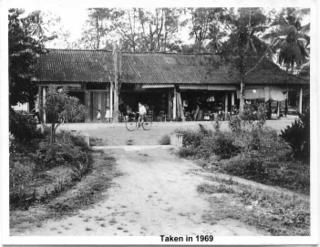
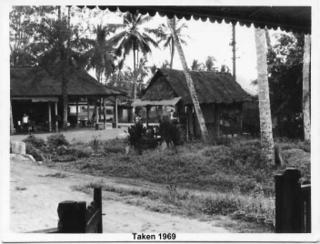
Shop No. 5 was on our side of the road facing Shop No. 1. It was a small coffee shop with attap roof and no walls. We called the owner Fook Chow Lou (Hock Chew man). I often bought snacks like tau sar piah from him. At one time, there was a stall beside this selling You Char Kueh (You Tiao). We enjoyed watching the man prepare the you tiao. From the picture above, you may also be able to make out the public toilet located next to a pond (please refer to sketch above). Did you know that we made our deposits directly into the pond!
Well that’s all I have to tell you about the village my siblings and I grew up in. The next time you travel on the Central Expressway from Ang Mo Kio towards Braddell Road, look to the left and try to picture the kampong we called Chui Arm Lor.

I hope you enjoyed reading this blog. If it stirs up some fond memories for you, please share them with us.

I also have some good news for you. I managed to persuade my old friend Tan See Jong (Safti Lima & Romeo coy, 1971) to contribute an article about his childhood surroundings in a place call Genting Lane. Look out for it.


Reach out for the joy and the sorrow.
Put them away in your mind.
For memories are time that you borrow,
To spend when you get till tomorrow.